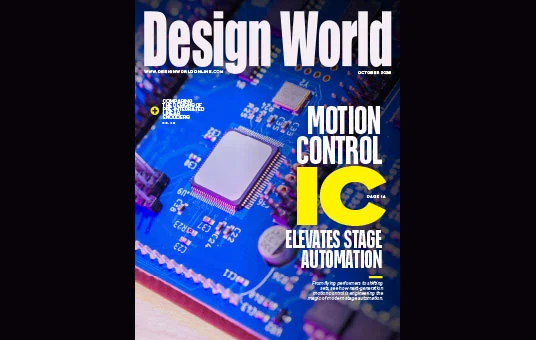
The October 2026 edition of Design World serves as a definitive roadmap for the future of motion control, exploring the intersection of high-stakes entertainment engineering and industrial precision. As the demands for fluid, reliable, and safe automated systems grow—both on the theatrical stage and the factory floor—the industry is witnessing a shift toward hardware that offers greater flexibility and intelligence. At the heart of this month’s cover story is the technological evolution of Creative Conners, a leader in modular stage machinery, and their strategic migration to next-generation motion control integrated circuits (ICs).
Main Facts: The Shift to Magellan MC58113
The central narrative of the October issue focuses on the engineering overhaul undertaken by Creative Conners. For years, the company relied on legacy motion chips that, while functional, imposed rigid limitations on their stage automation systems. The primary bottleneck was the constraint of symmetric acceleration and deceleration, which forced machinery to behave in predictable, linear ways that often lacked the nuance required for high-end theatrical productions.
In a comprehensive Design Notes feature, Lisa Eitel details how the company transitioned to Performance Motion Devices’ (PMD) Magellan MC58113 IC. This move was not merely an upgrade; it was a fundamental shift in control architecture. By implementing the MC58113, Creative Conners unlocked three critical capabilities:
- Asymmetric Motion Profiles: Engineers are no longer bound by symmetric acceleration and deceleration. This allows for complex, organic movement profiles that are essential for the realistic animation of stage props and scenery.
- Dynamic Profile Modification: The ability to adjust motion profiles on the fly is a game-changer for performer-flying effects. It allows operators to react to the real-time needs of a live production without resetting the underlying control logic.
- Bidirectional Signal Compatibility: The IC restored support for the bidirectional ±10-V signal, a standard requirement for driving hydraulic valves. This integration allows for the seamless blending of electric and hydraulic actuation within a single control ecosystem.
Chronology: The Evolution of Stage Automation
The transition to advanced ICs like the Magellan MC58113 did not happen in a vacuum. It was the result of a multi-year effort to modernize the infrastructure of stage automation.
- 2020–2023: The Legacy Era. Creative Conners utilized first-generation motion control chips. While reliable, these components required significant "workarounds" to achieve the fluid, life-like movements demanded by modern directors and scenic designers.
- 2024: Identifying the Bottleneck. During the development of a high-complexity touring show, the engineering team identified that legacy hardware constraints were limiting the "expression" of their mechanical sets. The inability to change profiles dynamically emerged as a critical point of failure in rehearsal scheduling.
- 2025: Testing and Integration. The team began bench-testing the PMD Magellan series. The primary challenge was retrofitting the software abstraction layer to communicate effectively with the new IC while maintaining backwards compatibility with existing stage machinery.
- October 2026: Deployment and Industry Adoption. Following successful implementation in touring venues and permanent installations, the results are presented in Design World, marking a new standard for modular stage controls.
Supporting Data: Precision and Protection Across the Machine
Beyond the cover story, the October issue provides a deep dive into the broader ecosystem of motion control. Modern machinery is no longer just about the controller; it is about the entire feedback loop.
Linear Encoder Advancements
One of the key technical discussions centers on the comparative performance of wired versus capacitive/wireless readheads in pre-integrated linear encoders. Data from recent testing suggests that while wired encoders remain the gold standard for high-EMI (electromagnetic interference) environments, capacitive wireless readheads have reached a "performance parity" that significantly reduces installation time and cabling complexity. This is particularly relevant for modular stage sets that must be assembled and disassembled in different cities on a weekly basis.
Edge Intelligence in Safety
The issue also explores the paradigm shift in safety sensors and switches. Next-generation perimeter safety systems are moving away from simple "stop-on-contact" logic. Instead, they now feature integrated edge intelligence—sensors capable of distinguishing between a human operator, a prop, and background noise. This reduces false-positive machine shutdowns, a common issue in complex, high-traffic stage environments.
The Rise of Unitized Components
Hydraulic systems, often considered "old-school" in the age of all-electric motion, have seen a renaissance through the redesign of unitized pistons and glands. What were once viewed as basic assembly components have evolved into performance-enabling modules. By integrating sensors directly into the gland, manufacturers can now monitor seal health and pressure fluctuations in real-time, effectively moving from reactive maintenance to predictive health monitoring.
Official Responses: Insights from the Engineering Frontlines
The industry’s reception of these advancements has been overwhelmingly positive. Lead engineers at Creative Conners noted that the migration to the MC58113 was driven by a desire to "democratize" complex motion. "Our goal was to make it as easy to program a hydraulic lift as it is to program a simple motor," said a lead developer. "The Magellan IC provides the raw power, but the real value is in the time we save our technicians during the load-in phase of a production."
PMD representatives have also weighed in, noting that the demand for "intelligent" motion control—chips that can process data at the edge rather than waiting for a central PLC—has spiked by 40% over the last 18 months. This trend toward decentralized control is expected to continue as industrial IoT (IIoT) requirements become standard in both factory automation and commercial entertainment.
Implications: The Future of Motion Control
The shift documented in this issue of Design World has profound implications for multiple sectors.
For the Theatrical and Entertainment Industry
The ability to perform asymmetric motion and dynamic profile changes allows for a new language of stagecraft. We can expect to see more "humanoid" movement in scenery, safer and more responsive performer flying, and a reduction in the "clunky" mechanical sounds that have historically marred theatrical productions.
For Industrial Manufacturing
The convergence of hydraulic and electric control on a single IC architecture suggests a future where factory floors are less segmented. The same intelligence applied to a theater winch could eventually manage high-precision robotic assembly or automated logistics in a warehouse, reducing the need for disparate control systems.
The Sustainability Factor
Finally, the move toward smarter sensors and predictive health monitoring in hydraulic and linear systems leads to a significant reduction in waste. By knowing exactly when a seal or a sensor is nearing the end of its life, operators can replace components just-in-time rather than replacing entire systems prematurely.
Conclusion: A New Standard for Engineering Excellence
As we look toward the end of 2026, the October issue of Design World reinforces the idea that motion control is the "silent partner" of innovation. Whether it is the seamless transition of a stage set during a Broadway performance or the precise movement of a robotic arm in a sterile medical manufacturing facility, the underlying principles remain the same: high-speed data processing, flexible acceleration profiles, and a robust feedback loop.
The integration of the Magellan MC58113 IC is just the beginning. As engineers continue to push the boundaries of what is possible, we anticipate further developments in AI-driven motion control and even greater integration between physical hardware and digital control systems.
For those at the cutting edge of engineering, the message from this issue is clear: the constraints of the past are no longer the boundaries of the future. By embracing more intelligent, flexible, and integrated control architectures, the industry is poised to create systems that are not only more efficient but capable of feats that were considered impossible only a few years ago.
We invite our readers to join the conversation. How are these shifts impacting your specific field? Are you seeing similar trends in your own hardware integration projects? Let us know your thoughts, and ensure you are subscribed to the Engineer’s Edge to keep up with the latest in motion control technology.