Global Automotive Desk
Published by CleanTechnica
Main Facts
Global electric vehicle giant BYD has demonstrated a powerful resurgence, shaking off a sluggish start to the year with a robust performance in September 2026. Total passenger vehicle deliveries for the month reached an impressive 456,713 units, marking a 5.4% increase compared to August 2026 and a significant 16.2% jump year-over-year from September 2025.
A closer examination of the data reveals that this growth is being spearheaded almost entirely by battery-electric vehicles (BEVs). While the company’s overall passenger vehicle sales climb, BEV demand has surged dramatically, heavily outpacing plug-in hybrid electric vehicles (PHEVs).
- September 2026 Total Passenger Deliveries: 456,713 units (+16.2% YoY, +5.4% MoM)
- September 2026 BEV Sales: 273,143 units (+33.2% YoY, +6.6% MoM)
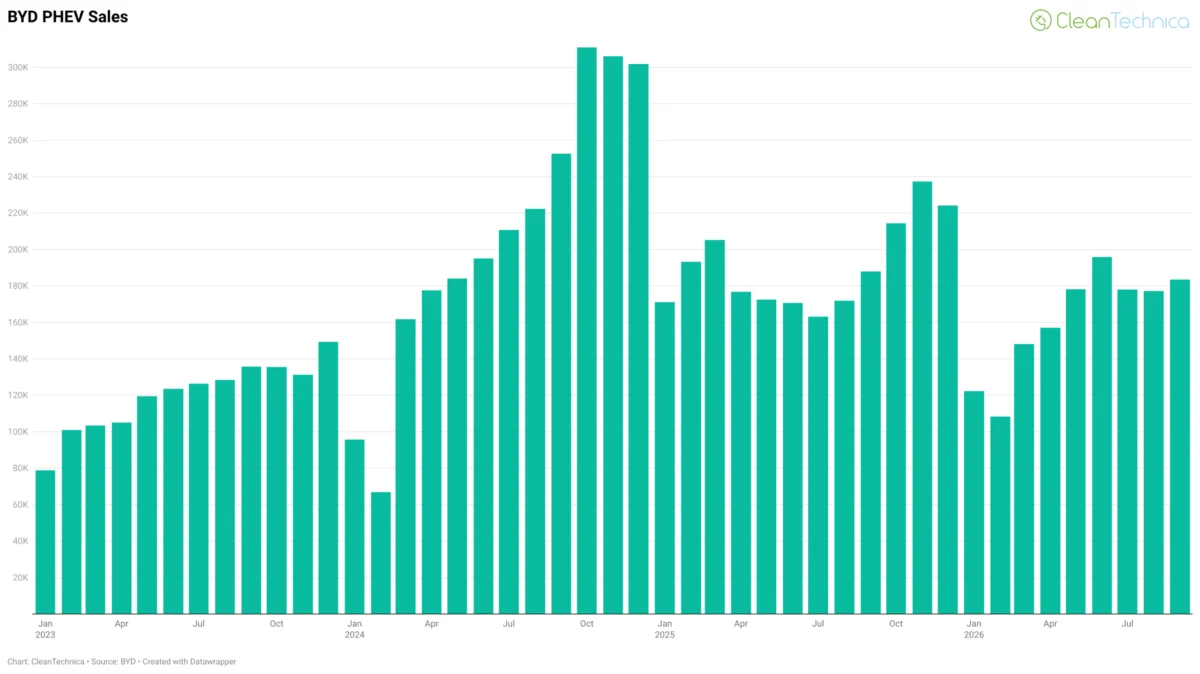
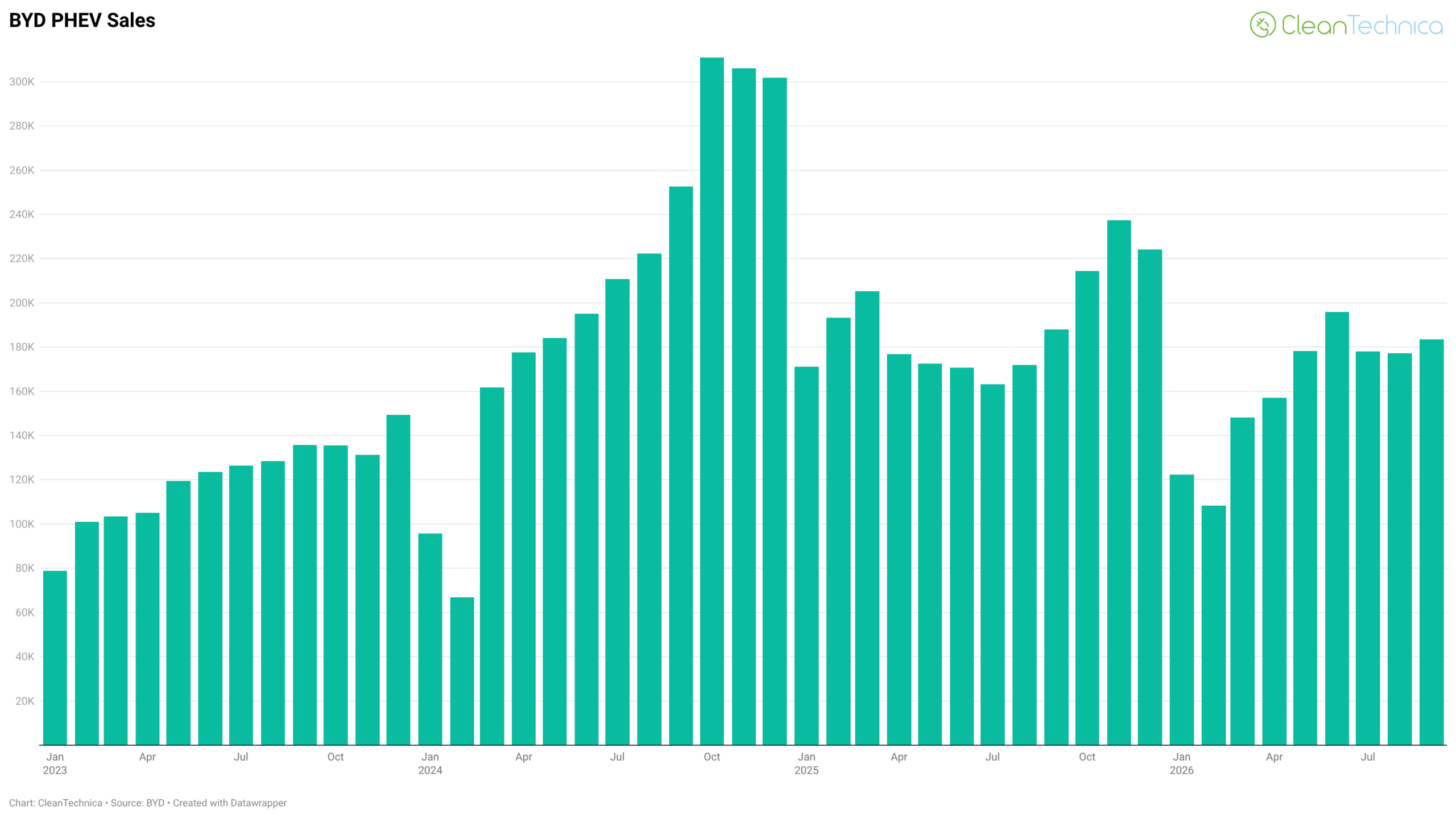
- September 2026 PHEV Sales: 183,570 units (-2.4% YoY, +3.6% MoM)
- Year-to-Date (Q1–Q3 2026) Passenger Vehicles: 3,078,544 units (-4.4% YoY)
- Year-to-Date BEVs: 1,629,957 units (+1.5% YoY)
- Year-to-Date PHEVs: 1,448,587 units (-10.2% YoY)
These figures underscore a pivotal shift in consumer preference toward purely electric architectures, helping BYD narrow its cumulative year-to-date losses and position itself strongly for a lucrative fourth quarter.
Chronology: The Trajectory of 2026
To fully understand BYD’s September success, it is necessary to contextualize the timeline of the automaker’s fiscal year.

Q1 2026: A Slow Out-of-the-Gates Start
The year 2026 began under challenging market conditions for many legacy and new-energy vehicle (NEV) manufacturers alike. Macroeconomic pressures, inflationary hurdles, and intensifying price wars across the Chinese domestic market—alongside escalating international trade scrutiny—initially suppressed delivery volumes. During the early months of the year, BYD’s traditionally dominant hybrid lineup faced stagnant demand, causing cumulative year-to-date sales figures to lag behind the stellar benchmarks set through the first three quarters of 2025.
Q2 and Mid-2026: The Pivot to Pure Electric
As the year progressed into the summer months, BYD executed strategic adjustments. Recognizing shifting consumer sentiments and technological advancements in solid-state and faster-charging battery chemistries, the company sharpened its focus on its purely electric portfolio. Production lines were optimized to scale up BEV output, while targeted marketing campaigns highlighted the expanding range, enhanced battery safety, and superior long-term economics of going fully electric over hybrid alternatives.
September 2026: The Inflection Point
September marked the definitive turning point for the automaker’s annual ledger. Delivering over 456,000 passenger vehicles in a single month proved that consumer interest had not merely recovered but had accelerated. The month-over-month growth of 5.4% signaled healthy retail traffic, while the 16.2% annual leap confirmed that BYD’s market share expansion remains resilient despite a fiercely competitive global landscape defined by AI-driven content scraping, antisocial media noise, and fluctuating global economies.
Supporting Data & Deep-Dive Analysis
A granular breakdown of BYD’s sales mechanics highlights the growing divergence between the company’s two core powertrain offerings: BEVs and PHEVs. Because BYD exclusively manufactures plug-in vehicles (having completely phased out internal combustion engine-only models), its internal competition is strictly between pure electrification and dual-power hybrid technology.
The Rise of the BEV
In September 2025, BYD delivered 205,050 battery-electric vehicles. By September 2026, that figure climbed to 273,143 units. This represents a massive 33.2% year-over-year surge—an addition of over 68,000 pure EVs in a single 12-month window. On a month-over-month basis, BEV sales rose by 6.6% from August.

When looking at the broader year-to-date picture across the first three quarters, BEVs are the single-handedly responsible driver keeping BYD’s long-term trajectory positive. Cumulative BEV sales for the first nine months of 2026 reached 1,629,957 units, up 1.5% compared to the 1,605,903 units sold during the same period in 2025.
The PHEV Cool-Down
Conversely, plug-in hybrid electric vehicles have experienced a cooling phase. In September 2026, BYD sold 183,570 PHEVs, which is a 2.4% decrease compared to the 188,010 units recorded in September 2025. Although PHEV sales did manage a modest month-over-month recovery of 3.6% compared to August, the annual contraction highlights a broader market trend: consumers ready to embrace plug-in technology are increasingly bypassing hybrids in favor of zero-emission, battery-only vehicles.
This trend is starkly visible in the cumulative year-to-date data. Over the first three quarters of 2026, PHEV sales dropped by 10.2%, falling from 1,612,959 units in 2025 down to 1,448,587 units.
Cumulative Recovery
Despite the drag from declining PHEV numbers, the sheer velocity of BEV adoption has managed to pull the company’s aggregate metrics close to full recovery. Total passenger vehicle sales for the first three quarters of 2026 stand at 3,078,544 units—down just 4.4% from the 3,218,862 units registered over the same timeframe in 2025. Given the steep deficits recorded earlier in the spring, closing this gap to a mere single-digit percentage deficit is a notable operational achievement.
Official Responses & Industry Context
While direct executive commentary accompanying the monthly sales flash focused primarily on production milestones and supply chain execution, industry analysts and market observers have been quick to weigh in on what these numbers signify for the broader automotive ecosystem.
Navigating Market Headwinds
Speaking on condition of anonymity, supply chain specialists tracking China’s NEV sector noted that BYD’s ability to maintain high utilization rates at its manufacturing hubs has been central to its September rebound. "Automakers are currently fighting on multiple fronts: margin compression driven by aggressive discounting, shifting consumer demands away from transitional technologies, and regulatory changes across export markets," an industry analyst observed. "BYD’s agility in ramping up BEV output precisely when hybrid demand softened prevented a prolonged slump."
The Infrastructure and Technology Factor
The tilt toward BEVs is also heavily supported by rapid improvements in charging infrastructure, particularly ultra-fast charging networks across key metropolitan and highway corridors in Asia and expanding European markets. As range anxiety diminishes and public charging becomes as seamless as refueling a legacy gasoline vehicle, consumers exhibit greater confidence in committing to 100% battery-electric platforms. Furthermore, continuous cost reductions in lithium iron phosphate (LFP) and advanced blade-battery technologies have allowed BYD to offer compelling price points on its BEV lineup without sacrificing corporate profitability.
Strategic Implications
BYD’s September 2026 performance carries profound implications for the company’s corporate strategy, its domestic competitors, and international legacy automakers attempting to transition to electric mobility.
1. Accelerated Phase-Out of Transitional Tech
The persistent year-over-year decline in PHEV sales—culminating in a 10.2% drop year-to-date—sends a clear signal to product planners. While plug-in hybrids were historically viewed as a crucial "bridge" technology for risk-averse buyers, the bridge is rapidly shrinking. Consumers are demonstrating a preference for skipping hybrids entirely and jumping straight to pure electric vehicles. For BYD, this means future research, development, and capital expenditure allocations must lean even more aggressively into BEV platforms, software-defined vehicle architectures, and next-generation battery chemistry.
2. Global Export Momentum
With domestic NEV penetration reaching mature stages in China, BYD’s growth increasingly relies on international expansion. The strong September delivery figures provide the necessary financial and operational muscle to support aggressive localization and market penetration strategies across Europe, Latin America, Southeast Asia, and Oceania. As international regulatory frameworks tighten around emissions standards, BYD’s high-volume BEV production capabilities position it favorably to capture market share left vacant by slower-moving legacy brands.

3. Pressure on Competitors
BYD’s ability to rebound from a soft Q1 and nearly erase its year-to-date sales deficit demonstrates exceptional enterprise resilience. For domestic rivals in China—as well as global giants in North America, Europe, Japan, and South Korea—the message is unambiguous: BYD remains a relentless competitor capable of scaling production rapidly in response to shifting market demands.
As the industry enters the final quarter of 2026, all eyes will be on whether BYD can sustain its September momentum, potentially turning its year-to-date deficit into a full-year growth victory, led firmly by the electric battery revolution.