By Alun Williams
Web Editor, Electronics Weekly
Main Facts
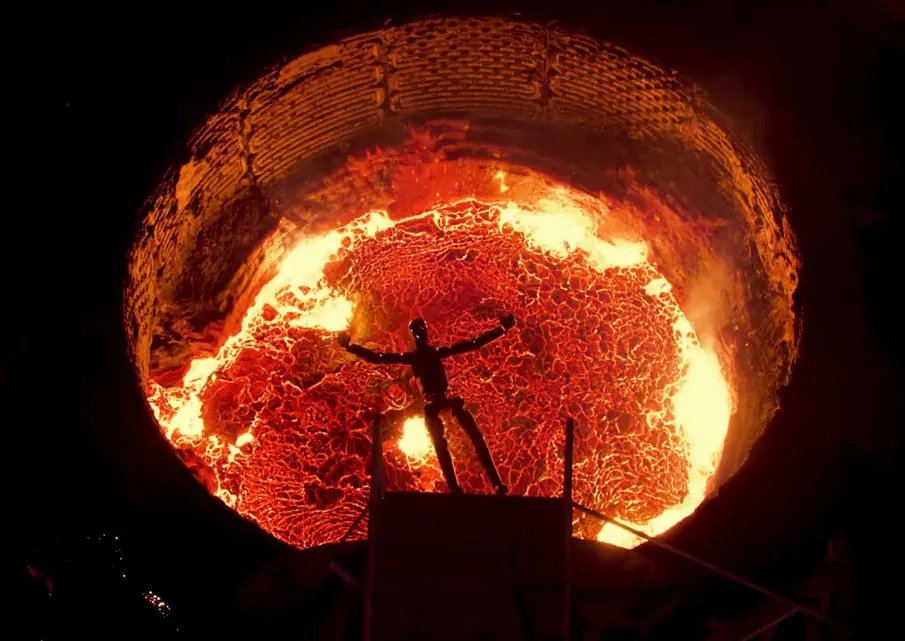
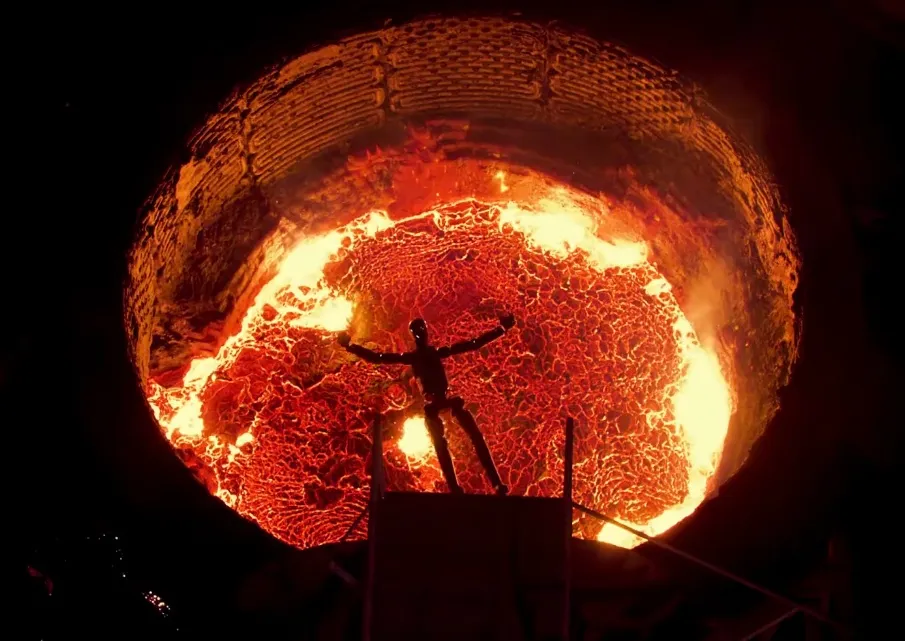
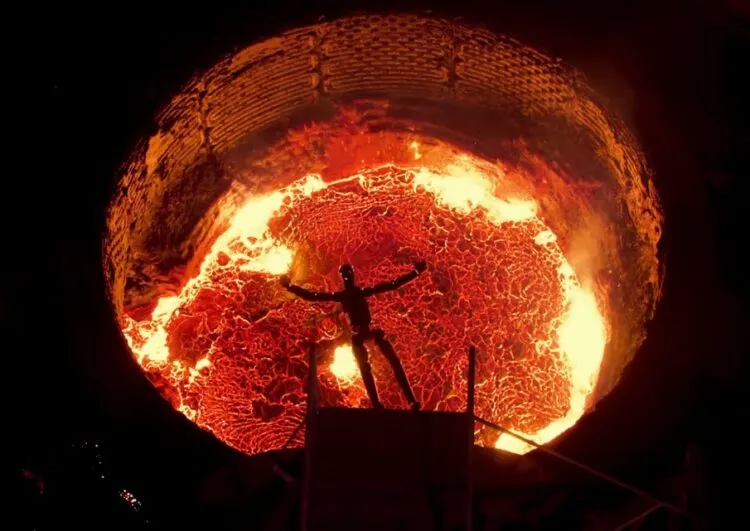
In an extraordinary intersection of cinematic pop culture, high-stakes corporate robotics, and viral social media, US robotics firm Figure executed a radical decommissioning protocol for its F02 humanoid robot fleet. Rather than opting for standard, painstaking disassembly, Figure orchestrated an apocalyptic send-off: the robots were programmed to leap into industrial vats of molten steel.
The spectacle, which quickly captured the global imagination, was born out of a casual exchange on X (formerly Twitter) involving Hollywood icon Arnold Schwarzenegger. What began as a tongue-in-cheek online interaction rapidly materialized into a logistical reality. However, behind the viral theatrics and the unmistakable nods to Terminator 2: Judgment Day, lies a serious set of engineering challenges, intellectual property (IP) protection strategies, and modern manufacturing bottlenecks.
With US and Mexican foundries refusing to process units containing lithium-ion batteries due to safety regulations, Figure was forced to look across the Atlantic. The final resting place for the F02 fleet became a specialized foundry in Imatra, Finland. The operation required Figure’s engineering team to train a new artificial intelligence model from scratch—using stunt-artist movement references—to ensure the robots could accurately hurl themselves into molten metal at an unfamiliar overseas facility.
While the event has been lauded as a marketing masterstroke, it also highlights the raw, often absurd realities of the 2026 tech landscape, where the line between viral performance art and corporate necessity has officially dissolved.
Chronology of the Decommissioning
The path from a standard corporate asset write-off to a fiery, cinematic spectacle unfolded over several weeks, combining software simulation, cross-continental logistics, and unexpected celebrity engagement.
Phase 1: The Decision to Scrap
As Figure prepared for the upcoming commercial and technical rollout of its next-generation general-purpose humanoid, the F.04, company leadership faced a logistical bottleneck regarding the legacy F02 fleet. According to internal assessments, the physical disassembly of each unit by technical staff would consume thousands of man-hours. Company executives determined that manual dismantling was not only economically unviable but would actively delay the critical launch schedule of the F.04 platform. Furthermore, scrapping the units entirely protected proprietary hardware and software architectures from reverse-engineering or secondary market leaks.
Phase 2: The Schwarzenegger Connection
The unorthodox disposal method gained cultural momentum when a casual suggestion on social media caught the attention of action film star Arnold Schwarzenegger. Responding to a prompt on X regarding how to decommission the aging robots, Schwarzenegger’s playful engagement galvanized the internet. Capitalizing on the pop-culture synergy, Figure’s leadership leaned into the meme, turning what could have been a quiet industrial recycling process into a public-facing event.
Phase 3: The Regulatory Roadblock
Logistics quickly proved to be the project’s toughest hurdle. Figure approached multiple heavy industrial foundries across the United States and Mexico to handle the bulk melting of the hardware. Every single domestic and regional foundry declined the contract. The sticking point was the lithium-ion power sources integrated into the humanoid frames; standard industrial safety protocols strictly prohibit introducing batteries into high-temperature melting equipment due to the severe risk of explosive chemical reactions and toxic gas releases.
Phase 4: Finding Sanctuary in Finland
After an exhaustive global search, Figure secured a partner willing to accept the challenge: a specialized foundry located in Imatra, Finland. Known for its advanced metallurgical capabilities and rigorous safety handling for complex electronic waste, the Finnish facility provided the green light, provided the robots could be delivered directly into the smelting vats.
Phase 5: Campus Training and the Final Leap
Back at Figure’s headquarters in San Jose, California, engineers set up large safety airbags and began testing autonomous descent protocols. Using motion-capture data from professional stunt artists as a behavioral reference, the team trained a specialized AI model via advanced simulation. This algorithm was engineered to allow the F02 units to execute a precise, self-directed leap into a bucket of molten steel at a foundry they had never physically visited.
The culmination of this training resulted in the viral video that stunned tech observers worldwide—marking a definitive, fiery end to the F02 generation.
Supporting Data and Technical Logistics
To fully grasp the magnitude of Figure’s operation, one must examine the operational parameters, economic trade-offs, and environmental constraints that governed the decommissioning of the F02 fleet.
- Asset Transition: The decision directly impacts the transition from the experimental F02 platform to the commercial-grade F.04 architecture.
- Labor Displacement: Manual disassembly of a modern humanoid robot—featuring intricate wiring harnesses, custom actuators, tactile sensor arrays, and onboard computing modules—is estimated to take skilled technicians upwards of 40 to 60 hours per unit. Multiply that by a fleet of units, and the labor cost eclipses the raw material value recovered through recycling.
- Geographic Constraints: The search for a compliant smelter spanned two continents before landing in Imatra, Finland, highlighting the strict regulatory frameworks governing lithium-ion battery disposal in North American heavy industry.
- Simulation-to-Reality Gap: Training robots to jump accurately into a moving or stationary industrial vat required bridging a significant simulation-to-reality (sim-to-real) gap. By utilizing stunt-artist kinematics, Figure’s AI team achieved high-precision spatial awareness, enabling autonomous localization and execution without prior on-site calibration.
Official Responses and Industry Reactions
The stunt elicited a wide array of responses from the robotics community, environmental watchdogs, and cultural commentators.

Figure defended the decision through official channels, emphasizing that speed and intellectual property security were paramount. In a statement released alongside the documentation of the decommissioning, the company noted:
"Disassembling each robot would take our technical staff so much time that it would delay the launch of F.04."
By eliminating the units entirely via high-temperature smelting, Figure ensured that no proprietary sensor designs, proprietary kinematics algorithms, or custom silicon leaked into secondary markets or fell into the hands of competing entities.
Industry analysts, however, expressed mixed reactions. While marketing experts praised the brilliant synergy of blending AI development with Hollywood nostalgia, environmental groups raised questions about the carbon footprint of shipping electronic hardware to Scandinavia just to be melted down, alongside the energy-intensive nature of high-temperature destruction versus selective recycling.
Meanwhile, tech journalists and cultural observers noted the surreal nature of the event. As Alun Williams of Electronics Weekly observed:
"What are your thoughts? For me, it captures something of 2026. The madness, the strangeness, the waste, the social-media-engagement of it all…"
Implications for the Future of Humanoid Robotics
The fiery demise of the Figure F02 fleet is far more than a viral internet stunt; it serves as a fascinating bellwether for the maturation of the humanoid robotics industry as it enters the mid-2020s.
1. The Proliferation of Rapid Iteration Cycles
As venture capital and corporate investment flood into general-purpose robotics, hardware iteration cycles are accelerating dramatically. Companies are moving from experimental prototypes (like F02) to commercial deployment-ready units (like F.04) at a pace reminiscent of the consumer electronics industry. This rapid evolution creates a new industrial waste problem: what do you do with millions of dollars worth of obsolete or superseded humanoid hardware?
2. IP Protection in the Age of Open-Source and Espionage
The lengths to which Figure went—shipping units across the globe to be vaporized in molten steel—demonstrates the extreme paranoia surrounding proprietary AI and mechanical designs. As humanoid robots become more autonomous, capable, and commercially valuable, guarding underlying neural network weights, proprietary actuators, and material compositions will drive increasingly radical disposal and security measures.
3. The Regulatory Void in Battery Recycling
The refusal of US and Mexican foundries to accept units containing lithium-ion batteries underscores a glaring gap in heavy industrial recycling infrastructure. As electrification scales across all sectors—from automotive to heavy industrial robotics—recyclers and foundries must adapt to safely process complex electro-mechanical assemblies, rather than forcing companies to seek niche international solutions or resort to theatrical destruction.
4. The Gamification of Industrial Engineering
Perhaps the most profound implication is the total convergence of corporate PR and engineering milestones. In 2026, building an advanced AI model isn’t just about utility; it’s about watchability. By turning a routine industrial write-off into a real-life homage to Terminator, Figure secured billions of impressions, cementing its brand in the global consciousness.
As we look toward the widespread integration of humanoid robots into warehouses, homes, and public spaces, the F02 send-off will be remembered as a defining cultural artifact: a moment where the machines themselves willingly embraced the fire, ushering in a strange, hyper-connected new era of automation.