The integration of artificial intelligence into core engineering and manufacturing workflows is transitioning rapidly from isolated software pilots into scaled, mainstream enterprise infrastructure. Recent announcements from global technology leaders—ranging from automotive and semiconductor pioneers to industrial software giants—reveal a concerted push toward GPU-accelerated computing, graph neural networks, conversational AI agents, and industrial-scale digital twins.
Far from serving merely as flashy visualization tools, these next-generation systems are addressing some of the most stubborn bottlenecks in industrial development: lengthy finite element analysis (FEA) runtimes, reactive factory floor firefighting, and the structural silos that separate design, simulation, and physical execution.
This briefing provides a comprehensive analysis of the latest technological breakthroughs reshaping industrial engineering, examining the core facts, chronological milestones, supporting quantitative data, official industry responses, and the profound long-term implications for engineers and operations teams.
1. Main Facts: The New Frontier of Industrial AI
The modern industrial landscape is experiencing a paradigm shift driven by five interconnected technological vectors: AI surrogate modeling, conversational plant optimization, multi-agent enterprise orchestration, simulation-ready semiconductor fab twins, and heavily capitalized physics-based AI platforms.
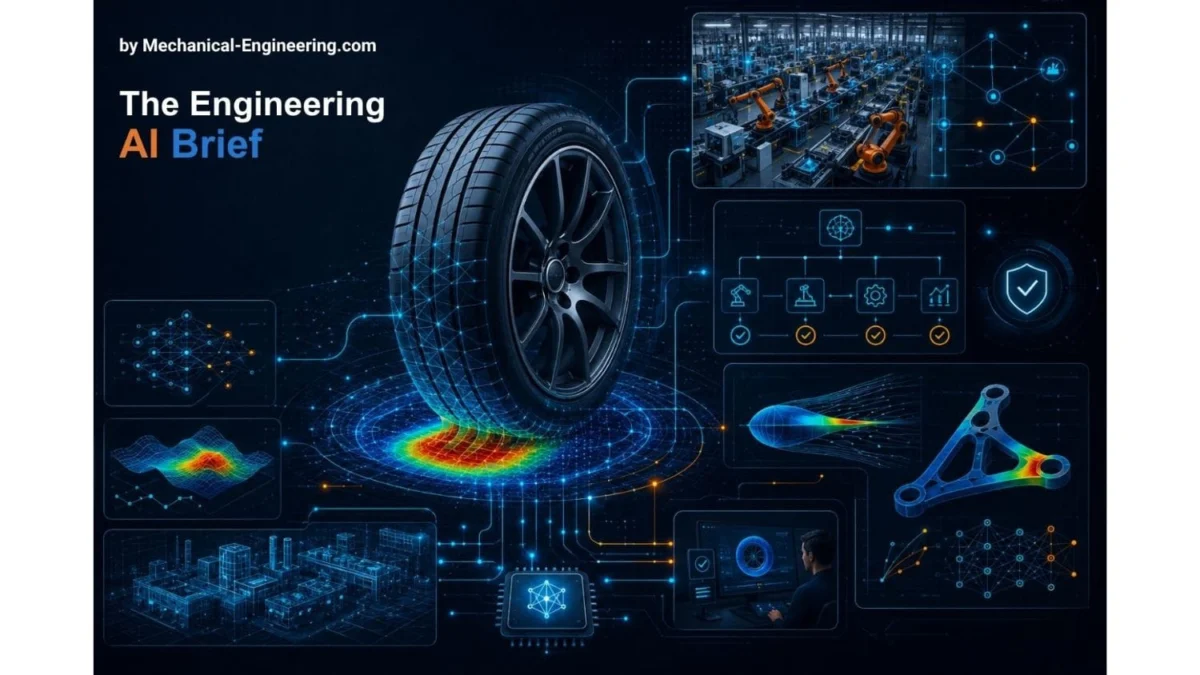
- Dunlop and Fujitsu’s AI Tyre Surrogate: Developed to drastically reduce the computational burden of structural tyre analysis, this graph neural network (GNN)-based surrogate model predicts tyre deformation, road contact shape, and pressure distribution with high fidelity.
- Plataine’s Conversational Agents: Moving beyond static dashboards, Plataine’s Total Production Optimization platform now utilizes real-time conversational agents to detect supply chain disruptions, re-optimize shop-floor schedules, and execute natural-language "what-if" simulations.
- Siemens Intelligence Center X: Siemens has launched a governed, enterprise-grade orchestration framework that connects industrial data sources, workflows, and multi-agent AI systems to automate complex problem-solving across manufacturing plants.
- Micron and MetAI’s SimReady Fab Twins: Utilizing NVIDIA Omniverse libraries and MetAI’s MetGen platform, this initiative transforms fragmented semiconductor fabrication data into parametric, modular digital twins for layout validation and material flow analysis.
- PhysicsX’s $300 Million Series C: Backed by heavyweights including Temasek, NVIDIA, Siemens, and Applied Materials, PhysicsX has secured massive funding to scale its Large Physics Models, promising rapid physical simulations across aerospace, energy, and advanced manufacturing.
2. Chronology of Recent Developments
The velocity at which industrial AI frameworks are moving from research labs to commercial deployment has accelerated notably. The recent timeline of milestones underscores a coordinated industry-wide push:
- Early 2026: Semiconductor manufacturing sees a breakthrough as Micron and MetAI implement OpenUSD-based digital twins on NVIDIA Omniverse, bridging the gap between CAD layouts and physical simulation environments.
- June 2026: Dunlop and Fujitsu unveil their proof-of-concept AI surrogate model for tyre structural analysis, slashing conventional finite element method (FEM) processing times by roughly 90%.
- Mid-2026: Plataine introduces its next-generation suite of conversational AI agents, targeting dynamic shop-floor disruptions and real-time decision optimization within the Total Production Optimization software.
- Simultaneously in 2026: Industrial software titan Siemens formally rolls out Intelligence Center X, utilizing its RapidMiner portfolio (Mendix, Graph Studio, and AI Studio) to provide a governed orchestration layer for industrial AI agents.
- Recent Funding Milestone: PhysicsX closes a landmark $300 million Series C funding round at a $2.4 billion valuation, signaling institutional confidence in deep-tech physics AI scaling for enterprise engineering applications.
3. Supporting Data and Quantitative Metrics
The business and technical value of these innovations is substantiated by hard performance metrics across speed, accuracy, and operational efficiency:
- 90% Time Reduction in Tyre CAE: Dunlop and Fujitsu’s AI surrogate model compresses traditional structural simulation workflows from approximately 45 minutes down to just 5 minutes, while successfully managing roughly 600,000 mesh elements.
- 87.7% Predictive Accuracy: Despite the dramatic compression in compute time, the graph neural network achieves an average 87.7% accuracy when benchmarked against traditional FEM analysis for contact shape prediction.
- April 2027 Commercial Target: Dunlop is actively refining the surrogate model with the objective of deploying it as a fully integrated, practical design-support tool by the spring of 2027, with Fujitsu simultaneously optimizing the framework for its energy-efficient FUJITSU-MONAKA processors.
- $2.4 Billion Valuation: PhysicsX’s latest funding round elevates its market valuation to $2.4 billion, reflecting massive investor appetite for platforms capable of predicting physical behaviors in seconds rather than days.
- Dramatic Efficiency Gains in Operations: Early enterprise deployments of agentic orchestration frameworks have yielded striking results, including an 85% reduction in production issue resolution time at Vivix and a 95% reduction in manual effort for pricing optimization use cases at Axiz.
4. Official Responses and Industry Perspectives
Industry leaders emphasize that these developments are not intended to replace human engineering judgment, but rather to augment human capabilities, remove tedious friction, and elevate the strategic value of engineering and operations teams.
- Fujitsu and Dunlop on Design Efficiency: By combining Dunlop’s deep domain expertise in tyre engineering with Fujitsu’s advanced computing infrastructure, the collaboration aims to democratize early-stage exploration. Engineers can screen thousands of structural and material variants before committing to expensive physical prototypes.
- Plataine on Factory Firefighting: Plataine frames its conversational agents as a cure for manufacturing blindness. Rather than forcing plant managers to parse complex, static spreadsheets during a crisis, the system acts as an intelligent co-pilot that instantly models recovery paths and evaluates trade-offs in real time.
- Siemens on Industrial Orchestration: Siemens underscores that the true bottleneck of industrial AI has never been algorithm capability, but rather governance, security, and scalability. With Intelligence Center X, the company is providing a structured runway that integrates AI agents safely into existing corporate workflows with strict human-in-the-loop validation parameters.
- PhysicsX on Deep-Tech Scaling: Backed by industrial titans like Siemens and NVIDIA, PhysicsX views its Large Physics Models as the missing bridge between abstract machine learning and rigorous industrial engineering, bringing real-time predictive capabilities to high-stakes fields like aerospace, defense, and heavy machinery.
5. Strategic Implications for Engineers and Manufacturers
As these technologies transition from experimental pilots into everyday production environments, they carry profound implications for how engineering organizations operate.
Democratizing Design Space Exploration
In traditional mechanical and structural engineering, time constraints severely limit the number of design iterations an engineer can run. By cutting simulation times from hours or minutes to mere seconds—as demonstrated by Dunlop’s tyre model and PhysicsX’s physics AI—teams can explore significantly broader design spaces. Engineers can optimize for weight, durability, and cost much earlier in the product lifecycle, catching structural flaws before detailed Computer-Aided Engineering (CAE) and expensive physical testing begin.
Moving From Reactive Firefighting to Proactive Optimization
Manufacturing floors have historically relied on reactive problem-solving ("firefighting") when machinery breaks down, materials are delayed, or labor shortages occur. Conversational AI agents and real-time digital twins shift this dynamic. By running natural-language "what-if" scenarios, operations managers can stress-test recovery plans before executing them on the physical shop floor, minimizing downtime and stabilizing delivery timelines.
The Imperative of Data Governance and Human Oversight
Despite the staggering efficiency gains, industry experts issue a unified warning: AI-driven predictions and automated recommendations are only as good as the underlying data.
- Surrogate models must be rigorously checked against ground-truth FEM data and physical test results.
- Digital twins require clean, highly accurate CAD files, facility metadata, and disciplined OpenUSD modeling to avoid compounding errors.
- Agentic workflows (such as those orchestrated by Siemens and Plataine) explicitly require human-in-the-loop validation, strict policy limits, and robust auditability.
An AI model can accelerate a simulation or suggest a supply chain reroute in seconds, but the ultimate legal, safety, and operational accountability rests firmly with the human engineer.
Conclusion
The convergence of GPU-accelerated computing, physics-informed neural networks, and conversational enterprise agents marks a turning point for industrial engineering. Organizations that successfully adopt these tools—while maintaining rigorous data discipline and engineering oversight—will compress development cycles, enhance operational resilience, and outpace competitors stuck in legacy, siloed workflows.