The American Consumer Packaged Goods (CPG) sector currently finds itself in the throes of a profound digital transformation paradox. On one hand, U.S. manufacturers are aggressive adopters of Artificial Intelligence (AI), with deployment rates across multiple sites nearly doubling the global average. On the other hand, the industry is hemorrhaging 20% of its revenue to production inefficiencies—a performance metric that trails the global average by five percentage points.
This disconnect between the widespread implementation of advanced technology and the actualization of operational efficiency has become a focal point for industry analysts. Neil Smith, Segment President for Consumer Packaged Goods at Schneider Electric, recently unpacked this phenomenon in a comprehensive video interview with IIoT World. Drawing from an expansive survey of 1,500 industry leaders across 14 countries, Smith highlights a structural malaise: the industry is attempting to build the future of manufacturing on the foundations of the past.
The Core Conflict: A Snapshot of Current Metrics
To understand the current state of the CPG industry, one must look at the data. The U.S. market displays a unique set of statistics that, at first glance, appear contradictory:
| Metric | U.S. CPG | Global Average |
|---|---|---|
| AI Deployed Across Multiple Sites | Over 50% | ~25% |
| Revenue Lost to Production Inefficiency | 20% | ~15% |
| Confidence in AI ROI by 2030 | 99% | Lower |
While 99% of U.S. leaders maintain a firm belief that their AI investments will pay dividends by 2030, the current fiscal reality suggests that the technology, as it is currently deployed, is failing to move the needle on the factory floor.
Chronology of the Digital Stagnation
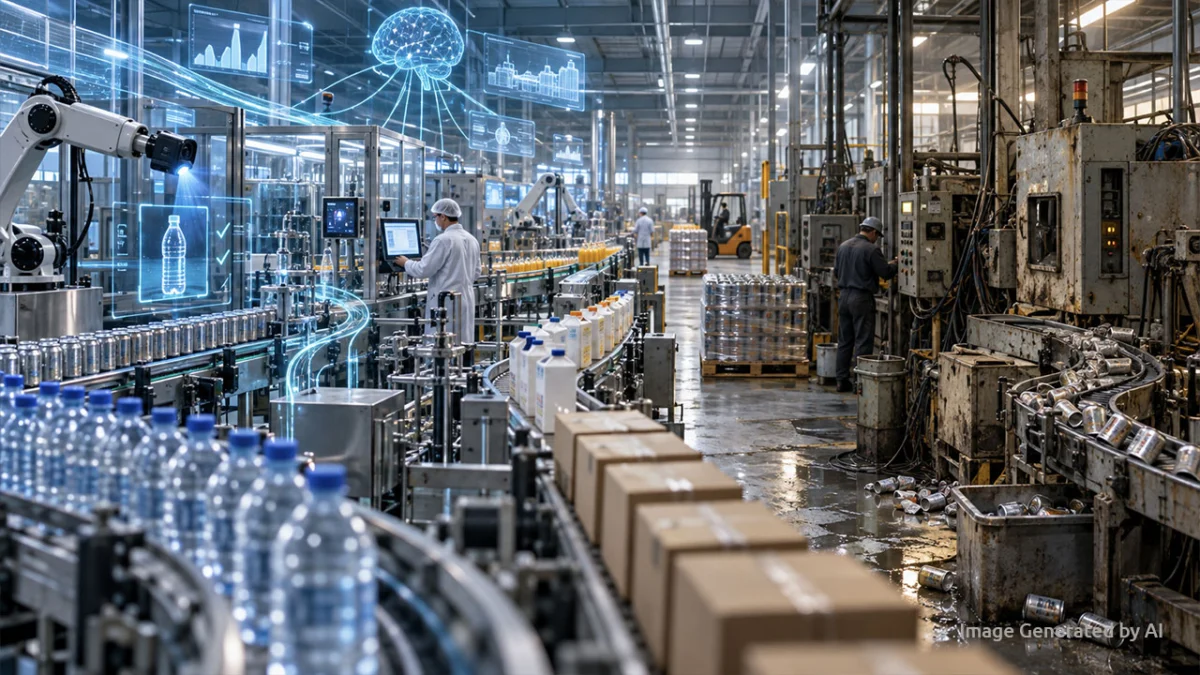
The "brownfield" nature of U.S. manufacturing is perhaps the most significant historical hurdle. A large portion of the nation’s CPG infrastructure dates back to the mid-20th century—the 1950s and 60s.
The Era of Siloed Automation
Historically, these plants were designed as isolated islands of production. Control systems were local, proprietary, and physically disconnected from any external network. As digital technology evolved, manufacturers began layering modern software over these legacy foundations. However, this was often done piecemeal.
The Pilot Trap
In the last decade, the surge in AI interest led to a rush of "pilot projects." Companies deployed localized AI solutions to solve specific, narrow problems—such as predictive maintenance on a single candy-molding machine or energy monitoring for one cooling system. While these pilots often yielded positive results in a vacuum, they created "siloed intelligence."
The Current Impasse
Today, we are witnessing the consequences of this fragmented approach. Because the AI models were developed within closed, proprietary systems, they are non-portable. A successful AI model running on a line in an Ohio facility cannot be easily "lifted and shifted" to a sister plant in Georgia because the underlying data architectures, sensor types, and control protocols differ entirely.
The Anatomy of the 20% Revenue Loss
Why do production inefficiencies remain so high despite the influx of high-tech tools? The answer lies in the "trapped data" problem.
In many modern U.S. CPG plants, critical operational data remains imprisoned within individual Programmable Logic Controllers (PLCs), sensors, and SCADA (Supervisory Control and Data Acquisition) systems. Because these systems were never designed to "talk" to one another, the AI models are forced to operate on incomplete, fragmented data sets.
When an AI system lacks a holistic view of the production line—from the intake of raw materials to the final packaging stage—it cannot perform enterprise-wide optimization. It can optimize a single machine, but it cannot synchronize the plant. This leaves the facility vulnerable to systemic inefficiencies, such as bottlenecks, energy waste, and quality variability, which collectively drain roughly 20% of annual revenue.
Barriers to Scaling: A Triad of Challenges
Schneider Electric’s research identifies three primary "friction points" that prevent manufacturers from moving from small-scale pilots to enterprise-wide digital maturity.
1. The Human Capital Deficit
The most cited barrier is the talent gap. There is a profound scarcity of professionals who possess both the "boots-on-the-ground" manufacturing experience and the high-level data science expertise required to bridge the two worlds. AI is only as good as the context provided to it; without deep domain knowledge, even the most advanced algorithms can misinterpret production anomalies as successes, or vice versa.
2. Cybersecurity Vulnerabilities
Opening up isolated factory systems to the enterprise network creates a massive attack surface. The manufacturing industry has been a frequent target of high-profile cyber breaches in recent years. Manufacturers are often paralyzed by the trade-off: they want the connectivity that AI requires, but they are terrified of the risk of a ransomware attack shutting down a production line.
3. The Weight of Technical Debt
Technical debt is the "ghost in the machine." Many manufacturers are paying the price for decades of disparate, unintegrated hardware. Before an AI model can effectively "see" the entire factory, the underlying data architecture must be modernized. This requires a tedious, expensive, and time-consuming process of cleaning, contextualizing, and unifying data from legacy systems that predate the modern internet.
Strategic Recommendations: How to Bridge the Gap
For CPG manufacturers to finally see the ROI they expect by 2030, a fundamental shift in strategy is required. The focus must move away from "buying AI" and toward "building data platforms."
Prioritize Data Platforming
Manufacturers must stop treating AI as a "plug-and-play" solution. Instead, the investment should be directed toward enterprise-wide data systems that pull operational data out of the silos. By creating a unified "data lake" or "digital thread," companies can ensure that information from every sensor and controller is cleaned, contextualized, and standardized. This creates a portable data layer that allows AI models to be scaled across sites, lines, and machines.
Embrace Open, Software-Defined Automation
The future lies in interoperability. Moving toward open, software-defined automation allows manufacturers to bypass the limitations of legacy control systems. By using software to wrap around existing hardware, firms can close the loop—turning AI-generated insights into actionable, automated production adjustments, such as automatically adjusting set points or optimizing line speed to increase yield.
Shift from "Technology Projects" to "Transformation Projects"
Perhaps the most critical advice from Schneider Electric is philosophical. Many implementations stall because they are viewed as IT initiatives rather than business transformations. Digital transformation is not merely an upgrade; it is a fundamental shift in how a business operates. The workforce, business processes, and technology must evolve in lockstep. Without cultural buy-in and a roadmap that integrates human expertise with machine intelligence, technology will remain a sunken cost.
Implications for the Future of CPG
The U.S. CPG sector stands at a crossroads. The current 20% loss to inefficiency is unsustainable in an era of tightening margins and supply chain volatility. However, the high confidence levels—the 99% who expect ROI by 2030—suggest that the industry is aware of its potential.
If manufacturers can successfully navigate the transition from siloed, legacy-heavy operations to integrated, data-driven ecosystems, the potential for growth is immense. The "infrastructure-first" approach championed by industry leaders is not just a technical recommendation; it is a survival strategy.
As Neil Smith noted, the potential is already there. The infrastructure is in place; it simply requires the strategic discipline to stop rebuilding at every site and start building a foundation that scales. By addressing the data layer today, U.S. CPG manufacturers can finally turn the promise of the digital revolution into the reality of operational excellence.
This article is based on a video interview with Neil Smith, Segment President, Consumer Packaged Goods at Schneider Electric, and Lucian Fogoros of IIoT World. AI tools were used to help summarize and organize the data. Reviewed and edited by the IIoT World editorial team.