
By Anurag Gurtu
Co-founder and CEO of Airrived
Executive Summary: Main Facts
The race to dominate physical AI and advanced robotics is routinely framed as a David-versus-Goliath struggle: major artificial intelligence laboratories attempting to break free from NVIDIA’s hardware monopoly. Headlines are filled with news of custom silicon tape-outs, massive venture capital injections, and multi-billion-dollar corporate acquisitions.
However, a deeper analysis of the underlying infrastructure reveals a starkly different reality. While industry giants like OpenAI and Anthropic pour vast sums of capital into custom-designed chips to bypass NVIDIA, NVIDIA has executed a masterclass in strategic positioning.
By announcing a record-breaking $12.9 billion acquisition of Hugging Face—the central repository where global developers discover, test, and deploy AI models—NVIDIA has bypassed the hardware layer entirely. Instead of fighting for supremacy in silicon alone, NVIDIA has purchased the digital marketplace where all models must ultimately reside, regardless of whose physical chips execute them.
Chronology of the Silicon Exodus
To understand the current tension in the physical AI market, one must trace the escalating sequence of moves made by frontier labs determined to reduce their financial and strategic dependence on Jensen Huang’s hardware empire.
- Early 2024–2026 (The Custom Silicon Surge): Major AI laboratories accelerated efforts to design in-house processors. OpenAI partnered with Broadcom on a high-speed inference chip codenamed "Jalapeño," achieving what industry analysts called one of the fastest tape-outs in advanced semiconductor history. Concurrently, Anthropic established a heavily funded in-house silicon team, dangling compensation packages capable of rivaling top-tier quantitative trading firms to poach elite chip architects.
- Mid-2026 (Consolidation and Strategic Partnerships): The merger-and-acquisition landscape shifted violently. Advanced Micro Devices (AMD) acquired World Labs for $8.2 billion to bolster its spatial intelligence capabilities. Qualcomm forged a strategic partnership with Liquid AI to advance embedded edge agents. Meanwhile, Skild AI launched its flagship S1 robot foundation model, and Google DeepMind integrated its Gemini Robotics 2 architecture directly into Apptronik’s Apollo 2 humanoid platform.
- Late 2026 (NVIDIA’s Counter-Move): Amidst widespread industry declarations that labs were successfully cutting ties with NVIDIA, the company quietly announced its intent to acquire Hugging Face for $12.9 billion. This transaction—the largest in NVIDIA’s corporate history—fundamentally altered the playing field, transforming NVIDIA from a dominant hardware vendor into the universal gatekeeper of AI software distribution.
Supporting Data and Market Dynamics
The narrative that NVIDIA is being sidelined relies on impressive achievements in semiconductor engineering, but it fundamentally misunderstands where power resides in the broader technology ecosystem.
[The Physical AI Stack & NVIDIA's Position]

 ┌──────────────────────────────────────────────┐
 │ Application Layer (Robots, Enterprise Agents)│
 ├──────────────────────────────────────────────┤
 │ Distribution & Models (Hugging Face)         │ <--- NVIDIA's $12.9B Acquisition
 ├──────────────────────────────────────────────┤
 │ Software & Frameworks (CUDA / Developer Tools│ <--- NVIDIA's 20-Year Moat
 ├──────────────────────────────────────────────┤
 │ Silicon Layer (OpenAI, Anthropic, AMD, TPUs) │ <--- The Hyper-Competitive Chip War
 └──────────────────────────────────────────────┘
The Custom Silicon Reality Check
The engineering milestones achieved by frontier labs are undeniably impressive:
- OpenAI’s Jalapeño: Developed in just nine months in collaboration with Broadcom, this chip represents a remarkable engineering sprint. Yet, industry insiders note it remains a specialized, narrow inference processor optimized primarily for OpenAI’s proprietary workloads, rather than an open platform upon which external enterprises can build resilient businesses.
- Anthropic’s Silicon Initiative: Anthropic’s hardware division is currently operating within a multi-gigawatt Tensor Processing Unit (TPU) framework tied heavily to Google and Broadcom infrastructure, while its long-term custom silicon roadmap remains in its developmental infancy.
- Established Compute Alternatives: Google has refined its Tensor Processing Units (TPUs) for over a decade. Amazon Web Services (AWS) relies on Trainium, and Meta scales its infrastructure using its proprietary Meta Training and Inference Accelerator (MTIA).
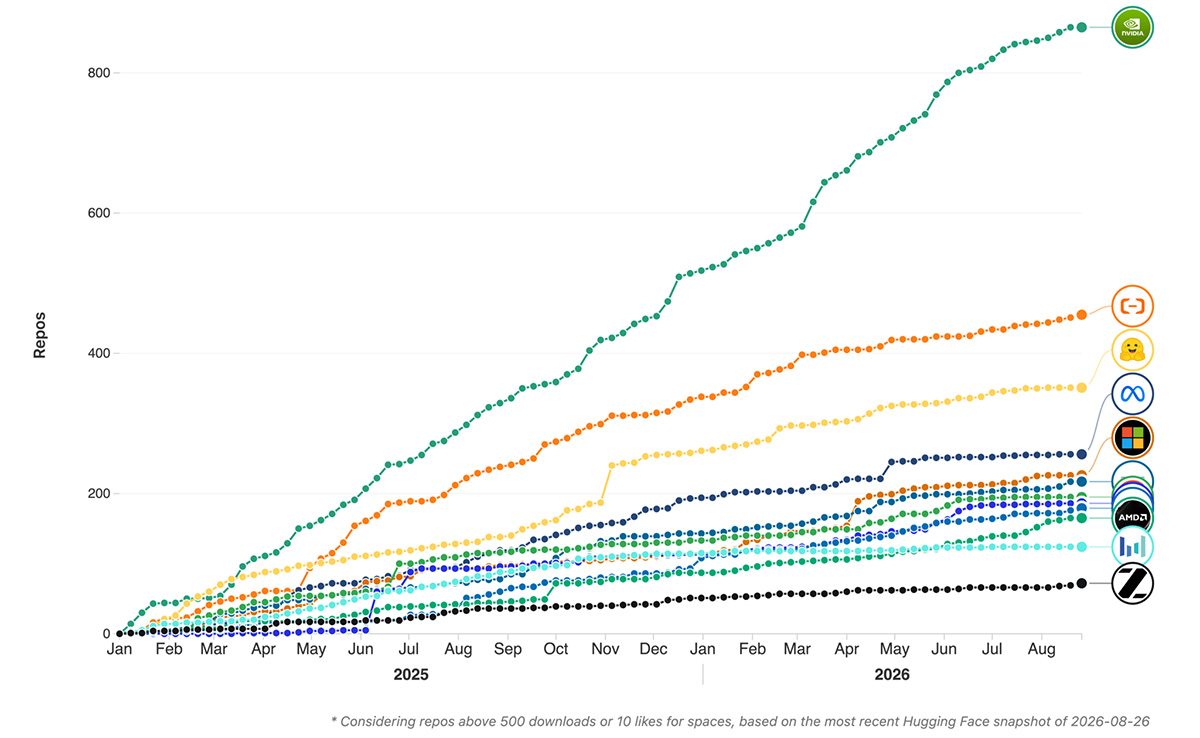
Despite these multi-billion-dollar diversification efforts, none of these proprietary chips address the needs of the estimated 200,000 enterprises that will never fabricate their own silicon. These organizations rely on accessible platforms to fine-tune and deploy models. By acquiring Hugging Face, NVIDIA secured the primary digital gateway utilized by this vast developer community. Public data indicates that NVIDIA already maintains the highest number of software repositories and the second-largest portfolio of homegrown models on the platform.
Official Responses and Strategic Pivot: The Rise of "Sovereign AI"
Throughout corporate earnings calls, NVIDIA leadership has consistently emphasized a specific strategic category: sovereign AI.
Rather than focusing exclusively on commercial developers or traditional enterprise clients, NVIDIA has cultivated relationships with nation-states. Governments across the globe are committing massive public budgets to achieve "AI independence," seeking assurance that their national infrastructure will not remain perpetually beholden to a small oligopoly of U.S.-based AI laboratories.
The Geopolitical Calculus
No sovereign government funding its own national AI compute infrastructure wants to tie its strategic future to a proprietary chip designed by OpenAI, Anthropic, or any single commercial entity that could become a geopolitical vulnerability.
NVIDIA capitalized on this anxiety with a compelling value proposition: architectural neutrality. By positioning its hardware as universally compatible with any model, framework, or cloud provider, NVIDIA champions freedom of choice. However, this philosophy of openness takes on a different hue now that the company owns the marketplace where those choices are displayed, evaluated, and downloaded.
While companies like OpenAI and Anthropic optimize their internal cost of goods sold (COGS) through custom silicon, NVIDIA is optimizing to sit beneath the entire global tech economy’s cost structure. Regardless of which laboratory wins the model-training wars, developers must still distribute, refine, and deploy their creations through platforms deeply integrated with NVIDIA’s ecosystem.
Implications for Physical AI and Robotics
As artificial intelligence transitions from digital chat interfaces into physical machinery, the strategic importance of infrastructure intensifies exponentially.
The Operational Realities of Embodied AI
A humanoid robot operating on a manufacturing floor, navigating a bustling warehouse, or handling hazardous materials cannot afford to wait for round-trip API calls to a distant cloud server. Physical AI demands:

- Local Inference: Real-time decision-making loops executed directly on the edge.
- Data Sovereignty: Proprietary sensor and operational data must remain secure and internal to the enterprise.
- Deployment Resilience: Edge runtimes that cannot fail simply because a regional cloud provider experienced an outage or a software vendor altered its licensing terms.
In this domain, "sovereignty" ceases to be a theoretical procurement slogan and becomes an absolute operational requirement. Yet, the physical AI sector inherits the exact same landlord dilemma seen in digital software. The entity that controls the training pipelines, simulation environments, edge runtimes, developer toolkits, and model repositories is not merely selling hardware—it is dictating the terms by which physical intelligence is engineered and scaled.
The Alternative: Application-Layer Sovereignty
This structural bottleneck highlights the value of true platform portability across models, compute clusters, and deployment environments.
Emerging paradigms—such as the sovereign agentic platforms recently introduced by enterprises like Airrived—aim to redefine sovereignty for everyday business users. In this context, sovereignty does not mean constructing a national data center or maintaining a multi-year silicon roadmap. Instead, it empowers enterprise users to own, manage, and execute AI workflows without requiring dedicated data science teams, specialized chip fabrication, or forward-deployed infrastructure engineers.
This application-layer approach operates independently of hardware branding. It cares exclusively about whether inference is fast, cost-effective, and reliably executed, allowing multi-trillion-dollar infrastructure giants to compete over capital expenditures while downstream users focus on operational outcomes.
Conclusion
The ongoing race to build custom AI chips is frequently cast as an epic rebellion against hardware dominance. Yet, a dispassionate look at market mechanics suggests a more complex outcome.

OpenAI and Anthropic are expending immense resources to manufacture independence from NVIDIA’s compute ecosystem. Concurrently, NVIDIA has deployed capital to insure itself against the possibility of losing those very customers—purchasing the digital thoroughfare through which all modern AI models must travel.
Label this dynamic a corporate war if you wish. From an infrastructure perspective, however, NVIDIA is simply collecting tolls on both sides of the digital frontier, inviting the rest of the technology sector to continue its expensive quest for diversification while remaining securely anchored to the industry’s ultimate landlord.