WASHINGTON — Occupational noise remains one of the most pervasive yet preventable health hazards in modern industry. From construction sites and manufacturing floors to bustling airports and heavy-machinery workshops, workers are routinely exposed to decibel levels that threaten their long-term sensory health. Addressing this critical issue, the National Institute for Occupational Safety and Health (NIOSH) has released a comprehensive new toolbox talk aimed at equipping safety managers, supervisors, and frontline workers with actionable strategies to recognize, mitigate, and prevent noise-induced hearing loss (NIHL).
The newly published resource underscores a sobering reality: unlike other bodily tissues, the delicate sensory cells within the human inner ear cannot regenerate once destroyed. Beyond the immediate workplace dangers of missed safety instructions, communication barriers, and auditory distractions, long-term exposure to excessive noise carries profound systemic health consequences, ranging from chronic tinnitus to an elevated risk of cognitive decline and dementia.
Main Facts: The Scope of the Occupational Noise Crisis
Occupational hearing loss is among the most common work-related illnesses in the United States and globally. According to federal safety data, millions of workers across various industrial sectors are exposed to hazardous workplace noise on a daily basis.
- The Irreversible Nature of Damage: NIOSH emphasizes that loud noise physically destroys the microscopic hair cells (stereocilia) inside the cochlea. Once these cells are damaged or dead, medical science currently offers no method of repair or regeneration.
- Beyond Hearing Loss: The impact of chronic noise exposure extends far past the ability to hear. Workers suffering from noise-induced hearing loss frequently develop tinnitus—a persistent, debilitating ringing, buzzing, or roaring in the ears that can severely disrupt sleep, mental health, and overall quality of life.
- Cognitive and Neurological Implications: Emerging public health research highlights a strong correlation between hearing loss and broader health crises. Studies increasingly link auditory deprivation to accelerated cognitive decline, social isolation, and an increased risk of developing dementia later in life.
- Safety Complications on Site: In the immediate term, high ambient noise levels create critical communication hazards. Workers may fail to hear verbal warnings, machinery malfunction alarms, or backing-up vehicle signals, exponentially increasing the risk of catastrophic workplace injuries and fatalities.
Chronology: The Evolution of Workplace Hearing Conservation
To understand the urgency of NIOSH’s latest intervention, it is necessary to examine how workplace noise regulation and safety culture have evolved over the decades.
Early Industrial Era to Mid-20th Century
For generations, occupational noise was accepted as an unavoidable byproduct of industrial progress. Factory floors, shipyards, and construction zones operated with deafening machinery, and workers experienced gradual hearing loss as a normal consequence of aging or manual labor. Protective equipment was primitive, uncomfortable, and rarely mandated.
The Establishment of OSHA and NIOSH (1970s)
The landscape of American worker safety shifted dramatically with the passage of the Occupational Safety and Health Act of 1970, which led to the creation of both the Occupational Safety and Health Administration (OSHA) and NIOSH. For the first time, federal agencies were tasked with setting exposure limits and researching the physiological impacts of industrial environments. Early noise standards established permissible exposure limits (PELs) based on an 8-hour time-weighted average (TWA) of 90 decibels (dBA), though NIOSH later recommended a stricter recommended exposure limit (REL) of 85 dBA.
The Hearing Conservation Amendment (1983)
Recognizing that compliance with basic exposure limits was insufficient to stop progressive hearing loss, OSHA introduced the Hearing Conservation Amendment. This landmark ruling required general industry employers to implement formal hearing conservation programs whenever employee exposure equaled or exceeded an 8-hour TWA of 85 dBA. These programs mandated regular noise monitoring, audiometric testing (hearing tests), baseline evaluations, and the provision of hearing protection devices (HPDs).
The Shift Toward Proactive Communication (Present Day)
Despite decades of regulation, thousands of workers still suffer preventable hearing damage annually. In response, federal agencies and safety organizations have pivoted toward more accessible, frontline educational tools. Recognizing that complex regulatory manuals are rarely read by workers in the field, NIOSH developed the "toolbox talk" format—short, digestible, conversational modules designed for supervisors to deliver directly to crews before a shift begins. The latest 2026 toolbox talk represents the culmination of modern human factors research, blending technical safety engineering with practical behavioral psychology.

Supporting Data: Understanding Decibels and Risk
To effectively communicate noise hazards, safety professionals rely on clear metrics regarding sound intensity and duration. Sound is measured in decibels (dB) on a logarithmic scale, meaning that a small numerical increase represents a massive exponential leap in sound energy and potential damage.
- The Threshold of Danger: Generally, noise levels begin to pose a threat to human hearing at 85 decibels (dBA). For context, normal conversation occurs at roughly 60 dBA, heavy city traffic registers around 85 dBA, and a typical lawnmower or leaf blower sits near 90 to 100 dBA.
- Industrial Noise Levels: Construction tools such as jackhammers and circular saws frequently generate noise between 100 and 110 dBA. Industrial presses, jet engines, and heavy manufacturing equipment can easily exceed 115 to 130 dBA.
- Safe Exposure Duration: According to NIOSH guidelines, for every 3-decibel increase above the 85 dBA threshold, the permissible safe exposure time is cut in half:
- 85 dBA: Safe for up to 8 hours.
- 88 dBA: Safe for up to 4 hours.
- 91 dBA: Safe for up to 2 hours.
- 100 dBA: Safe for less than 15 minutes per day without protection.
Demographic and Economic Impact
According to the Bureau of Labor Statistics (BLS), occupational hearing loss consistently ranks among the most frequently recorded occupational illnesses in manufacturing and construction sectors. Beyond the human toll of diminished sensory health, the economic burden manifests through workers’ compensation claims, lost productivity, increased error rates, and costs associated with retraining or replacing disabled workers.
Official Responses and Expert Insights
Safety experts, public health researchers, and occupational health organizations have widely praised the release of NIOSH’s updated guidance, emphasizing that prevention must start long before permanent damage occurs.
Dr. Elena Vance, an industrial hygienist and occupational epidemiologist, noted that the greatest challenge in hearing conservation is the invisible nature of the hazard.
"Unlike a chemical spill or a guarded machine part, you cannot see, smell, or easily touch noise," Dr. Vance explained. "Workers often become desensitized to high decibel levels within days, mistakenly believing they have ‘gotten used to it.’ In reality, that numbness is often the first sign of auditory fatigue and cellular damage. Tools like the NIOSH toolbox talk bridge the gap between abstract regulatory data and daily survival on the job site."
Labor representatives have similarly endorsed the initiative, stressing that safety education must be paired with employer accountability.
"Providing a toolbox talk is an excellent step, but it must be backed by a workplace culture where workers feel fully empowered to request proper equipment, halt work in dangerously loud environments without fear of retaliation, and insist on well-maintained engineering controls," stated Marcus Holloway, a regional safety coordinator for heavy industrial construction unions.
NIOSH representatives reiterated in their release that comprehensive hearing conservation cannot rely on earplugs alone. The agency continues to advocate for the Hierarchy of Controls, prioritizing elimination and substitution of loud machinery before falling back on administrative controls and personal protective equipment (PPE).

Implications: Building a Sustainable Culture of Hearing Safety
The release of the NIOSH toolbox talk carries profound implications for safety management across multiple industries. Organizations that fail to adapt their hearing conservation programs to meet modern standards face mounting risks, including regulatory penalties, civil liability, and severe workforce retention challenges.
1. Shift Toward Proactive Safety Cultures
Forward-thinking companies are moving away from compliance-driven minimums toward total worker health models. By integrating regular toolbox talks into daily operations, supervisors normalize discussions surrounding hearing protection, transforming safety from a bureaucratic checkbox into a shared team value.
2. Technological Integration in Noise Monitoring
Modern safety programs are increasingly leveraging wearable noise dosimeters and smartphone-based sound level meter applications. These technologies allow workers and safety managers to track real-time cumulative noise exposures, offering instant feedback when decibel limits are approached or breached.
3. Proper Fitting and Dual Protection
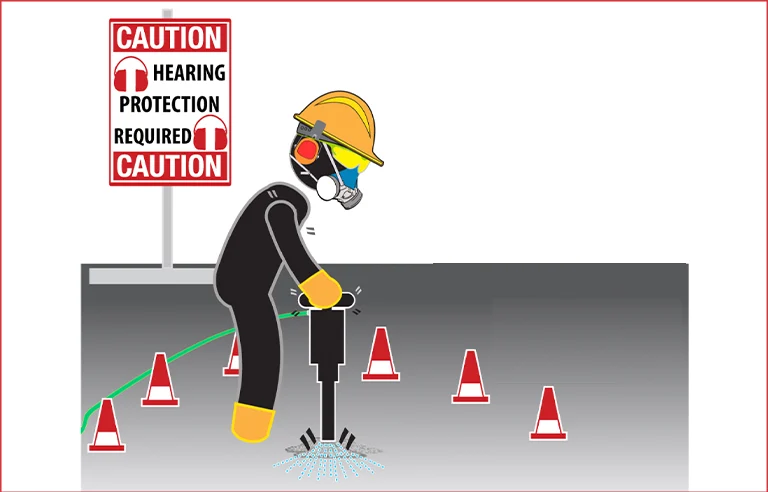
A recurring vulnerability in industrial settings is the improper use of hearing protection devices. Simply handing out foam earplugs is inadequate; workers must be trained on the "roll, pull, and hold" insertion technique to achieve the labeled Noise Reduction Rating (NRR). In ultra-high-noise environments exceeding 100 dBA, safety managers are increasingly implementing dual protection—requiring workers to wear both properly fitted earplugs and earmuffs concurrently.
4. Mitigating Long-Term Cognitive Risks
As public health research continues to establish the link between sensory deprivation and cognitive decline, occupational safety is increasingly viewed as a pillar of lifelong wellness. Protecting a worker’s hearing today does not merely preserve their ability to enjoy music or converse with grandchildren tomorrow; it actively safeguards their neurological health and long-term vitality.
Conclusion
NIOSH’s latest toolbox talk serves as both a timely reminder and an essential operational guide for industries navigating the persistent threat of workplace noise. By combining stark physiological facts with engaging incident narratives and actionable safety protocols, the resource empowers employers and employees alike to take proactive command of their acoustic environments. In an era where workplace safety demands holistic attention to total worker health, preserving the delicate sensory architecture of the human ear remains a fundamental moral, professional, and economic imperative.