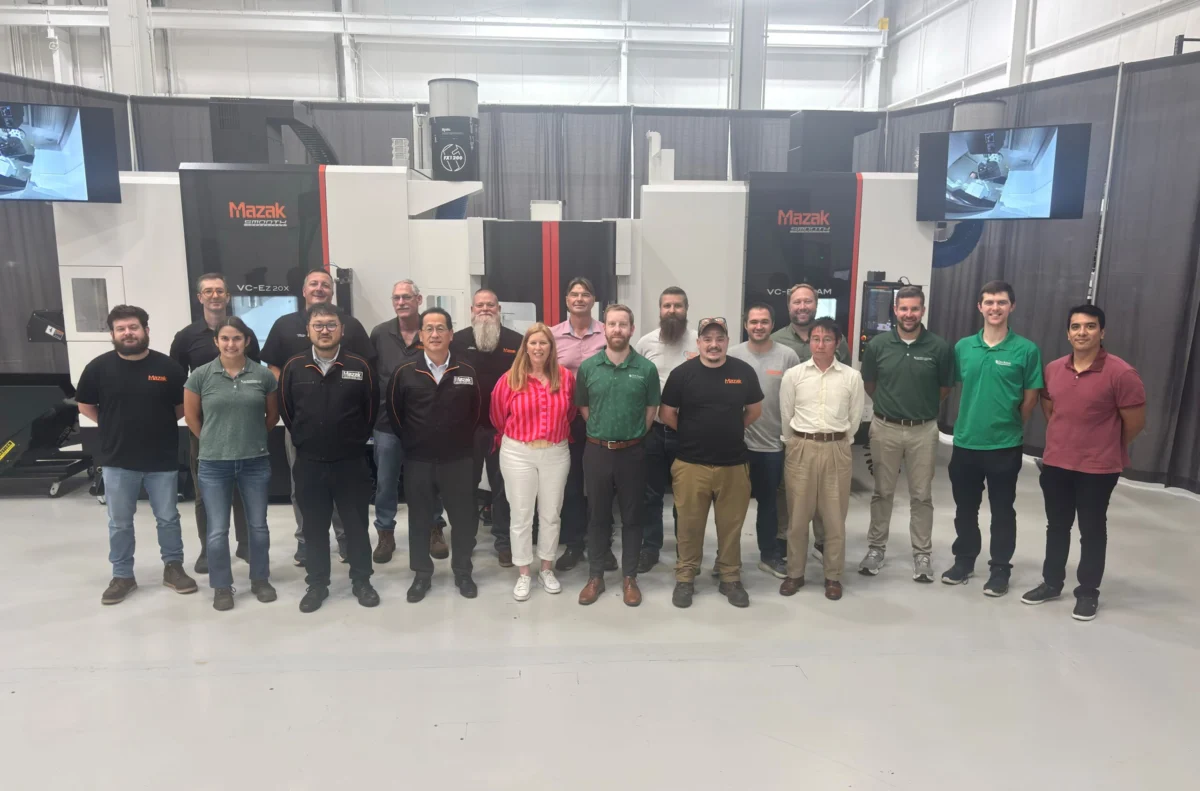
The manufacturing landscape is undergoing a seismic shift. As global supply chains demand greater agility and the push for sustainable, rapid production intensifies, the intersection of additive and subtractive manufacturing has become the industry’s most critical frontier. At the forefront of this evolution is a groundbreaking partnership between Mazak Corporation and the Oak Ridge National Laboratory (ORNL). Together, they have unveiled a sophisticated, convergent metal additive manufacturing platform—the VC-Ez WAAM system—designed to unify large-scale metal deposition with high-precision finish machining within a single, automated workflow.
Showcased at the 2026 International Manufacturing Technology Show (IMTS) in Chicago, this system represents a bold step toward the "factory of the future," where high-mix, low-volume production is no longer a logistical burden, but a competitive advantage.
The Core Innovation: Unifying Additive and Subtractive
At its heart, the new platform leverages a hybrid approach, integrating the Fronius International Wire Arc Additive Manufacturing (WAAM) technology with two of Mazak’s high-precision VC-Ez 20X Vertical Machining Centers.
Unlike traditional powder-based additive manufacturing, which can be limited by build size and high material costs, the WAAM process utilizes electric arcs and standard welding wire. This method allows for the rapid, layer-by-layer deposition of metal, offering significant advantages in speed, cost-effectiveness, and design freedom. By fusing this additive capability with the surgical precision of Mazak’s 5-axis machining, the system creates a closed-loop environment where a part can be "grown" and finished without leaving the automated framework.
Chronology of Development: A Longstanding Synergy
The development of the VC-Ez WAAM platform did not happen in a vacuum; it is the culmination of years of collaborative research between Mazak and ORNL.
Early Research and Foundation
The relationship between Mazak and ORNL has spanned over a decade, focusing on the fundamental physics of machining and the industrialization of hybrid manufacturing. ORNL, renowned for its work in materials science and advanced manufacturing, provided the research rigor, while Mazak provided the industrial-grade machine tool architecture.

Prototyping and Testing
During the mid-2020s, the partnership shifted from theoretical research to applied development. The primary goal was to address a persistent "valley of death" in manufacturing: the transition from an additive-manufactured preform to a finished, high-tolerance industrial component. By selecting the VC-Ez 20X series as the base unit, the teams were able to test the stability of the platform under the thermal stresses inherent in WAAM processes.
The IMTS 2026 Reveal
The culmination of these efforts was the debut at the AMT’s Emerging Technology Center at IMTS 2026. The exhibit served as a proof-of-concept, demonstrating that large-scale metal components could be fabricated with the repeatability and precision required for aerospace, automotive, and heavy industrial applications.
Supporting Data: Technical Specifications and Performance
The efficacy of the VC-Ez WAAM system is rooted in its robust hardware specifications and the intelligence of its control systems.
Machine Architecture
The VC-Ez 20X machines, which serve as the "finishing" stage of the platform, are engineered for high-accuracy processing. Key features include:
- Axis Travels: 31.49" in X, 20.07" in Y, and 20.07" in Z (800 mm x 510 mm x 510 mm).
- Dynamic Performance: Rapid traverse rates of 1,260 ipm (32,000 mm/m) on all three axes ensure that cycle times are minimized.
- Precision: The 5-axis rotary/tilt trunnion table utilizes advanced roller gear cam technology, providing the rigidity necessary for complex geometries and 3+2 or full 5-axis machining.
- Compact Footprint: Measuring only 104.21" x 146.32", the VC-Ez 20X series offers a 26.5% smaller footprint than previous generations, allowing manufacturers to maximize floor space without sacrificing capacity.
Workflow Integration
The secret to the system’s efficiency is the Mazak automated palletized transfer system. This system acts as the connective tissue between the WAAM deposition cell and the CNC finishing stations. By using standardized pallets, the system ensures that once a part is deposited, it can be moved to the milling station with perfect, repeatable fixturing, eliminating the need for time-consuming re-calibration.
CNC Control
Each unit is equipped with the MAZATROL SmoothEz5 CNC. This controller is designed to bridge the gap between complex programming and operator ease. By supporting both EIA/G-code and MAZATROL Conversational programming, it allows operators to manage both the additive deposition paths and the subtractive machining strategies from a unified interface.

Official Perspectives
Dan Janka, president of Mazak Corporation, emphasized that this system is more than just a new machine; it is a manifestation of a long-term commitment to the industry. "This system represents Mazak’s longstanding relationship with the Oak Ridge National Laboratory in terms of machining research and the advancement of hybrid additive manufacturing technology," Janka stated during the IMTS unveiling.
The partnership reflects a broader industry trend where OEMs (Original Equipment Manufacturers) must collaborate with national labs to de-risk the adoption of emerging technologies. By providing a "production-relevant" workflow, Mazak and ORNL have effectively signaled to the market that WAAM is ready for the shop floor.
Implications: The Future of Manufacturing
The introduction of the VC-Ez WAAM platform has profound implications for the manufacturing sector, particularly for industries grappling with supply chain fragility.
1. The Death of Long Lead Times
In traditional manufacturing, obtaining complex forged or cast parts can take months. With WAAM, companies can print "near-net-shapes" in hours or days, then immediately machine them to final dimensions. This drastically shortens the "concept-to-part" timeline, allowing for rapid prototyping and true on-demand manufacturing.
2. High-Mix, Low-Volume Flexibility
Traditionally, high-volume production requires dedicated, single-purpose tooling. This system flips the script. Because the platform uses software-defined paths (via the MAZATROL SmoothEz5) and flexible palletization, a manufacturer can produce a custom aerospace bracket in the morning and a specialized tooling die in the afternoon, all on the same hardware.
3. Sustainability and Material Efficiency
Wire Arc Additive Manufacturing is inherently more material-efficient than subtractive manufacturing from a solid billet. By depositing metal only where it is needed, manufacturers can reduce raw material waste—often referred to as the "buy-to-fly" ratio—by a significant margin. This aligns with global ESG (Environmental, Social, and Governance) goals, as the carbon footprint of producing and transporting large steel billets is mitigated.

4. Structural Repair and Tooling
Beyond new part production, the system is ideally suited for the repair of high-value structural components. Rather than scrapping a worn-out part, the WAAM system can deposit new material onto the worn surfaces, which are then machined back to original specifications. This capability has massive implications for the maintenance, repair, and overhaul (MRO) sectors in defense and aerospace.
Conclusion
The collaboration between Mazak and Oak Ridge National Laboratory serves as a blueprint for the future of industrial production. By successfully integrating WAAM with 5-axis machining, they have moved beyond the experimental phase and into the realm of scalable, industrial-grade production.
As manufacturers face increasing pressure to shorten lead times, reduce material waste, and navigate the complexities of high-mix, low-volume production, systems like the VC-Ez WAAM platform will likely become the standard. This isn’t just about making parts faster; it’s about making the manufacturing process itself more resilient, flexible, and capable of meeting the unknown demands of the coming decade. As we look toward the future, the integration of these technologies suggests a new era of manufacturing—one where the boundary between "additive" and "subtractive" is blurred, leaving only the efficiency of the finished product.