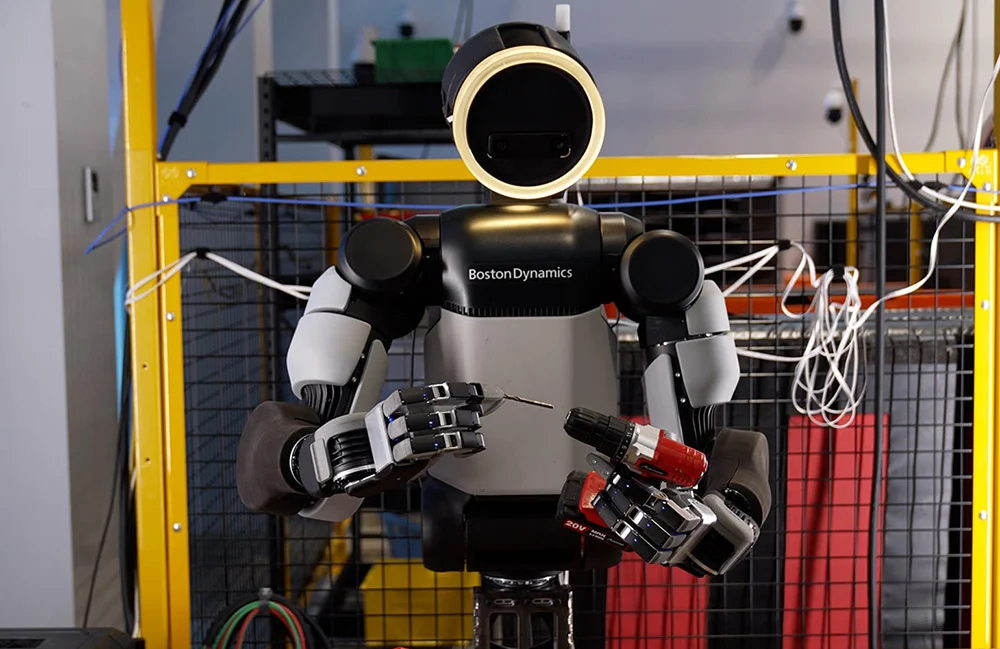
While viral videos of bipedal robots executing backflips, dancing, or delicately folding laundry continue to capture the public imagination—and billions in venture capital—the actual mechanics of transitioning humanoid robots from experimental laboratory prototypes to mass-produced industrial assets are unfolding quietly behind closed doors.
As pioneers like Tesla, 1X Technologies, XPeng, and UBTECH race to scale production, the global manufacturing ecosystem is facing unprecedented engineering hurdles. To understand the transition from custom bench-assembly to manufacturing lines pushing out tens of thousands of units, The Robot Report sat down with Thomas Brown, Senior Director for Engineering and Technology (including digital commerce and robotics) at Jabil Inc.
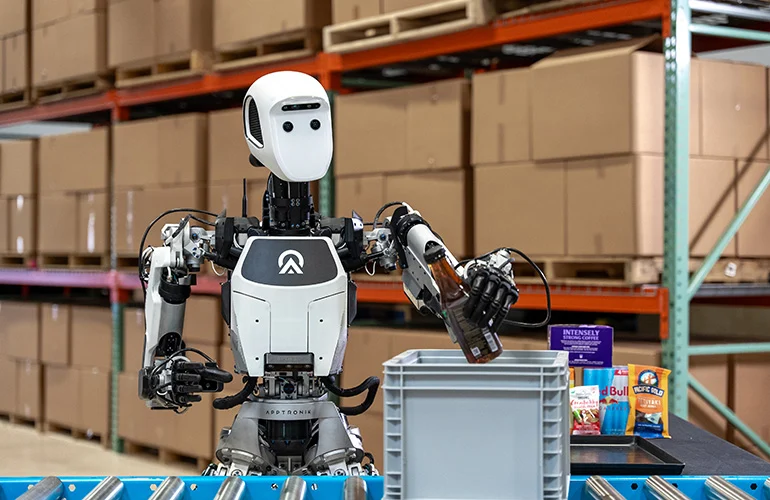
Headquartered in St. Petersburg, Florida, Jabil functions as a critical global backbone for hardware innovation, partnering with visionary robotics developers—such as Apptronik, creator of the Apollo humanoid—to bridge the gap between speculative design and scalable, cost-effective commercialization.
1. Main Facts: The Reality of Moving From Prototypes to Tens of Thousands
The humanoid robotics sector is navigating a pivotal transition phase. For years, the industry relied on hand-assembled, bespoke prototypes utilized primarily for gathering AI training data and securing early-stage customer validations. However, according to industry experts like Jabil, that era is rapidly coming to a close.
The Scale Threshold: The industry is moving from single-digit production runs to targets in the tens of thousands. This shift requires strict adherence to predictable cost structures, enhanced manufacturability, and rigorous quality control.
The Compute Challenge: Physical artificial intelligence (AI) is heavily dependent on edge computing. While current processing hardware (such as the NVIDIA Jetson series) is sufficient for scripted demonstration reels, the immense processing power and memory required to run advanced foundation models locally remain expensive and restrictive.
The Automotive Catalyst: Global automotive giants—including Hyundai, Tesla, and BMW—are injecting capital and operational expertise into humanoid development. Their involvement is vital for teaching robotics startups how to design for high-volume manufacturing, balancing automotive-grade robustness with the compact form factors typical of consumer electronics.
Diverse Market Integration: While consumer applications like household chore automation remain a long-term goal (estimated roughly five years to two decades away), immediate commercial viability lies in structured industrial environments such as automotive lines, smart warehouses, and flexible manufacturing facilities.
2. Chronology: The Evolution of Humanoid Manufacturing
To grasp how the humanoid sector reached its current inflection point, it is helpful to trace its trajectory from early academic concepts to industrial integration:
The Academic and Research Era (Pre-2020): Humanoid robotics was largely confined to university labs and government-funded research institutions. Robots were hydraulically or electrically complex, heavily tethered, and exceptionally expensive, with little focus on commercial scalability or cost reduction.
The Investor and Demo Boom (2020–2023): Backed by massive injections of venture capital, private tech companies began showcasing agile bipedal and wheeled humanoids via polished marketing videos. These demonstrations successfully proved the mechanical feasibility of dynamic balance and basic manipulation, triggering a gold rush of funding.
The Strategic Partnership Phase (2023–2024): Recognizing that building a robot in a lab is vastly different from manufacturing millions reliably, robotics startups began partnering with Tier-1 electronic manufacturing services (EMS) providers like Jabil. Concurrently, manufacturing conglomerates (like BMW and Hyundai) integrated early-stage humanoids into pilot plant environments.
The Industrial Ramp-Up (2025–Present): The industry is officially entering a volume-scaling phase. Manufacturers are being forced to reset and diversify supply chains, slash bill-of-materials (BOM) costs, and engineer robust components—such as hybrid wiring harnesses and modular power supplies—capable of surviving the rigors of continuous factory shifts.
3. Supporting Data and Technical Realities
Transitioning a humanoid robot from a CAD file to a mass-production assembly line exposes unique engineering bottlenecks. Jabil’s insights highlight several technical metrics and supply chain realities currently defining the sector:
The Cost-to-Volume Ratio
Early-stage humanoid robots are prohibitively expensive due to custom actuators, specialized sensors, and low-volume component sourcing. Because these units are costly, developers can only afford to field a limited fleet for AI data collection. Mass production changes this economic equation: lowering the design complexity allows companies to hit price points that make large-scale enterprise deployment financially viable.
Power, Compute, and Sensor Integration
Edge Computing Costs: Processing real-time spatial awareness, kinematic calculations, and localized neural networks demands substantial edge compute. While chips are becoming more capable, their per-unit cost remains an ongoing pain point for companies trying to scale.
Power Management: Modern humanoids require diverse power distribution systems, including hot-swappable batteries to minimize downtime on factory floors.
Miniaturized Robustness: Engineers must design internal wiring harnesses that combine the rugged durability required in automotive applications with the ultra-slim form factors found in high-end consumer electronics.
4. Official Responses: Perspectives from Jabil’s Thomas Brown
Providing an insider’s view into how global manufacturing partners view the current robotics boom, Thomas Brown addressed key questions regarding expectations, design philosophies, and future markets.
Managing Expectations on Volume
"In terms of managing expectations, a lot of customers have gotten humanoids out in low volumes, but we are entering a phase of tens of thousands, where it’s no longer something that’s assembled by hand on site. You’re starting to get to where you need a cost structure, manufacturability, and to improve quality. These are areas where Jabil can really add a lot of value."
The Compute Bottleneck
"Compute is now sufficient for many of the experiences you see on the demo reels, but we do need more computing capacity at the edge. The NVIDIA Jetson series is a popular lineup for our customers developing their aspirations in the robotic space. We’re getting more compute and memory, but prices are an ongoing pain point for scale."
Super-Set Capabilities vs. Narrow Solutions
Discussing whether developers should target human-equivalent or superhuman capabilities, Brown emphasized the value of developing a broad foundational platform:
"I think it’s more about having a super set of capabilities that you can apply in bits and pieces to other markets. You see it already with some of the humanoids, where they have a wheeled base instead of being bipedal. It’s a much easier problem to solve… The company that conquers that can conquer all other challenges, but the company that conquers just one is going to struggle to go up the stack."
The Path to Consumer Robotics
When asked when everyday consumers might finally see commercial humanoid robots in homes, Brown offered a pragmatic timeline:
"Maybe in five-ish years. It could be 20 years, but progress is going very rapidly. If the model development continues at the pace it has and if the computing continues at the pace it has, we’re certainly going to be there on the AI and electronics hardware side."
5. Implications for the Future of Manufacturing and Society
The integration of humanoid robots and advanced mobile manipulators into commercial environments carries profound implications that extend far beyond simple labor replacement.
Reimagining Factory Floor Layouts
Traditionally, manufacturing lines are rigidly designed around fixed-automation machinery and human ergonomic constraints. However, as humanoid fleets become ubiquitous, they threaten to completely alter structural assumptions regarding industrial architecture.
If an enterprise can rely on a programmable, versatile fleet of bipedal or wheeled humanoids that can autonomously swap their own end-effectors, fetch components from warehouse storage, and reconfigure workstations via software commands, the physical assembly line ceases to be a permanent bottleneck. Instead, factories will transform into flexible, software-defined operational substrates.
Safety, Standards, and Legal Frameworks
Before humanoid robots can safely roam unstructured commercial or consumer spaces, significant regulatory work remains. While traditional industrial robotic arms operate within strict safety zones defined by ISO standards, safety fences, and predetermined standoff distances, humanoids are designed to work alongside humans in dynamic environments.
The robotics industry must proactively develop:
Rigorous methodologies for tracking failure modes.
Standardized safety certifications for mobile, AI-driven bipedal systems.
Clear legal frameworks and insurance models to govern liability in the event of hardware or cognitive errors.
Conclusion: An Optimistic Horizon
Despite the steep engineering, financial, and regulatory challenges ahead, manufacturing partners remain overwhelmingly optimistic. By refining supply chains, driving down bill-of-materials costs, and matching software ambitions with scalable hardware execution, companies like Jabil are helping transform the sci-fi dream of generalized robotics into a concrete industrial reality.