By Global Industrial Insights Desk
Artificial intelligence has officially crossed the threshold from speculative tech hype into the bedrock of mainstream engineering software. A sweeping wave of enterprise announcements, software rollouts, and regulatory shifts has redefined how design, simulation, verification, and manufacturing tools operate. Major industrial software heavyweights—including Cadence, Dassault Systèmes, PTC, Siemens, and Synopsys—are no longer just experimenting with machine learning; they are baking GPU acceleration, AI agents, and real-time digital twins directly into the core environments utilized by global manufacturing giants.
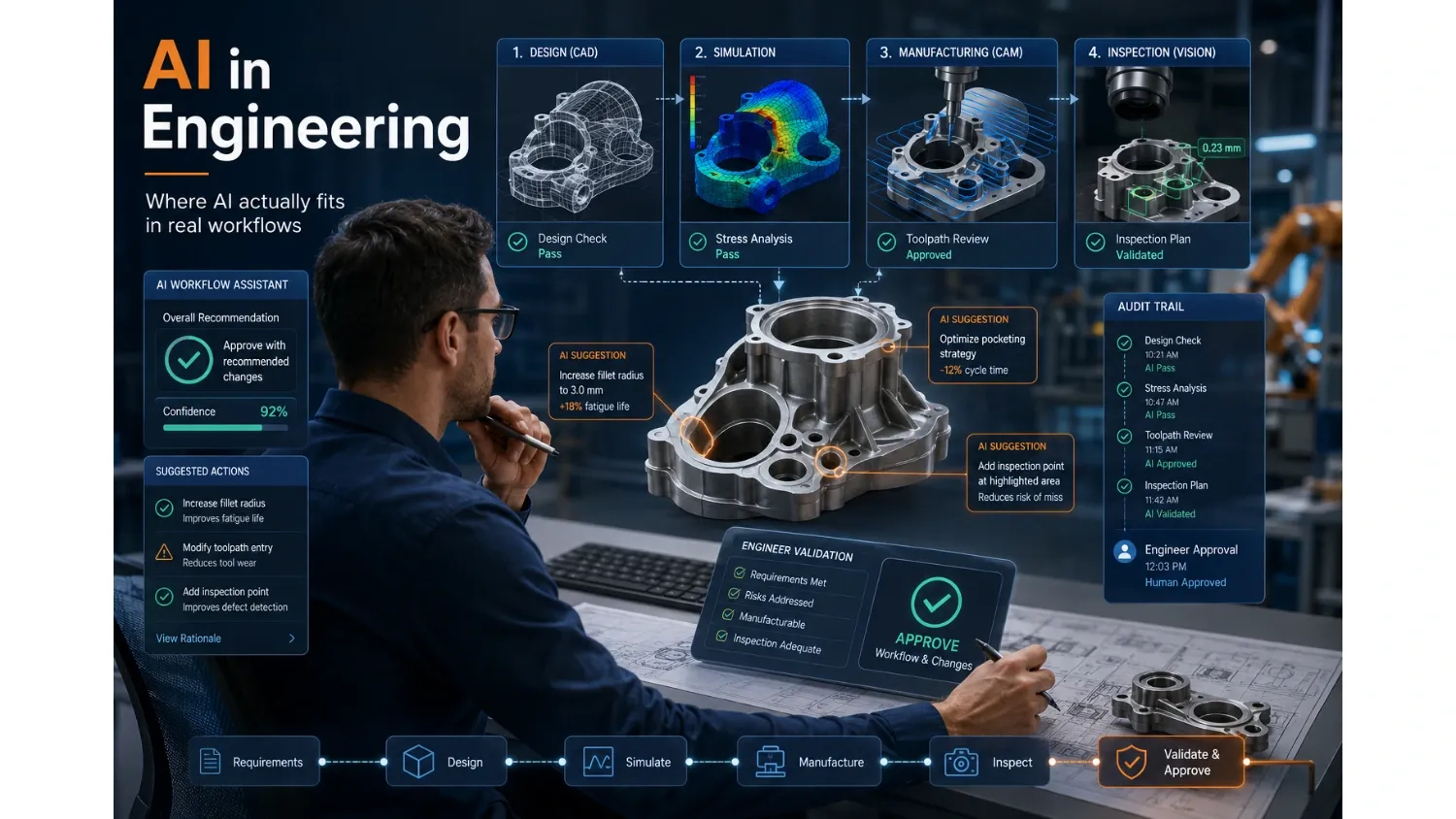
Yet, as the engineering sector accelerates into this new paradigm, a unifying ethos remains central: while AI acts as a powerful multiplier for speed and iteration, the ultimate burden of responsibility—setup, baseline assumptions, data hygiene, and validation—still belongs squarely to the human engineer.
1. Main Facts: The Industrial AI Landscape at a Glance
The convergence of high-performance computing (HPC) and artificial intelligence has triggered a structural shift across mechanical, aerospace, and automotive engineering workflows.
- Unprecedented Simulation Speeds: NVIDIA’s latest hardware architectures are upending traditional computer-aided engineering (CAE) timelines. Honda is leveraging NVIDIA’s Grace Blackwell architecture to run Ansys Fluent aerodynamic simulations up to 34 times faster than traditional CPU-based setups. Meanwhile, Solar Turbines has slashed the processing time for massive, billion-cell combustor simulations down to a mere 14 hours using Cadence Fidelity.
- Unified Design-to-Simulation Ecosystems: Synopsys’s launch of Ansys 2026 R1 bridges previously fragmented software silos, connecting mechanical design, materials data (such as Ansys Granta MI), embedded software, functional safety, and quantum-informed physics (QuantumATK).
- Bounded CAM Automation: Siemens NX CAM 2512 introduces "AI Make Machining Suggestion," an intelligent tool that pairs large language models (LLMs) with enterprise-specific historical machining data to automate toolpath generation while respecting shop-floor standards.
- Pragmatic Factory Vision: On the factory floor, AI vision systems are moving beyond isolated proofs-of-concept. However, hardware integrators emphasize that cameras are merely one component of a complex electro-mechanical inspection chain requiring rigorous optical setup, PLC timing, and sensor calibration.
- Regulatory Pragmatism: In a significant policy pivot, EU lawmakers have reached a provisional deal to delay high-risk AI system rules to December 2027 and exempt machinery from the stringent provisions of the EU AI Act, recognizing that industrial machinery is already heavily governed by established sector-specific safety frameworks.
2. Chronology: The Timeline of Industrial AI Integration
The rapid commercialization of engineering AI did not happen overnight; it represents the culmination of years of iterative hardware advancement and regulatory negotiations.
- Early Experimentation (2022–2024): Industrial software vendors began introducing rudimentary machine-learning algorithms primarily focused on anomaly detection, basic shape optimization, and localized cloud-based rendering. These tools were largely additive and unintegrated.
- The Hardware Leap (Late 2024–2025): The introduction of enterprise-grade GPU architectures optimized for multi-physics calculations changed the equation. Simulation solvers that once took days began running in hours, making real-time interactive simulation a viable prospect for enterprise engineering teams.
- March 2026: Synopsys officially launches Ansys 2026 R1, cementing the post-acquisition integration roadmap by delivering cross-domain workflows and workflow-specific AI agents like GeomAI and Mesh Agent. Concurrently, NVIDIA highlights breakthroughs in industrial digital twins at global developer conferences, showcasing deep collaborations with Honda, Siemens, and Cadence.
- May 2026: EU lawmakers strike a provisional compromise modifying the EU AI Act. Following intensive lobbying from industrial giants like Siemens and ASML, machinery is formally carved out to prevent regulatory redundancy, and the compliance timeline for high-risk implementations is pushed back to late 2027.
3. Supporting Data: Benchmarks, Performance, and Metrics
The business case for industrial AI rests on quantifiable reductions in cycle times, compute costs, and programming hours. The data emerging from enterprise deployments illustrates the dramatic efficiency gains currently redefining engineering departments.
| Industrial Application | Technology / Tool Used | Performance Benchmark / Metric | Impact on Workflow |
|---|---|---|---|
| Aerodynamic Simulation | NVIDIA Grace Blackwell / Ansys Fluent | Up to 34x faster execution compared to legacy CPU-based runs. | Enables exhaustive design space exploration within tight project deadlines. |
| Combustor Modeling | Cadence Fidelity / NVIDIA GPU acceleration | Billion-cell simulations completed in just 14 hours. | Eliminates historical computational bottlenecks in turbomachinery design. |
| CAM Programming | Siemens NX CAM 2512 (AI Make Machining Suggestion) | Generates three distinct machining proposals per selected face. | Reduces CNC programming hours and enforces internal shop standards. |
| AI Governance Timeline | EU AI Act Provisional Modification | High-risk implementation deadline shifted from August 2026 to December 2027. | Grants industrial firms a critical runway to align legacy systems with compliance frameworks. |
These metrics demonstrate that AI in engineering is fundamentally about compression—compressing days of simulation into hours, and hours of routine CAM programming into minutes.
4. Official Responses and Industry Perspectives
Industry leaders and software developers have offered varied perspectives on the rapid infusion of AI into engineering workflows, balancing technical enthusiasm with cautious operational governance.
The Software Vendors: Driving Connectivity and Friction Reduction
Software executives emphasize that the true value of AI lies in workflow orchestration rather than autonomous design generation.
"The integration of generative tools and high-performance computing is designed to strip away the friction of routine CAE tasks," notes product development leadership at Synopsys regarding the Ansys 2026 R1 release. "Tools like Mesh Agent and GeomAI are not here to replace engineering intuition; they are engineered to clear away manual bottlenecks so designers can test more hypotheses."
Siemens highlights a similar philosophy regarding its AI Make Machining Suggestion feature in NX CAM. By indexing internal corporate databases alongside LLMs, the system learns what good looks like for a specific shop, ensuring that automation mirrors proven tribal knowledge rather than generic, out-of-the-box assumptions.
The Hardware Enablers: Massive Acceleration as the New Baseline
NVIDIA’s enterprise strategy hinges on the premise that digital twins and AI agents require staggering computational firepower—power that modern GPU architectures are uniquely suited to provide. By demonstrating massive speedups with industrial powerhouses like Honda and Solar Turbines, hardware manufacturers are signaling that real-time multi-physics simulation is no longer a futuristic goal, but an immediate operational requirement.
Regulatory and Manufacturing Sectors: Relief from Red Tape
The decision by EU lawmakers to exclude machinery from the EU AI Act was met with considerable relief by industrial heavyweights. Industry associations had warned that dual-layer compliance frameworks would stifle innovation and impose crippling administrative overhead on European manufacturers.
By deferring high-risk rules to late 2027 and harmonizing AI regulations with existing machinery directives, the European Union has signaled a willingness to protect industrial competitiveness while maintaining rigorous safety standards through established frameworks like ISO/IEC 42001.
5. Implications: What This Means for the Modern Engineer
As AI cements its role across design, simulation, and manufacturing, the day-to-day reality for engineers is undergoing a profound transformation. The narrative that AI will completely automate engineering roles has given way to a more nuanced, realistic appreciation of human-machine collaboration.
The End of Routine Friction, the Rise of Deep Validation
The introduction of AI copilots, automated meshing agents, and generative geometry explorers means engineers will spend less time wrestling with software bugs, manual mesh cleanups, and repetitive toolpath generation. However, this efficiency gain brings a new responsibility: validation.
When an AI-assisted simulation runs 34 times faster, or an LLM instantly generates three cutting parameter options for a complex CNC milling operation, the engineer must possess the domain expertise to interrogate the results. Blindly trusting an AI-generated mesh or a machine-learning-optimized combustor geometry is a recipe for catastrophic structural or mechanical failure. The fundamentals of physics, material science, and manufacturing tolerances matter more than ever.
The Evolving Skill Set: From Specialist to Systems Orchestrator
Over the next few years, the most valuable engineering professionals will not be those who specialize in a single isolated software package. Instead, the strongest career signals point toward engineers who can act as system orchestrators—individuals capable of bridging design, simulation, manufacturing data, and safety compliance.
- CAE Engineers must evolve into validation experts, adept at spotting anomalies in AI-accelerated multi-physics solvers.
- Manufacturing Engineers must learn to curate and clean the internal machining datasets that feed AI-driven CAM assistants.
- Quality Engineers must bridge the gap between machine vision inspection data and upstream process control, using optical feedback loops to prevent defects before they materialize.
Navigating Governance and Compliance
While the EU’s decision to exempt machinery from the AI Act relieves immediate pressure, compliance and traceability remain paramount. Industrial organizations must ensure that their AI-assisted tools adhere to rigorous safety standards. Engineers will need a working understanding of AI governance frameworks to ensure that the systems they deploy are transparent, auditable, and reliable.
Summary Outlook
The integration of AI, GPU acceleration, and digital twins into mainstream engineering software marks the beginning of a new industrial era. Engineers do not need to transform into software developers or machine learning data scientists overnight.
However, they must become confident, critical users of AI-assisted tools. By embracing these technologies to accelerate iteration while fiercely protecting engineering judgment, data quality, and proven shop practice, modern engineers can harness the full potential of the AI era without compromising the physical integrity of the world they build.