The intersection of agriculture and renewable energy is rapidly evolving, driven by an urgent need for economic diversification among farmers and an unprecedented national thirst for electrical grid capacity. At the heart of this transition is agrivoltaics—the deliberate integration of agricultural production and photovoltaic solar energy generation on the same parcel of land. While proponents point to dual-use land models as a lifeline against soaring fuel and operational costs, the movement finds itself navigating a complex landscape of rapid industrial scaling, scientific innovation, and intense federal regulatory friction.
Main Facts: The Dual-Use Land Revolution
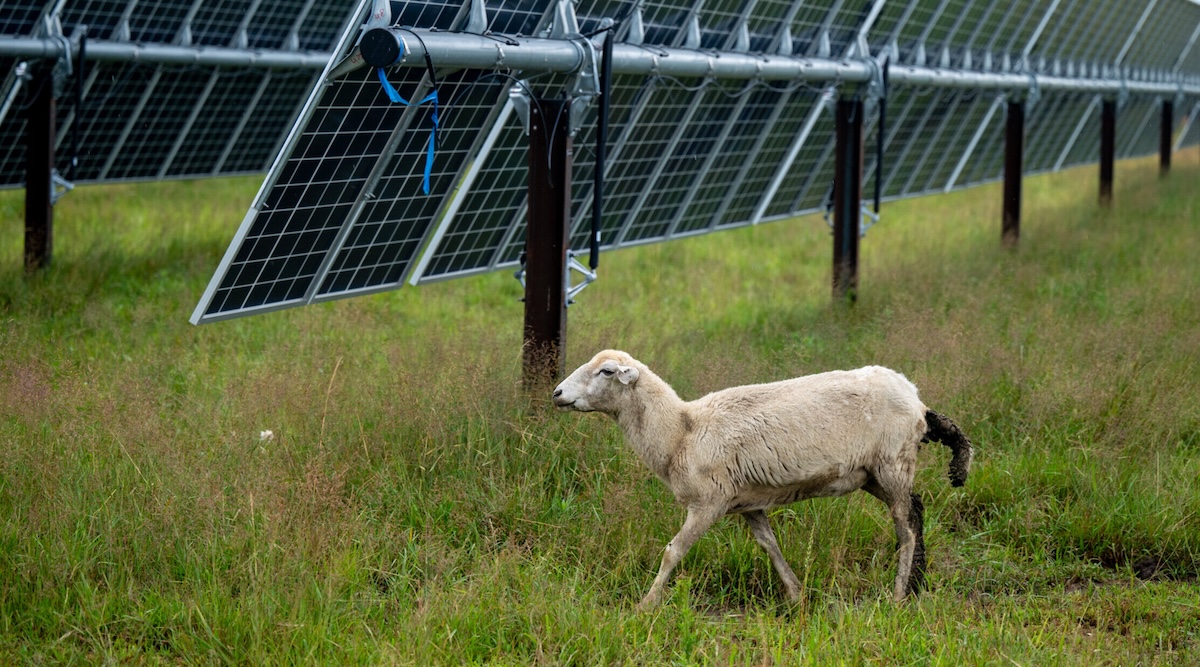
Agrivoltaics fundamentally redefines how rural real estate is utilized. Rather than forcing a binary choice between food production and energy generation, contemporary agrivoltaic systems design solar arrays with elevated clearances, optimized panel spacing, and specialized tracking systems. This configuration allows crops to grow beneath or between the panels, or permits livestock to graze directly beneath the infrastructure.
The benefits of this approach are multifaceted:
- Economic Stabilization: Landowners receive steady, diversified lease payments, shielding them from the notoriously volatile commodity markets and skyrocketing fuel and fertilizer expenditures.
- Vegetation and Land Management: Grazing animals—ranging from sheep and alpacas to miniature kunekune pigs—act as natural landscape managers. They control vegetation growth around sensitive electrical components, drastically reducing the need for heavy, diesel-powered mowing equipment.
- Grid Speed and Scale: Mega-projects are proving that utility-scale solar can be deployed with remarkable velocity, satisfying surging industrial and residential power demands without permanently converting arable soil into conventional, asphalt-heavy real estate developments.
Despite these demonstrable advantages, the sector faces severe headwinds. While academic institutions and regional partnerships push forward with federally backed research, shifts in federal administrative priorities and restrictive Department of Agriculture rules have created a tense regulatory battlefield for rural clean energy funding.
Chronology: From Experimental Plots to Mega-Scale Implementation
The trajectory of the American agrivoltaic movement has transitioned from localized academic curiosity to industrial-scale deployment over the past decade.
- 2017: CleanTechnica and agricultural researchers begin tracking early evidence that solar arrays could be thoughtfully engineered to accommodate agricultural activities, laying the groundwork for commercial viability.
- 2022: A major inflection point occurs as Doral Renewables breaks ground on the massive 1.3-gigawatt Mammoth solar power plant across Starke and Pulaski counties in northwest Indiana, leasing land from more than 65 local families.
- October 2024–Late 2025: The Mammoth project moves through phased construction. As the first blocks come online, thousands of head of livestock are introduced to manage vegetation. Concurrently, federal policy shifts create friction, with the USDA—under the direction of Secretary Brooke L. Rollins—implementing stricter guidelines that alter rural solar grant and loan accessibility.
- October 7, 2026: Doral Renewables formally celebrates the commercialization of the remaining 900 megawatts of the Mammoth project, completing the final phase in just 18 months and setting a new benchmark for speed-to-power delivery.
- Late 2026: Environmental organizations, including the Environmental Law & Policy Center and Earthjustice, file a formal lawsuit against the USDA and Secretary Rollins, challenging newly minted eligibility rules that retroactively strip funding from existing rural solar projects.
Supporting Data: Scale, Savings, and Scientific Inquiry
The quantitative metrics underlying modern agrivoltaic installations illustrate their profound footprint on both regional economies and environmental conservation.
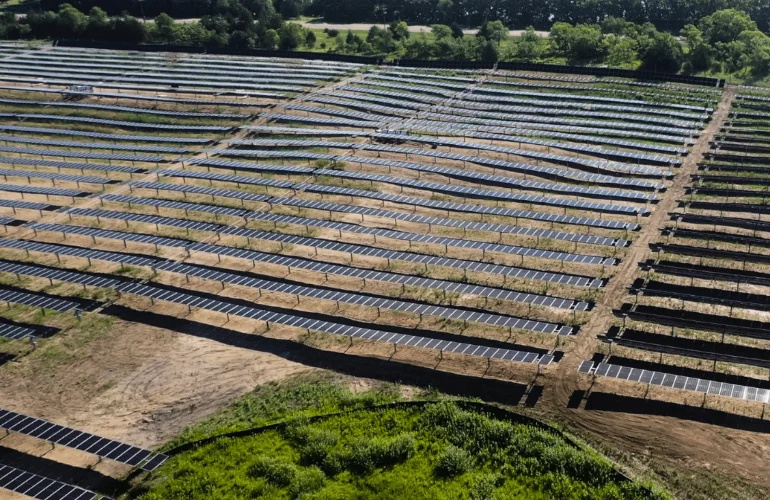
The Mammoth solar installation serves as a primary case study in industrial scale and local economic impact. Spanning 1.3 gigawatts, the project required an immense amount of foundational hardware. Notably, the Indiana steel industry supplied 20,000 tons of domestically produced steel for the racking systems and structural components, reinforcing the state’s manufacturing sector while driving clean energy deployment. By the time the initial 400 megawatts were operational, the site integrated over 2,000 grazing animals, cutting fossil fuel consumption associated with mechanical site maintenance.
Further north, Doral’s 1.3-gigawatt Vista Sands solar project in Wisconsin demonstrates the ecological synergies of combining solar infrastructure with native plant restoration and habitat conservation. Supported by conservation groups like the Audubon Society, engineering reports indicate that Vista Sands will facilitate the shutdown of more than 50 high-capacity wells. This reduction in groundwater pumping significantly conserves local water tables in stressed environmental areas while cutting down on agricultural chemical leaching from fertilizers and pesticides. An independent engineering report projected that the Vista Sands project would generate $630 million in public health and ecosystem benefits during its first year of operation alone.
To optimize these systems further, academic institutions have stepped in. Purdue University is spearheading the newly formed Midwest Agrivoltaics for Resilient Communities (MARC) initiative, backed by funding from the National Science Foundation. The Mammoth facility has dedicated a specialized demonstration zone within its footprint for MARC researchers to conduct rigorous trials involving advanced monitoring systems, crop yields, and robotics testing.
Official Responses: A Clash of Visions in Washington and State Capitals
The expansion of agrivoltaics has highlighted a stark ideological and policy disconnect between state-level economic developers and federal agricultural leadership.
At the state level, enthusiasm for rural renewable infrastructure is high. Indiana Secretary of Energy Suzanne Jaworowski championed the rapid deployment of the Mammoth project, emphasizing its dual utility as both an energy generator and a land preserver.
"In the world of economic development right now, every project is looking for speed to electrons. With demand for electricity skyrocketing, we need every electron we can get on the grid," Jaworowski stated during the October 7 commercialization ceremony. She added, "We want to create an energy infrastructure that will draw economic development and do it in a way that preserves our way of life and our agricultural environment."
This sentiment contrasts sharply with the stance emanating from the federal level. US Secretary of Agriculture Brooke L. Rollins has frequently advanced the perspective that utility-scale solar installations pose a fundamental threat to the integrity of American farmland. Rather than embracing agrivoltaics as a tool to insulate farmers from high fuel expenses—such as the administration’s contentious efforts to source diesel imports—federal agricultural policy has moved to restrict financial pathways for rural clean energy.
The friction culminated in legal action when the Environmental Law & Policy Center and Earthjustice launched a joint lawsuit against the USDA. The plaintiffs argue that the agency instituted unlawful anti-eligibility criteria under the longstanding Rural Energy for America Program (REAP).

"USDA has imposed unlawful anti-solar eligibility criteria on REAP while abruptly changing the rules of the program such that farmers and rural small businesses across the country have been individually stuck with tens of thousands of dollars of unexpected expenses," the coalition stated in their legal filing, pointing to retroactive denials that threaten existing projects and chill future green investments in the heartland.
Implications: The Future of the Rural Heartland
The implications of the agrivoltaic debate extend far beyond property lines in Indiana and Wisconsin. For rural communities facing severe weather volatility, commodity price swings, and escalating operational expenses, the integration of food and energy production offers a vital pathway toward long-term economic resilience.
As Dr. Dan Chavas of Purdue University, principal investigator for the MARC project, notes, rural communities are disproportionately vulnerable to environmental shocks:
"When hail ruins a harvest, heat strains livestock, or windstorms cut electricity, farmers and their communities are hit hard. Our goal is to understand how agrivoltaics can make our nation’s rural communities more resilient and prosperous."
By harvesting sunlight and crops from the same acreage, farmers can stabilize their income, protect their soil from severe real estate development pressures, and contribute directly to localized energy security. However, realizing this potential on a national scale will depend heavily on whether federal policy adapts to empirical realities. As the legal battles surrounding federal grant programs unfold in the courts, the agrivoltaic movement continues to demonstrate on the ground that agriculture and solar power are not mutually exclusive competitors, but rather powerful partners in shaping a sustainable rural future.