By Caroline Hayes
Published by Electronics Weekly
Executive Summary: A New Paradigm in Automated PCB Testing
In an era where printed circuit board (PCB) assemblies are becoming increasingly dense, complex, and compact, the traditional methods of testing them have remained stubbornly bulky. Bulky instrument racks, sprawling cabling harnesses, and expensive, time-consuming testbench reconfigurations have long been accepted as the inevitable cost of manufacturing assurance.
However, a strategic partnership between Swedish PCB test innovator Wireflow and the UK-based switching and simulation specialist Pickering Interfaces is set to disrupt the status quo. The two industry heavyweights have formally joined forces to launch Testblox AB, a new venture engineered to deliver a revolutionary approach to automated test equipment (ATE).
Testblox introduces a modular ecosystem of playing-card-sized instruments designed to eliminate the need for traditional test system reconfigurations. By bringing the measurement instruments directly to the edge of the Device Under Test (DUT), Testblox is slashing footprint requirements, radically improving signal integrity, and offering a standardized, highly reproducible testing architecture designed and manufactured entirely within Europe.
Main Facts: What is Testblox AB?
At its core, Testblox AB is designed to solve the physical and operational bottlenecks associated with legacy ATE architectures. Traditional automated test systems rely on stacked benchtop instruments connected to a test fixture via long, cumbersome bundles of cables. This setup introduces parasitic capacitance, ground loops, high resistance, and noise susceptibility—all of which degrade signal integrity and compromise test repeatability.
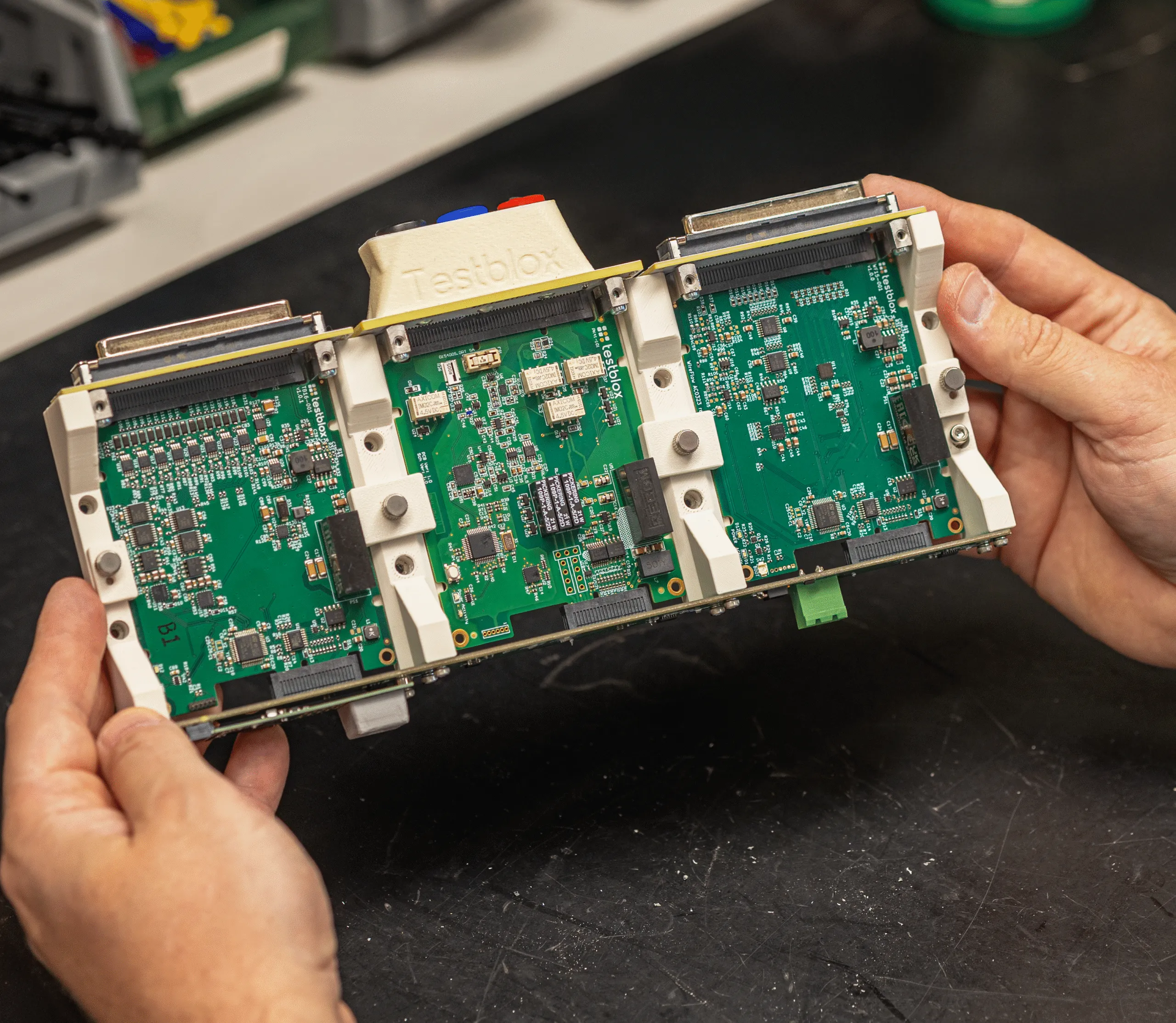
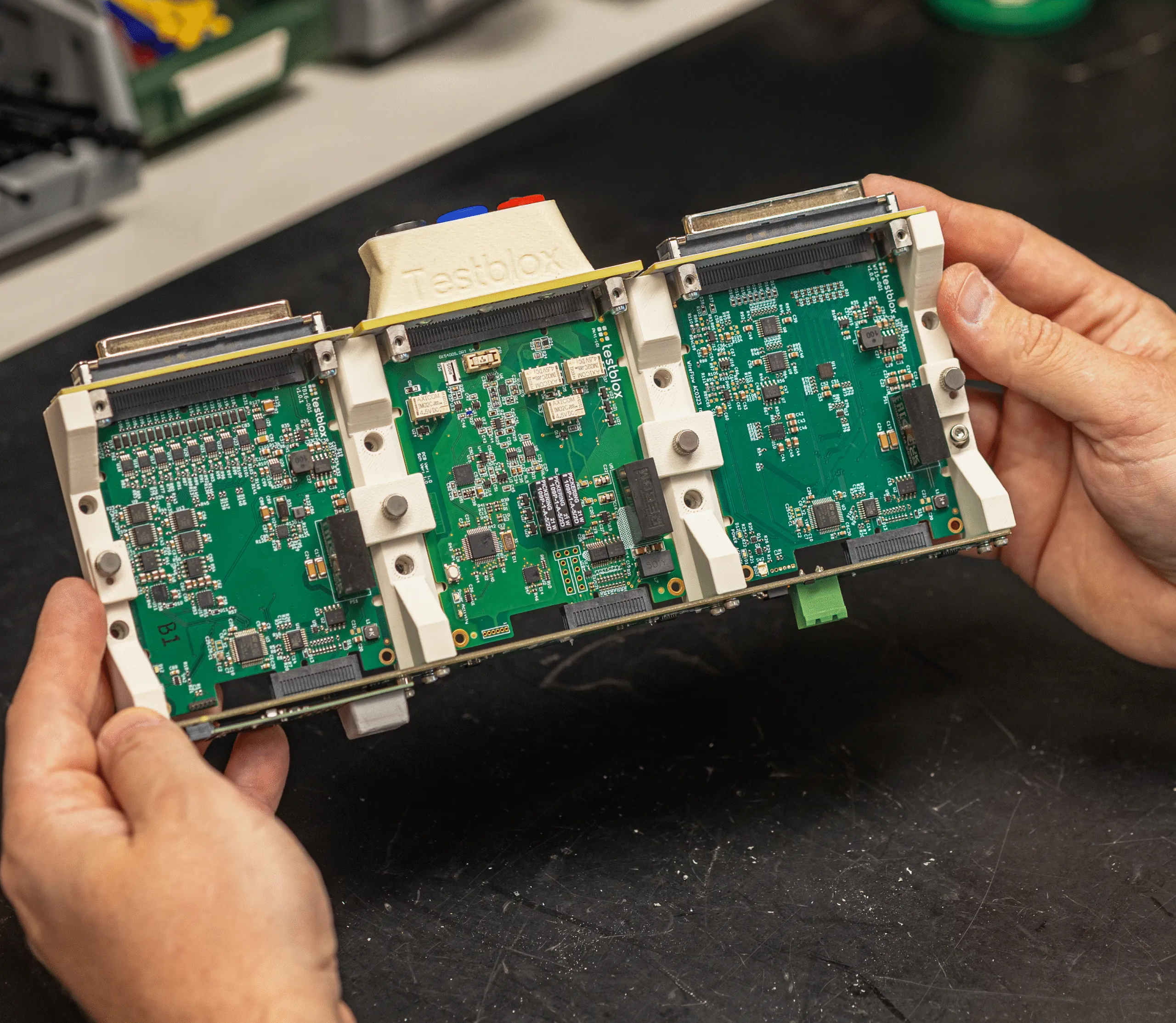
Testblox changes the game by offering over 30 Commercial-Off-The-Shelf (COTS) modules roughly the size of a playing card. These compact units share common electrical and mechanical interfaces, allowing them to be integrated directly into edge connectors or positioned immediately adjacent to test fixtures.
Key attributes of the Testblox ecosystem include:
- Comprehensive Functionality: The initial lineup covers a vast array of testing domains, including precision measurement, signal switching, power delivery, communications protocols, and general-purpose I/O (GPIO).
- Complete Electrical Isolation: Each module is fully isolated to maintain a pristine, consistent ground plane. This isolation minimizes ground-loop risks and drastically cuts down on internal cabling.
- Direct Interfacing: Modules can be wired directly to exposed pins within a test fixture using standard D-Sub connectors, or they can slot directly into a custom interface board for a completely wire-free connection to the DUT.
- Software Control Environment: Systems are configured and monitored over a USB interface using Brygga (derived from the Swedish word for "dock" or "pier"), the proprietary Testblox test management environment.
- Broad Automation Support: To fit seamlessly into existing automated workflows, Testblox provides robust Application Programming Interfaces (APIs) for widely used engineering languages, including Python, C#, and National Instruments (NI) LabVIEW.
- Collaborative DNA: The hardware lineup represents a synergistic blending of both parent companies’ engineering strengths. Pickering Interfaces has contributed advanced switching, digital multimeters (DMMs), simulation software tools, and select I/O, while Wireflow has supplied high-performance multi-function I/O and versatile power supply modules.
- European Manufacturing and Support: All Testblox modules are designed and manufactured within Europe, ensuring supply chain security and compliance with stringent regional standards. Furthermore, the products launch with a reassuring three-year warranty.
Chronology: The Road to Testblox AB
While Testblox AB is officially stepping into the spotlight as a newly minted entity, its foundation rests on decades of combined industry experience from its parent companies, culminating in a focused development cycle aimed at modernizing PCB validation.
- Decades of Foundation: Wireflow built its reputation in the Nordic region and beyond as a trusted provider of custom PCB test systems, test fixtures, and functional test software. Concurrently, the UK’s Pickering Interfaces established itself as a global leader in modular signal switching and simulation solutions for electronic test and verification.
- Identifying the Pain Points: Engineers at both companies recognized a growing frustration among electronics manufacturers. As PCBs shrank to accommodate IoT, automotive, and industrial applications, test fixtures were growing larger and more complex, leading to maintenance headaches and high replication costs.
- Architectural Conception: The vision for Testblox crystallized around the concept of extreme modularity—deconstructing traditional benchtop instrumentation into miniature, highly integrated blocks that could live inside or immediately next to the test fixture rather than across a laboratory or factory floor.
- Resource Pooling and Product Development: Wireflow and Pickering pooled their intellectual property and hardware portfolios. Pickering contributed its high-density switching matrices and DMM technologies, while Wireflow integrated its robust multi-function I/O and power management modules.
- The Launch of Testblox AB: The formal establishment of Testblox AB brings these innovations to the global commercial market. With an initial launch portfolio exceeding 30 COTS modules, the company opens its doors with a fully realized, scalable ecosystem ready for deployment in high-reliability manufacturing environments.
Supporting Data & Technical Deep-Dive
To understand the engineering significance of Testblox, one must examine the physical and electrical challenges of legacy ATE setups.
Footprint and Physical Real Estate
In high-volume manufacturing lines, floor space is at a premium. Traditional ATE systems often require full 19-inch equipment racks housing individual power supplies, DMMs, switches, and load banks. Testblox eliminates the rack entirely. By shrinking instruments down to the size of a playing card, the entire testing apparatus can be integrated into the footprint of the test fixture itself.
Signal Integrity and Electrical Performance
Signal degradation is the silent killer of accurate PCB testing. When test signals must travel through meters of cabling from a rack-mounted instrument to a bed-of-nails fixture, they are exposed to:
- Parasitic Capacitance and Inductance: Caused by long conductor paths.
- Electromagnetic Interference (EMI): Stray environmental noise picked up by unshielded or poorly shielded wire bundles.
- Ground Loops: Caused by potential differences between multiple instruments tied to different ground references.
Testblox’s modular approach dramatically shortens signal paths. Because the measurement and switching blocks reside inches—or millimeters—away from the DUT, exposure to resistance, noise, and connection shortfalls is minimized. Furthermore, the complete galvanic isolation of individual modules guarantees a stable, consistent ground plane, neutralizing ground-loop phenomena at the hardware level.
Maintainability and Scalability
In a traditional ATE setup, diagnosing a fault often requires tracing complex wiring harnesses, testing individual cables, and pulling heavy instruments out of racks for calibration or repair. Testblox’s modularity simplifies maintenance drastically. If a specific measurement or switching block fails, the faulty module can be swapped out modularly in minutes without disturbing the rest of the system.
Moreover, replicating a test system no longer requires hours of manual wire-wrapping or custom harness assembly. Testblox systems are inherently repeatable, allowing manufacturers to scale their testing capacity across multiple global production lines with absolute consistency.
Official Responses and Industry Perspectives
The collaborative nature of Testblox AB highlights a broader trend in the electronics industry: hardware manufacturers are realizing that closed, proprietary architectures must give way to open, modular, and scalable ecosystems.
While company spokespeople from Testblox emphasize the agility of their platform, the strategic intent behind the venture points to an open-ended future. Discussing the long-term roadmap for the company, corporate representatives noted:
"The architecture and commercial model are designed to support broader qualified participation over time."
This statement hints that Testblox may eventually open its ecosystem to third-party module developers, potentially creating a standardized "plug-and-play" marketplace for automated test instruments akin to what PXI and LXI achieved for modular instrumentation, but brought down to the fixture-edge level.
Industry analysts have also drawn parallels between Testblox’s launch and Pickering Interfaces’ recent push into high-density, scalable solutions—such as their high-density 2A LXI matrices tailored for dynamic testing requirements. By combining Pickering’s switching pedigree with Wireflow’s test-fixture expertise, Testblox is bridging the gap between high-level system switching and local, pin-level measurement.
Implications for the Electronics Manufacturing Industry
The introduction of Testblox AB carries profound implications across multiple verticals within electronics manufacturing, particularly in automotive, aerospace, medical devices, and consumer electronics.
1. Lower Capital and Operational Expenditure (CapEx & OpEx)
By eliminating the need for expensive, dedicated rack instrumentation for every unique test requirement, Testblox lowers the barrier to entry for advanced automated testing. Manufacturers can deploy sophisticated functional testing on smaller budgets, while saving heavily on ongoing maintenance, calibration downtime, and floor space rental.
2. Accelerated Time-to-Market
Configuring a new test system has historically been a major critical path item in product development cycles. By utilizing standardized COTS modules controlled via intuitive APIs (Python, C#, LabVIEW) and managed through the Brygga environment, test engineers can spin up complex verification routines in a fraction of the usual time.
3. Supply Chain Resilience
In an era marked by geopolitical instability and fragile global logistics, the decision to design and manufacture Testblox modules entirely within Europe is a strategic asset. European electronics manufacturers gain a secure, reliable supply chain for critical test infrastructure, backed by a robust three-year warranty that underscores manufacturing confidence.
4. Future-Proofing Production Lines
As PCBs continue to shrink and adopt higher pin counts, legacy test fixtures simply run out of physical space to route additional cabling. Testblox’s wire-free, direct-interface capability ensures that test engineers can accommodate higher-density boards without needing to completely redesign their testing infrastructure.
Conclusion
Testblox AB represents a maturation in how the electronics industry approaches functional verification and PCB testing. By stripping away the unnecessary bulk of traditional rack-and-cable test systems and replacing them with isolated, high-density, modular COTS blocks, Wireflow and Pickering Interfaces have solved some of the most persistent engineering headaches in manufacturing test.
With robust software integration via Python, C#, and LabVIEW, a flexible test management environment in Brygga, and a secure European manufacturing backbone, Testblox is well-positioned to become a foundational standard for modern automated test engineering. As the ecosystem expands to welcome broader industry participation, the days of sprawling, tangled test racks may officially be numbered.