As artificial intelligence shifts from experimental pilot programs to the backbone of operational decision-making in the pharmaceutical industry, a critical "explainability gap" has emerged. While AI models are increasingly capable of optimizing manufacturing processes, analyzing complex batch records, and accelerating regulatory submissions, their "black box" nature creates significant friction with the stringent requirements of global health authorities, most notably the FDA.
At the Industrial AI Summit 2026, industry experts convened to address the pressing question: “You closed the sensor-to-decision gap. Now, how do you explain it to the regulators?” The session featured Adam Procopio, Scientific Associate Vice President at Merck, and Kristen Sauter, President and General Manager of Life Sciences at Adlib Software. Their insights offer a roadmap for life sciences organizations struggling to reconcile the velocity of AI with the slow, deliberate pace of regulatory compliance.
The Strategic Dilemma: Build In-House or Procure Vendor Solutions?
One of the most recurring questions facing digital transformation leaders is whether to develop proprietary AI explainability frameworks or rely on third-party vendor platforms. The stakes are high; a miscalculation here could result in years of technical debt or, worse, a platform that fails to satisfy auditors.
The Hybrid Architecture Approach
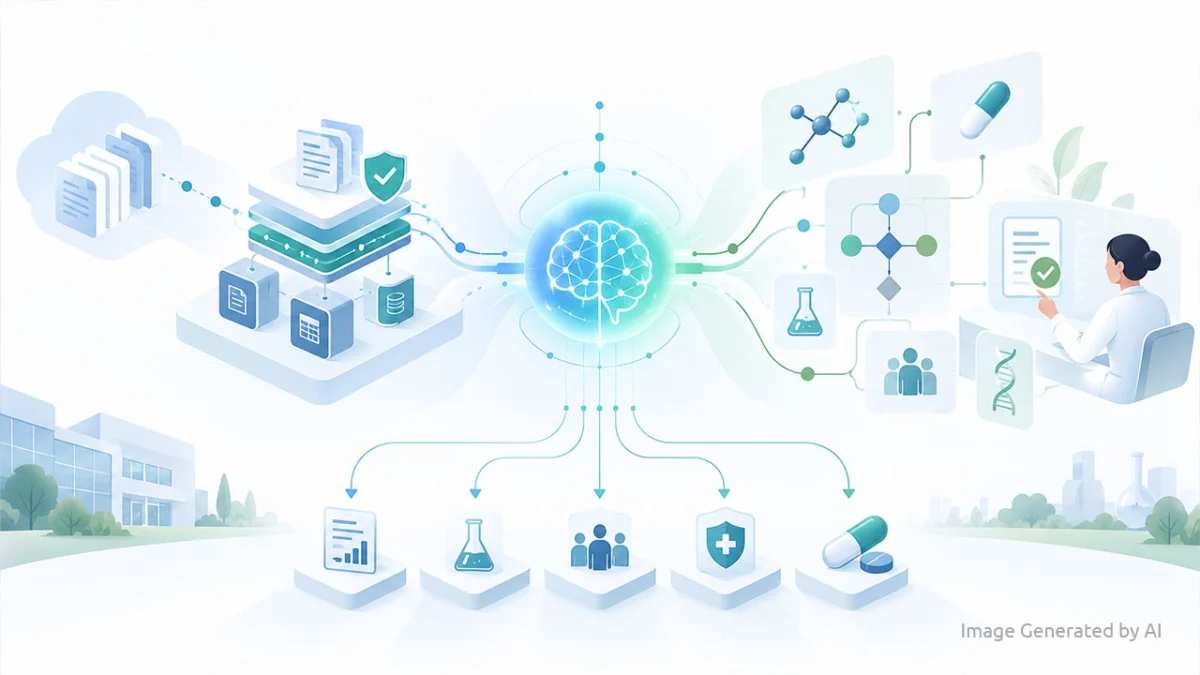
Adam Procopio of Merck argues against a binary choice. He advocates for a "hybrid architecture" that leverages the best of both worlds. “We generally prefer leveraging vendor platforms for core AI infrastructure,” Procopio notes. However, he draws a sharp line at scientific defensibility. “Explainability, evidence traceability, and scientific defensibility are areas where significant customization is required. The most effective approach is a hybrid architecture where commercial capabilities provide a foundation, while internal teams build the domain-specific reasoning and governance layers.”
The Vendor Perspective: Focus on Industry Patterns
Kristen Sauter of Adlib Software expands on this by identifying the specific components that companies should outsource. She suggests that the “document accuracy layer”—the infrastructure that normalizes, structures, and validates documents—is an industry-wide challenge, not a competitive differentiator.
“The rules for what makes a batch record processable, what a supplier Certificate of Analysis (CoA) must contain, or how a deviation log should be structured for retrieval—these are not proprietary to any one company,” Sauter explains. “They are industry patterns. A vendor who has processed these documents across dozens of pharma organizations brings pattern recognition that an internal team building from scratch will spend eighteen months rediscovering.”
Sauter concludes that internal teams should reserve their bandwidth for the “scientific judgment layer.” No vendor can replicate the deep institutional knowledge that informs a high-stakes regulatory decision. By outsourcing the data normalization and retaining control over the reasoning logic, firms can achieve both efficiency and regulatory rigor.
The Auditability Challenge: Authenticity in the Age of AI
If AI outputs are only as good as the data they ingest, the provenance of that data becomes a critical audit point. Auditors are no longer satisfied with simple citations; they are increasingly demanding proof that source documents have not been tampered with or misinterpreted during the AI’s ingestion process.
Beyond Citation: The Search for Decision Lineage
Procopio highlights a significant gap in current industry capabilities: "decision lineage." While companies have made strides in linking AI outputs back to source citations, knowing which document informed an answer is only the first step. The true challenge is mapping how that information cascades through the organization.
“It’s not enough to know which document informed an AI answer,” Procopio notes. “We increasingly need to understand which downstream analyses, recommendations, submissions, or decisions were influenced by that document. Comprehensive impact tracing—knowing exactly what to re-evaluate when a source document is updated—remains a major gap and an active area of development.”
Rendering Fidelity: Protecting the "Input Truth"
Sauter adds a technical layer to this discussion, emphasizing "rendering fidelity." She explains that in many systems, the process of ingesting a document for AI consumption can inadvertently create a degraded or partial representation of the original.
“When we process a document, we lock a version-specific rendering at the point of intake,” Sauter explains. “If someone asks three months later, ‘what did the model see when it made this recommendation?,’ the answer is not a reconstructed approximation. It is the actual input.” This, she argues, is the technical bedrock upon which an authenticity claim must be built. The document management system maintains the official record, while the processing layer provides the immutable evidence that the AI model operated on that specific version.
Scaling Human Oversight: From Proofreaders to Decision-Makers
A primary fear among quality assurance and regulatory affairs teams is the sheer volume of output generated by AI. As AI automates report writing, trend analysis, and data synthesis, the traditional model of human review—where an expert manually checks every word—becomes a bottleneck that renders the AI’s efficiency moot.
Shifting to Risk-Based Oversight
Procopio rejects the notion that the future of pharma involves humans "proofreading" AI output. Instead, he proposes a paradigm shift toward risk-based oversight. “AI can create information much faster than people can read it,” he observes. “The scalable approach is to let AI handle routine tasks while humans focus on higher-risk decisions, exceptions, and areas requiring deep scientific judgment.”
The goal, according to Procopio, is not to create "AI-supported editors," but to foster "AI-supported decision-makers." Scientists should not be spending their time checking for typos in AI-generated text; they should be evaluating the logic, the confidence levels, and the evidentiary assumptions behind the AI’s recommendations. By focusing human expertise on the reasoning rather than the output, firms can scale their AI capabilities without sacrificing safety or quality.
Implications for the Future of Life Sciences
The dialogue between Procopio and Sauter underscores a maturing industry. The "honeymoon phase" of AI—where organizations were simply excited by the novelty of automation—has given way to a more pragmatic, compliance-driven era.
Key Takeaways for Industry Leaders:
- Stop Rebuilding Commodity Infrastructure: Focus internal resources on the "scientific judgment" layer. If a vendor has already perfected the ingestion of complex pharmaceutical documents, lean on that expertise to save time and reduce technical risk.
- Invest in Decision Lineage: As the industry moves toward automated regulatory submissions, the ability to perform an "impact assessment" automatically when source data changes will become a non-negotiable requirement.
- Adopt Risk-Based Review: Transition the quality culture from "reviewing content" to "reviewing reasoning." Define the thresholds where human intervention is mandatory, and automate the oversight of lower-risk, repetitive tasks.
- Prioritize Rendering Fidelity: Ensure that the data the AI sees is a permanent, audit-ready record. Reconstructed approximations of documents are a liability in the eyes of regulators.
Conclusion: The Path Forward
The "sensor-to-decision gap" is effectively being closed, but the "explanation gap" remains. As the industry continues to integrate AI, the companies that succeed will be those that treat explainability not as an afterthought or a "nice-to-have" feature, but as a foundational architectural principle. By marrying the scale and pattern recognition of commercial AI platforms with the internal scientific rigor and institutional knowledge of their own teams, pharmaceutical companies can ensure that they are not just moving faster, but moving with the defensibility that patient safety and global regulations demand.
This article is based on insights from the "You Closed the Sensor-to-Decision Gap. FDA Will Ask You to Explain It" session at the Industrial AI Summit 2026. The session featured Adam Procopio (Merck), Kristen Sauter (Adlib Software), and Maya Schushan-Orgad (Teva Pharmaceuticals), and was moderated by Rick Franzosa (Tech-Clarity).