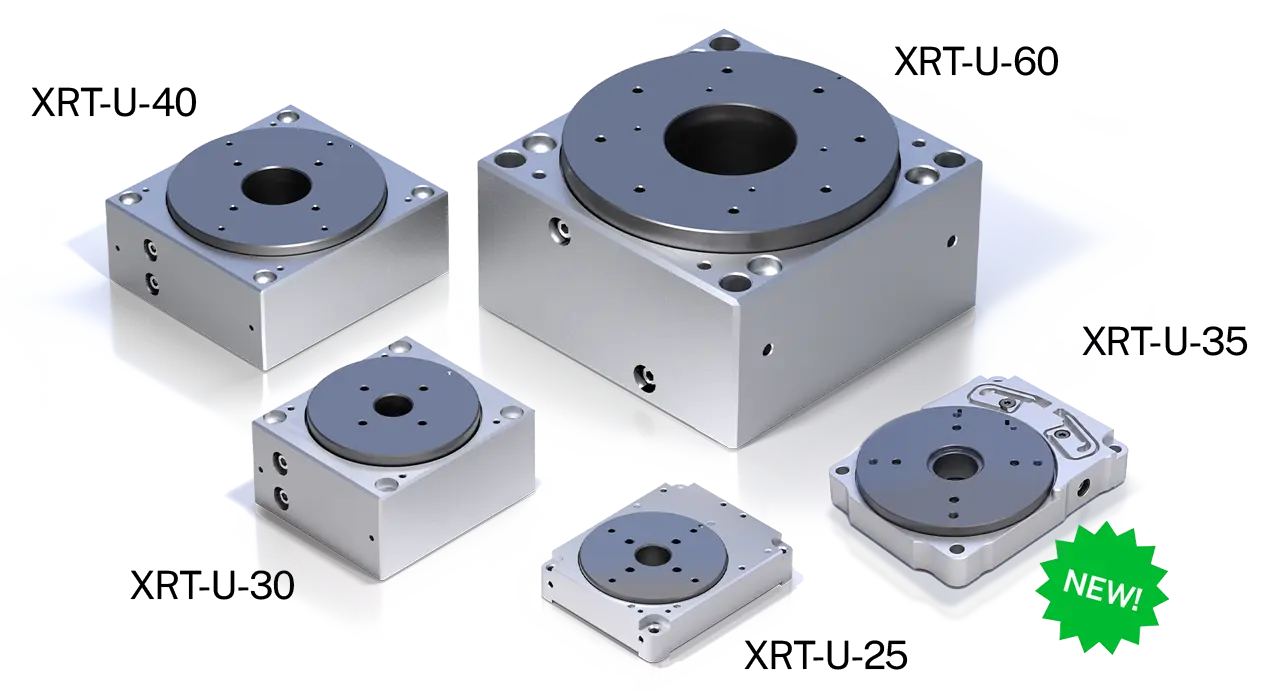
LEUVEN, BELGIUM — In an era where technological innovation is increasingly defined by miniaturization, high reliability, and uncompromised performance, precision engineering firm Xeryon has raised the bar once again. The Belgian manufacturer of advanced precision piezo motor technology has officially introduced its latest flagship product: the XRT-U-35 ultra-compact rotation stage.
Designed specifically for high-precision positioning systems across a wide array of advanced industries, the XRT-U-35 bridges a long-standing engineering gap. It successfully combines a remarkably low-profile housing with an impressive 40 mNm of continuous torque. Leveraging Xeryon’s proprietary and patented Crossfixx™ ultrasonic piezo technology, this new rotation stage aims to redefine what engineers can achieve within severely constrained installation spaces.
As research laboratories, photonics facilities, medical device manufacturers, and aerospace systems push toward smaller, more integrated designs, the introduction of the XRT-U-35 arrives at a critical juncture in the motion control sector.
Main Facts: Engineering Excellence in a Miniature Form Factor
At its core, the Xeryon XRT-U-35 is a masterclass in spatial optimization and electromechanical efficiency.
Key Technical Specifications at a Glance:
- Product Name: XRT-U-35 Ultra-Compact Rotation Stage
- Manufacturer: Xeryon (Leuven, Belgium)
- Core Technology: Patented Crossfixx™ Ultrasonic Piezo Technology
- Housing Dimensions: 36 mm in width × 9 mm in height (Ultra-low profile)
- Torque Output: 40 mNm (driven by a unique dual-motor configuration)
- Rotation Speed Range: Continuously adjustable from 0.01°/s to 1,080°/s
- Transmission Mechanism: Direct-drive (zero gearboxes, zero mechanical transmission elements)
- Central Aperture: 8 mm H7 through-hole
- Operational Lifespan: Rated for well over 10 million continuous revolutions
- Key Operational Benefits: Non-magnetic, whisper-quiet operation, ultra-low vibration, and self-locking position hold when powered down.
Unlike traditional electromagnetic motors that rely on heavy copper windings, iron cores, and complex multi-stage gearboxes, the XRT-U-35 utilizes high-frequency ultrasonic vibrations to drive the stage smoothly and accurately. This fundamental design shift results in a device that is immune to electromagnetic interference (EMI), exceptionally durable, and capable of sub-micron precision without the backlash typically associated with geared systems.
Chronology: The Evolution of Xeryon’s Piezo Journey to the XRT-U-35
To fully understand the significance of the XRT-U-35 release, it is helpful to trace the developmental timeline of Xeryon and the steady evolution of ultrasonic piezo motor design within the motion control landscape.
Early Foundations: The Limits of Traditional Motion
For decades, micro-positioning and rotation relied heavily on DC stepper motors and brushless DC motors paired with reduction gears. While these traditional systems served the industry well, they suffered from inherent physical limitations. Gearboxes introduced backlash, wear-and-tear, and mechanical play. Furthermore, traditional motors generated stray electromagnetic fields that interfered with sensitive scientific instruments, electron microscopes, and medical imaging devices. Space constraints also routinely forced engineers to make painful compromises regarding payload capacity and torque.
The Rise of Piezoelectric Alternatives
In response, engineering firms began exploring piezoelectric materials—substances that change shape when an electrical voltage is applied. Early piezo motors offered incredible resolution and quick response times, but they often struggled with continuous high-speed rotation, torque output, and long-term mechanical reliability under heavy operational loads.
The Breakthrough of Crossfixx™ Technology
Xeryon entered the market with a mission to solve these exact reliability and performance hurdles. Through years of rigorous research and development, the Belgian company engineered and patented Crossfixx™ technology. This proprietary ultrasonic piezo mechanism solved the friction and wear issues plaguing earlier generations of piezo devices. By optimizing the contact mechanics between the piezo actuator and the moving stage, Xeryon achieved high linear and rotational speeds while preserving nanometer-scale precision.
The Birth of the XRT-U-35
Building upon the commercial success of its earlier linear stages and larger rotary components, Xeryon’s engineering teams focused their attention on a persistent market demand: the need for a high-torque, ultra-thin rotation stage that could fit into the tightest optical and mechanical assemblies.
The result of this intensive R&D cycle is the XRT-U-35. Measuring a mere 9 mm in height and 36 mm in width, the stage represents the culmination of years of refinement in dual-motor balancing, micro-machining, and closed-loop ultrasonic control systems.
Supporting Data: Deep-Dive Into the Mechanics and Performance
A closer look at the data sheet of the XRT-U-35 reveals several engineering choices that set it apart from competing motion systems on the market.
Dual-Motor Configuration and Torque Delivery
Generating 40 mNm of torque from a housing that stands only 9 millimeters tall is no small feat. Traditional single-piezo setups would struggle to deliver this level of rotational force in such a compact envelope. Xeryon solved this by implementing a dual-motor configuration. By synchronizing two precision piezo actuators within the same housing, the XRT-U-35 distributes the driving force evenly, effectively doubling the torque output without significantly increasing the footprint or thermal signature of the unit.
Direct-Drive Architecture: Eliminating the Gearbox
In high-precision engineering, every mechanical interface is a potential source of error. Gearboxes introduce backlash, hysteresis, and frictional wear, all of which degrade positioning accuracy over time.
The XRT-U-35 utilizes a direct-drive architecture. The ultrasonic piezo elements couple directly with the rotor. This enables a remarkably wide and fluid speed range—from an infinitesimal creep speed of 0.01°/s all the way up to a rapid 1,080°/s—without the aid of gear reductions or belt drives. The absence of transmission components not only simplifies the mechanical bill of materials but also eliminates maintenance intervals associated with lubrication and gear replacement.
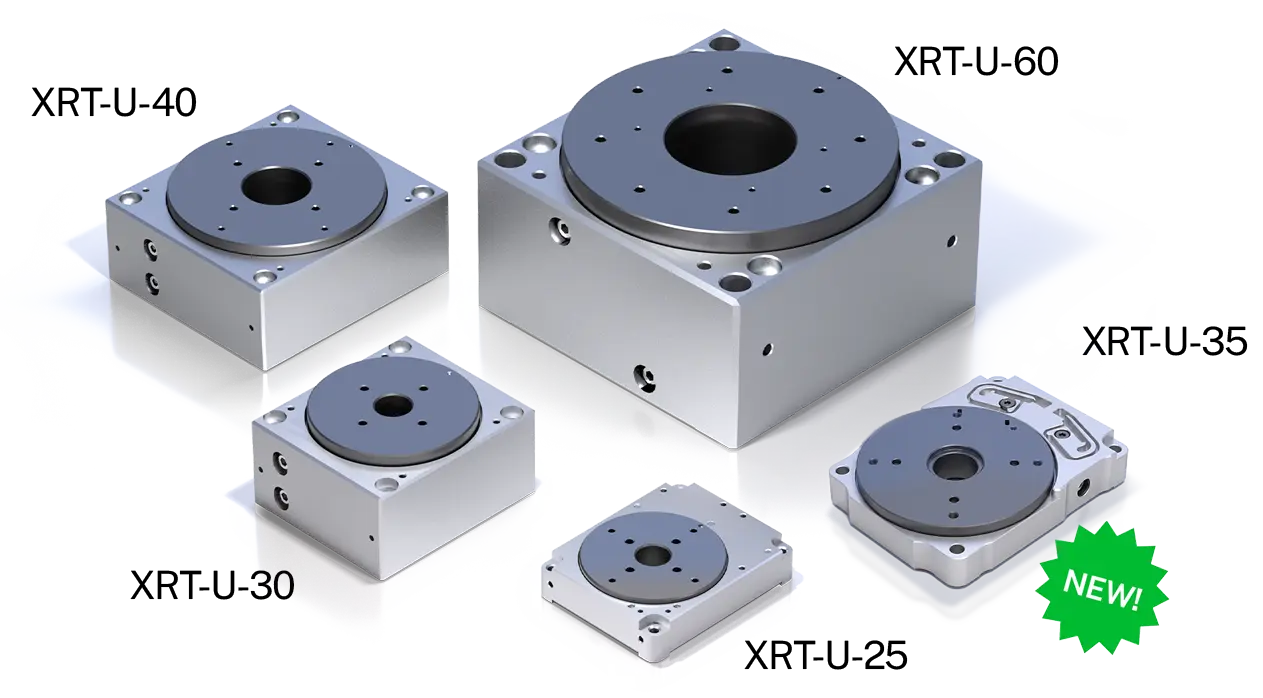
The 8 mm H7 Central Aperture
One of the most innovative integration features of the XRT-U-35 is its 8 mm H7 central through-hole. In many compact optical setups, routing cables, optical fibers, or laser paths around a bulky rotation stage introduces mechanical complexity and limits the range of motion.
By designing the XRT-U-35 with a hollow central axis, Xeryon allows engineers to pass cabling, tubing, or light beams straight through the exact center of rotation. This concentric routing prevents cable twisting, reduces the overall footprint of the assembly, and streamlines the integration process for complex multi-axis systems.
Durability, Non-Magnetic Properties, and Power-Off Self-Locking
- Lifespan: Because ultrasonic piezo motors move via microscopic frictional steps rather than rolling or sliding elements prone to catastrophic fatigue, the XRT-U-35 boasts a rated operational lifespan exceeding 10 million revolutions.
- Non-Magnetic Operation: Containing zero ferrous windings or heavy magnets, the stage is entirely non-magnetic. This makes it ideal for use in ultra-high vacuum (UHV) chambers, electron microscopes, and environments where magnetic interference cannot be tolerated.
- Self-Locking Feature: When power is removed from the stage, the frictional contact of the piezo elements holds the rotor firmly in place. This power-off self-locking capability ensures that delicate optical alignments or mechanical positions are not lost during unexpected power interruptions, enhancing overall system safety and reliability.
Official Responses and Industry Perspectives
Although specific executive soundbites accompanying the launch focus heavily on application versatility, industry analysts and motion control specialists have been quick to weigh in on the strategic importance of the XRT-U-35.
Motion control experts note that the market has experienced a surge in demand for "smart, silent, and small" actuators. As automation enters spaces previously dominated by manual adjustments—such as advanced photonics laboratories, portable medical diagnostics, and micro-assembly robotics—the hardware must shrink while performance expectations rise.
"The industry has long faced a compromise when miniaturizing rotation stages," notes one independent automation analyst. "You either sacrificed torque to get a thin profile, or you accepted a bulky motor housing that ruined your space budget. Xeryon’s use of dual-motor Crossfixx™ technology in a 9 mm package effectively changes the rules of engagement for optical table designers and instrument builders."
Furthermore, Xeryon’s leadership has emphasized that the XRT-U-35 was engineered with modular integration in mind. By offering a standardized mechanical interface alongside intuitive control electronics, the company aims to reduce development cycles for OEM manufacturers looking to upgrade their legacy positioning equipment.
Implications: Transforming Target Industries and Future Applications
The introduction of the XRT-U-35 is expected to have a profound ripple effect across several high-tech sectors where precision rotation in tight spaces is paramount.
1. Photonics and Laser Technology
In modern optical laboratories and industrial laser systems, beam steering, polarization control, and filter rotation require micro-radian precision. Traditional motors are often too bulky and introduce unwanted vibrations that destabilize sensitive optical paths. The whisper-quiet operation, lack of magnetic interference, and hollow central aperture of the XRT-U-35 make it an ideal drop-in solution for automated optical benches, interferometers, and fiber-optic alignment rigs.
2. Medical Devices and Analytical Instrumentation
Diagnostic equipment, DNA sequencers, and automated microscopy stages demand reliable, maintenance-free operation over millions of cycles. Because the XRT-U-35 is self-locking and generates negligible heat and vibration during operation, it can be integrated directly into analytical instruments without risking thermal drift or sample contamination.
3. Semiconductor Manufacturing and Inspection
The semiconductor industry operates on tolerances measured in nanometers. Inspection tools, wafer positioning systems, and micro-machining centers require actuators that can position components rapidly and hold them motionless under load. The combination of high speed (up to 1,080°/s), fine resolution (0.01°/s), and a 10-million-revolution lifespan positions the XRT-U-35 as a robust candidate for next-generation semiconductor tooling.
4. Aerospace and Defense
In satellite sub-systems, UAV instrumentation, and guidance hardware, weight, space, and power efficiency are critical metrics. The non-magnetic, lightweight, and compact design of Xeryon’s latest stage aligns perfectly with the aerospace industry’s relentless drive toward SWaP-C (Size, Weight, Power, and Cost) optimization.
Conclusion and Availability
The launch of the Xeryon XRT-U-35 marks a significant milestone in the evolution of piezo-electric motion control. By successfully packaging 40 mNm of continuous torque, an 8 mm through-hole, and a broad speed envelope into an ultra-low-profile housing measuring just 36 mm wide and 9 mm high, Xeryon has delivered a versatile tool for engineers pushing the boundaries of what is mechanically possible.
As industries continue to demand greater intelligence, higher reliability, and smaller physical footprints from their automation components, innovations like the Crossfixx™-powered XRT-U-35 ensure that motion control technology will remain fully equipped to meet the challenges of tomorrow.
For engineers, system integrators, and technical professionals seeking to incorporate the XRT-U-35 into their upcoming designs, comprehensive technical documentation, 3D CAD files, and application support are now available directly through the official Xeryon Website.