Main Facts
The industrial automation landscape is undergoing a fundamental architectural shift. Driven by the demands of digital transformation (DX), lean manufacturing, and soaring real estate and utility costs, the heart of factory motion—motors and drives—is stepping out of the traditional metal control cabinet and directly onto the machine floor.
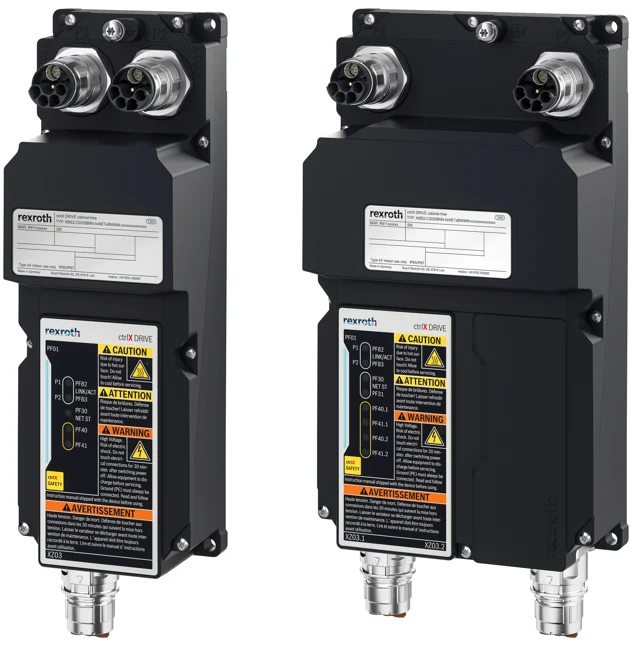
According to Joaquin Ocampo, Product Manager at Bosch Rexroth, modern cabinet-free drives represent a natural evolution of older distributed, or decentralized, drive topologies. However, today’s iterations are engineered with unprecedented ruggedness, sophisticated multi-axis capabilities, and standardized hybrid cabling. Rated up to IP65/67 to withstand harsh environments filled with dust, moisture, and vibration, these power-supplying motion components mount directly on or immediately adjacent to the motor.
Rather than relying on complex bundles of separate wires housed in an air-conditioned enclosure, cabinet-free setups utilize streamlined one- or two-cable hybrid connections. These single lines seamlessly integrate power conductors, data communication networks, and safety signals. By eliminating the conventional control cabinet, industrial operators are unlocking unprecedented spatial efficiency, reducing wiring errors, optimizing thermal management, and constructing hyper-modular production lines capable of pivoting on a dime to meet shifting consumer demands.
Chronology: From Centralized Enclosures to Decentralized Freedom
To understand the disruptive nature of cabinet-free automation, it is vital to examine the historical trajectory of industrial control systems.
Era of Centralization (The 20th Century)
For decades, industrial automation relied almost exclusively on centralized control architectures. Large, bulky metal enclosures—often referred to as control cabinets or panels—housed all programmable logic controllers (PLCs), human-machine interfaces (HMIs), power supplies, and multi-axis motor drives. Long runs of heavy, shielded copper cables snaked from these cabinets through cable trays and conduits to every motor and sensor on the factory floor. While this approach kept sensitive electronics grouped in a controlled environment, it created massive spatial footprints and turned machine maintenance into a logistical maze.
The First Wave of Decentralization (Early 2000s)
As machines grew more complex, engineers recognized the inefficiencies of routing hundreds of individual wires back to a single central hub. This realization birthed early distributed or decentralized drive concepts. Manufacturers began placing smaller, specialized drives closer to the machine axes. While this reduced some wiring overhead, the technology of the era was often limited by thermal constraints, lower environmental protection ratings, and proprietary cabling schemes that complicated installation and troubleshooting.
The Modern Cabinet-Free Revolution (Present Day)
Today, the convergence of advanced power electronics, ruggedized industrial packaging, and high-speed industrial Ethernet has unlocked true cabinet-free discrete automation. Advanced semiconductors—notably Silicon Carbide (SiC)—have drastically reduced thermal losses, allowing drives to operate reliably in ambient factory conditions without active air conditioning. Modern cabinet-free systems, such as Bosch Rexroth’s ctrlX DRIVE portfolio, leverage standardized hybrid connectivity and multi-axis consolidation. Drives can now power up to two independent axes (such as 2 x 30A outputs) from a single decentralized unit mounted right where the work happens.
Supporting Data and Technical Advantages
The transition toward cabinet-free automation is backed by compelling technical metrics and operational realities across four core pillars: space optimization, financial return on investment (ROI), energy efficiency, and error reduction.
1. Spatial Consolidation and Real Estate Optimization
Industrial real estate is at a premium. In many global manufacturing hubs, the cost per square foot of factory floor space has skyrocketed.
- Footprint Reduction: Eliminating the central control cabinet instantly frees up valuable square footage. On a multi-machine production line, removing several large cabinets can reclaim enough space to add an entirely new operational workcell.
- Cable Management: Traditional setups often required kilometers of individual copper wiring. Cabinet-free architectures utilize compact hybrid cables, drastically reducing the physical volume of wiring troughs and cable tracks.
2. Financial Implications and Cost Reductions
The economic advantages of shedding the control cabinet extend far beyond raw spatial savings:
- Hardware and Installation Costs: Fewer physical components mean reduced material costs. Furthermore, the labor hours required to wire, test, and troubleshoot complex multi-cabinet panels are slashed.
- Thermal Management Savings: Traditional cabinets trap substantial heat generated by insulated drives and power supplies, necessitating energy-intensive enclosure air conditioners or chillers. Removing the cabinet entirely eliminates the capital and operating expenses associated with cabinet cooling systems.
3. Reliability and Error Mitigation
In manufacturing, connection points are primary vectors for failure. Loose screw terminals, pinched wires, and broken solder joints account for a significant percentage of electrical downtime.
- Minimized Points of Failure: By consolidating power, data, and safety signals into standardized hybrid cables with robust industrial connectors, the total number of physical connection points drops exponentially.
- Standardization: Standardized connections streamline assembly and reduce the likelihood of human error during installation or routine maintenance.
4. Thermal Performance and Silicon Carbide (SiC) Technology
The integration of advanced wide-bandgap semiconductors, specifically Silicon Carbide, is a primary technical enabler of cabinet-free drives.

- Efficiency Gains: SiC semiconductors exhibit drastically lower switching and conduction losses compared to traditional Insulated-Gate Bipolar Transistors (IGBTs).
- Power Density: Because SiC devices generate significantly less waste heat, drives can be built in much smaller form factors with high power densities, allowing them to sit directly on the machine without active cooling mechanisms.
Official Perspectives and Industry Insights
The industry-wide shift toward cabinet-free architectures is championed by veteran automation experts who have witnessed decades of technological evolution. Joaquin Ocampo, a product manager with Bosch Rexroth boasting more than 25 years of specialized experience in advanced drive technology, emphasizes that these systems are designed to address the modern manufacturer’s desire for operational agility.
According to Ocampo, manufacturers today are under immense pressure to identify and eliminate operational bottlenecks while accelerating their digital transformation (DX) initiatives. "Motors and drives—the heart of motion within manufacturing—have evolved, too," notes Ocampo. "Now, cabinet-free drives are enabling new possibilities to let manufacturers boost machine responsiveness, flexibility, and productivity."
Ocampo highlights that modularity is no longer just a nice-to-have feature; it is an economic necessity. Historically, drives and their corresponding cabinets were inextricably bound to a single machine designed for a singular, static purpose. If market demand shifted or output needed to be scaled, end-users frequently had to scrap or supplement entire machine islands at great expense.
By decentralizing the intelligence and power conversion directly onto modular machine sections, operators can scale their production lines dynamically. Multiple axes integrated into a single compact housing allow manufacturers to drive multiple motors efficiently, providing the torque and responsiveness required for high-speed discrete automation without expanding the facility’s physical footprint.
Implications for the Future of Manufacturing
As the industrial sector marches further into the era of smart manufacturing, Industrie 4.0, and flexible production lines, the implications of cabinet-free automation are profound.
A Gradual Migration Strategy
Despite the clear benefits of cabinet-free architectures, industry analysts note that migration must be managed carefully. For plant managers accustomed to proven, decades-old centralized control topologies, completely abandoning control cabinets overnight can feel daunting. Production continuity is paramount, and downtime carries severe financial penalties.
To mitigate risk, industry leaders recommend a phased migration approach. Manufacturers often begin by testing cabinet-free setups on an isolated, non-critical workcell or a modular sub-assembly. This controlled pilot phase allows engineering teams to evaluate real-world performance, assess thermal stability, train maintenance personnel, and measure ROI before committing to a wholesale plant-wide migration.
Sustainability and the Bottom Line
While environmental sustainability and corporate carbon footprint reduction are central regulatory drivers in regions like Europe, they are increasingly tied to economic survival globally. Energy-saving technologies that eliminate parasitic loads—such as the massive cooling fans required for traditional control cabinets—deliver an immediate impact on a company’s bottom line.
Cabinet-free drives allow operators to precisely calculate and deliver the exact amount of power required at the exact point of motion, eliminating energy waste across long, inefficient distribution paths.
Conclusion
The rise of cabinet-free discrete automation marks a definitive turning point in industrial engineering. By stripping away the spatial, thermal, and financial burdens of the traditional control cabinet, manufacturers are unlocking new levels of agility, modularity, and lean operational efficiency. As adoption accelerates from isolated test cells to full-scale factory floors, cabinet-free drives are poised to redefine what is possible in modern motion control.