





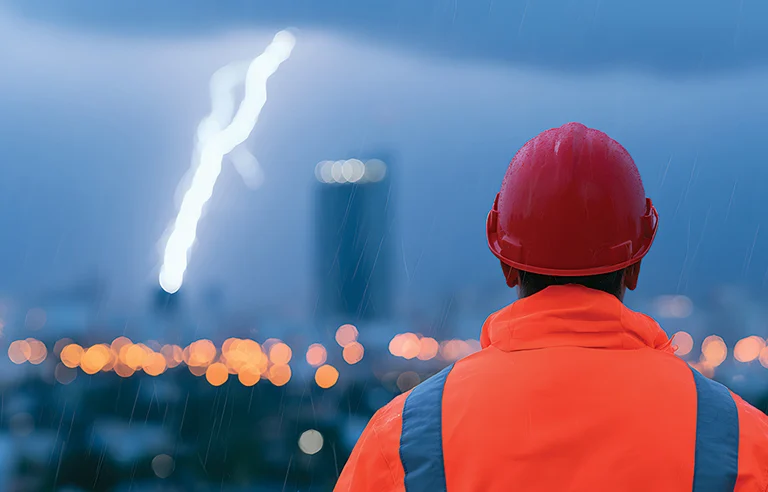
As climate patterns shift and extreme weather events become increasingly frequent, the risk posed by lightning strikes to outdoor workers remains a critical occupational hazard. According to the National Weather Service (NWS), “no place outside is safe near a thunderstorm.” For the millions of employees working in construction, agriculture, forestry, and utility maintenance, understanding the mechanics of lightning and implementing rigorous safety protocols is not merely a recommendation—it is a matter of life and death.
This report examines the necessary safety measures, including the "30-30 rule," environmental hazards, and strategic emergency responses required to maintain a safe working environment when electrical storms loom.
I. Main Facts: The Nature of the Threat
Lightning is one of the most underrated weather phenomena in the United States. While tornadoes and hurricanes often receive the lion’s share of media attention, lightning is a consistent, daily threat during the warmer months. A single lightning bolt can reach temperatures of 50,000 degrees Fahrenheit—roughly five times hotter than the surface of the sun—and contains millions of volts of electricity.
For outdoor workers, the primary danger lies in the unpredictability of lightning. It can strike from as far as 10 miles away from the center of a storm, often catching crews off guard even when the sky appears relatively clear above them. Because lightning seeks the path of least resistance to the ground, it is naturally attracted to the tallest structures in an area, which, in a flat field or an open construction site, often includes human beings or the heavy machinery they operate.
II. Chronology of a Storm: Implementing the 30-30 Rule
The most effective, universally recognized safety protocol for outdoor workers is the "30-30 rule." This rule provides a clear, actionable framework for determining when work must cease and when it is safe to resume.
The First 30: The Threshold of Danger
The first "30" refers to the time elapsed between seeing a lightning flash and hearing the subsequent clap of thunder. Sound travels at approximately one mile every five seconds. If you count fewer than 30 seconds between the flash and the rumble, the storm is within six miles—the established danger zone.
When the count drops below 30 seconds, all outdoor work should cease immediately. There is no "finishing the current task" or "packing up the tools" when the count is this low; the risk of a strike is imminent. Workers should immediately seek a fully enclosed building with electrical wiring and plumbing, as these systems help ground the structure in the event of a strike.
The Second 30: The Wait for Safety
The second "30" is perhaps the most difficult for crews to follow due to the urge to resume productivity. Once the storm has passed, workers must wait at least 30 minutes after the final rumble of thunder before returning to their outdoor tasks. The NWS emphasizes that storms can produce "stray" bolts long after the heavy rain has subsided and the sky appears to be clearing. This 30-minute buffer accounts for the potential of trailing lightning strikes that occur at the tail end of a dissipating system.
III. Supporting Data and Environmental Hazards
The environment plays a significant role in lightning conductivity. Knowing where not to stand is as important as knowing where to seek shelter.
Terrain and Elevation
Lightning strikes the tallest object in a given vicinity. Consequently, workers on mountain ridges, peaks, or exposed hills are at the highest risk. If caught in an exposed area, the strategy is to minimize your profile. Stay low to the ground, but do not lie flat; lying prone increases the surface area of your body in contact with the ground, making you more susceptible to ground current if lightning strikes nearby.
Aquatic and Conductive Risks
Water is an excellent conductor of electricity. Lakes, ponds, and rivers are categorically unsafe locations during a thunderstorm. Furthermore, objects that conduct electricity—such as barbed wire fences, power lines, windmills, and metal piping—should be avoided at all costs.
The Cave Fallacy
The U.S. Department of Agriculture (USDA) Forest Service offers a critical warning regarding natural shelters. While it may seem intuitive to duck into a cave or a rock overhang to escape the rain, these should be a "last resort." Caves are frequently sites of falling hazards and, depending on the geology, can channel electrical charges through the interior. A hard-topped, fully enclosed vehicle with the windows rolled up remains the safest alternative to a permanent building.
IV. Official Responses and Institutional Guidelines
The National Oceanic and Atmospheric Administration (NOAA) and the NWS have worked extensively to standardize lightning safety protocols. Their guidance is rooted in the philosophy that "when thunder roars, go indoors."
The Role of Technology
Official guidelines suggest that crews should not rely solely on their senses. While the 30-30 rule is a vital fallback, companies are encouraged to utilize NOAA Weather Radios. These devices provide real-time updates and localized alerts that can warn of approaching electrical activity before the first flash is even visible.
Modern safety managers are also increasingly integrating mobile-based weather monitoring apps that provide geofenced lightning alerts. These tools allow supervisors to track the proximity of lightning strikes in real-time, removing the guesswork from safety decisions and ensuring that all crew members have access to the same critical information.
Corporate Responsibility
Employers have a legal and moral obligation to provide a safe work environment. This includes:
- Mandatory Training: Regular safety briefings that ensure every worker understands the 30-30 rule.
- Clear Policy: Establishing a "Stop Work Authority," where any worker, regardless of rank, has the power to halt operations if they perceive a lightning risk.
- Communication Infrastructure: Ensuring that remote workers have reliable ways to receive weather updates.
V. Implications: The Human and Economic Cost
The implications of neglecting lightning safety are profound. Beyond the tragic potential for loss of life or permanent disability—such as cardiac arrest, neurological damage, and severe burns—there are significant economic and operational consequences.
Operational Downtime
While stopping work for 30 minutes or more can disrupt project timelines, the cost of a lightning-related injury far outweighs the loss of productivity. Legal liabilities, workers’ compensation claims, and the trauma experienced by a team witnessing a colleague’s injury can devastate a project’s culture and bottom line.
Changing Weather Patterns
The scientific community notes that climate change is altering the frequency and intensity of thunderstorms in many regions. As weather patterns become more volatile, the historical "safe months" for outdoor work are no longer reliable indicators. Safety protocols must be treated as dynamic, year-round requirements rather than seasonal suggestions.
The "Stay Alert" Mentality
The NWS underscores that vigilance must extend beyond the immediate storm. A common mistake is the "all-clear" bias—the belief that because the rain has stopped, the danger has passed. The most dangerous strikes often occur at the periphery of a storm. Maintaining an "alert" posture, even after the thunder has faded, is a cultural shift that safety managers must instill in their workforce.
Conclusion: A Culture of Safety
Lightning is a powerful, untamable force, but it is not an unpredictable one if workers are equipped with the right knowledge. By adhering to the 30-30 rule, utilizing technological aids like NOAA radios, and strictly avoiding conductive environments, outdoor professionals can significantly mitigate their risk.
The mandate is clear: there is no task, deadline, or quota that justifies exposing a worker to the lethal potential of a thunderstorm. Protecting personnel begins with the understanding that safety is not a passive state, but an active, ongoing process of observation, evaluation, and decisive action. When the thunder roars, the only acceptable response is to move indoors and stay there until the environment is demonstrably safe.
For further information on regional weather patterns and safety training resources, workers and managers are encouraged to visit weather.gov. In the high-stakes environment of outdoor labor, knowledge is the most effective form of armor against the elements.