By John Grady, CEO, Ayla Networks
Published by Electronic Design
Main Facts
In the modern consumer and industrial Internet of Things (IoT) landscape, over-the-air (OTA) firmware update capabilities are no longer a "nice-to-have" luxury feature—they are absolute table stakes. As connected ecosystems expand, devices must continuously adapt to new security vulnerabilities, shifting connectivity standards (such as Matter, Bluetooth, and Wi-Fi), and changing consumer expectations. However, a poorly executed firmware update that "bricks" a device is often far worse than no update at all, transforming a helpful patch into a costly device failure and a public relations nightmare.
Driven by stringent new international compliance regulations—most notably the European Union’s Cyber Resilience Act (CRA) and the U.S. Cyber Trust Mark—manufacturers are legally and ethically obligated to support secure, reliable OTA update mechanisms. Meeting these obligations requires two primary operational pillars:
- Design-Phase Resilience: Building hardware and software architectures that inherently anticipate failure (e.g., dual-partition schemes, sufficient storage headroom, delta imaging, and fail-safe recovery).
- Build-Environment Archiving: Preserving the exact toolchains, operating systems, dependencies, and makefiles required to compile functional firmware years down the road, insulating organizations against employee turnover and shifting corporate structures.
Chronology and The Lifecycle Threat Matrix
The vulnerability of an IoT device’s update lifecycle does not manifest on the day a bug is discovered; it begins years earlier, stretching across a predictable chronology of deployment and maintenance:

- Phase 1: Product Conception and Design (Years 0–1): Hardware and software engineers make foundational architecture decisions. If they fail to implement dual-partition schemes or allocate sufficient flash memory headroom, the device is structurally compromised for its entire lifecycle.
- Phase 2: Deployment and Active Maintenance (Years 1–3): The device ships to consumers. Early patches are frequent, engineering teams are intact, and the original build environment is fresh in developers’ minds. OTA platforms execute smoothly under active supervision.
- Phase 3: The Dormant Gap and Organizational Drift (Years 3–7+): Devices settle into homes and industrial environments. Firmware updates become rare. During this period, original engineers leave the company, corporate reorganizations blur product ownership lines, and external third-party development contractors move on to new projects.
- Phase 4: The Critical Vulnerability Event (Year 7+): A zero-day exploit or breaking connectivity standard change forces an urgent, mandatory fleet-wide update. Organizations lacking archived build environments find themselves unable to compile functional code, while devices lacking robust fallback mechanisms brick en masse upon encountering minor network drops during the update.
Supporting Data and Technical Imperatives
Managing OTA updates across a vast fleet—such as Ayla Networks’ footprint spanning over 15 million connected devices and more than 2,500 enterprise updates annually—reveals clear patterns regarding what separates a resilient IoT deployment from a catastrophic failure.
1. Designing for Failure
Every firmware update occurs in an uncontrolled environment subject to chaotic real-world variables: sudden power outages, network throttling, packet loss, and congested home Wi-Fi traffic. To prevent these variables from bricking devices, engineers must implement:
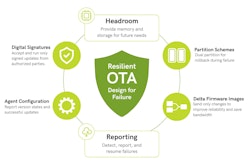
- Dual-Partition (A/B) Memory Schemes: The device maintains two distinct firmware storage partitions. While running on partition A, the new update is safely downloaded and verified in partition B. If the update fails integrity checks or causes a boot crash, the system automatically rolls back to partition A.
- Sufficient Storage Headroom: Designing microcontrollers and flash memory with enough excess capacity to support future feature expansion and image staging.
- Delta Firmware Images: Transmitting only the binary differences (deltas) rather than entire firmware packages, minimizing bandwidth consumption and reducing download time windows.
- Robust Cryptographic Verification: Implementing strict digital signature policies to ensure malicious actors cannot inject unauthorized, unverified code into the update pipeline.
2. Safeguarding the Build Environment
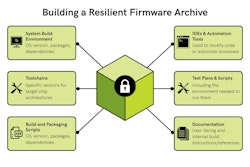
A major hidden risk in IoT maintenance is the decay of tribal knowledge and software dependencies. Source code control systems (like Git) are necessary, but they are insufficient on their own. Over a span of several years, toolchain updates, deprecated compiler versions, and broken links to external libraries can render a legacy codebase completely unbuildable.
To counter this, development teams must adopt containerized environments and Virtual Machines (VMs). By snapshotting the complete ecosystem—including the exact Integrated Development Environment (IDE), specific compiler toolchains, OS dependencies, makefiles, and packaging scripts—into an archived container, organizations ensure that future developers can reliably replicate the original build conditions. Furthermore, all external source dependencies must be fetched and locked directly into the archive prior to closure, preventing broken external links from halting future compilation.
Official Responses and Regulatory Pressure
Regulatory bodies worldwide are shifting OTA update capabilities from an internal engineering best practice into an uncompromising legal obligation.
- The European Union Cyber Resilience Act (CRA): The CRA establishes mandatory cybersecurity requirements for products with digital elements, explicitly holding manufacturers accountable for providing security updates throughout the expected lifetime of a product. Non-compliance risks heavy financial penalties and market exclusion across EU member states.
- The U.S. Cyber Trust Mark: Launched to give consumers a clear, reliable indicator of IoT cybersecurity, this labeling program evaluates connected devices based on robust vulnerability management practices, of which transparent, secure OTA firmware updates are a core requirement.
Industry leaders emphasize that meeting these standards requires careful platform selection. When choosing an OTA infrastructure provider, brands must look for solutions that offer:
- Staggered Rollouts: Deploying updates incrementally across small subsets of a device fleet rather than all at once, catching edge-case bugs before they impact all users.
- Fine-Grained Device Targeting: The ability to push targeted patches based on hardware revisions, geographic regions, or specific firmware versions.
- Comprehensive Telemetry: Real-time, transparent success and failure reporting dashboards to monitor installation progress across disparate models.
Implications for Brands, Consumer Trust, and the Bottom Line
In the age of social media and online review ecosystems, a product’s reputation is perpetually vulnerable. A single widespread firmware glitch that bricks a fleet of smart-home devices can instantly ignite viral backlash, devastating online ratings and permanently damaging consumer trust.
Crucially, this reputational damage extends far beyond current-generation flagships. Aggregate ratings for legacy models—even those no longer actively manufactured—directly influence a brand’s overall market perception and current sales velocity. Conversely, a brand that can seamlessly patch vulnerabilities, add valuable features, and extend the functional lifespan of deployed hardware cultivates profound customer loyalty.
Summary Checklist for Engineering Leaders:
- Design for Failure: Always implement dual-partition rollback mechanisms, digital signature validation, and reliable failure-state reporting.
- Preserve the Build Ecosystem: Utilize containerization and VMs to permanently archive toolchains, makefiles, and external software dependencies alongside source code.
- Partner Wisely: Select an enterprise-grade OTA platform capable of handling staged deployments, granular targeting, and real-time fleet analytics.
By treating OTA capability as a lifelong commitment rather than a post-launch afterthought, engineering teams can insulate their organizations against regulatory penalties, operational drift, and catastrophic fleet failures.