




Main Facts
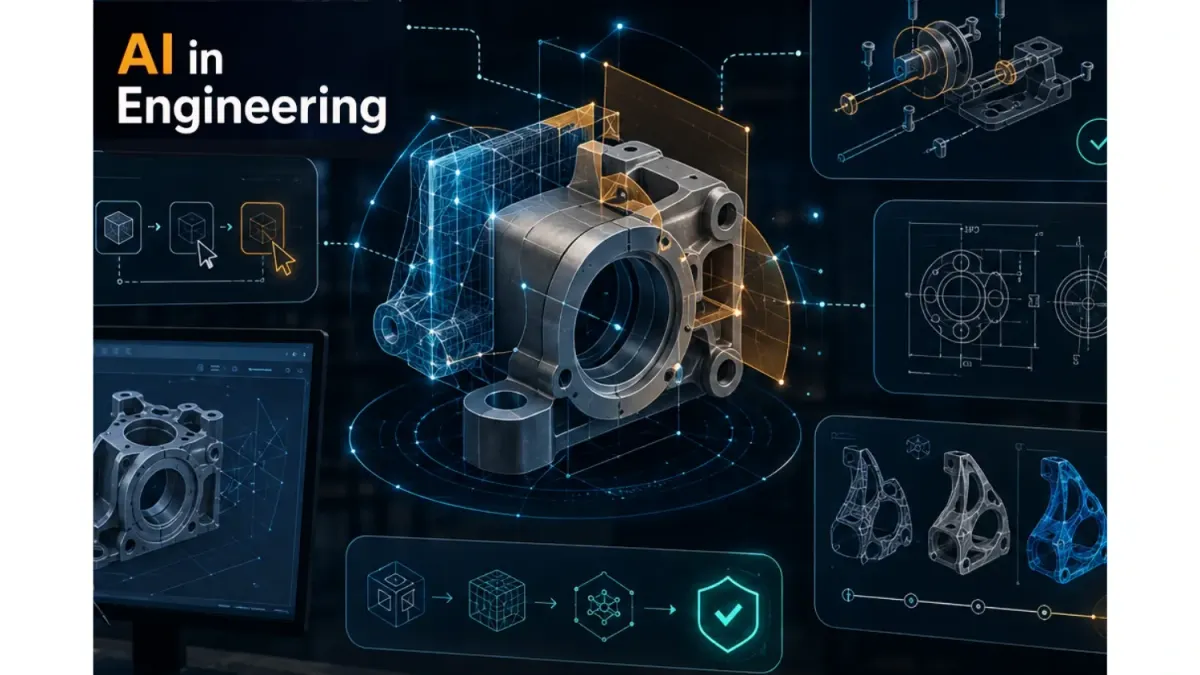
Artificial intelligence in engineering is undergoing a fundamental paradigm shift. For the past few years, the integration of AI into computer-aided design (CAD), computer-aided engineering (CAE), and product lifecycle management (PLM) has largely been characterized by superficial overlays. Industry professionals have grown accustomed to conversational chatbot layers grafted onto legacy software, serving primarily as advanced search engines for manuals or basic script-generation assistants.
However, a sweeping wave of new announcements across the engineering software landscape indicates that AI is breaking out of the conversational sandbox. It is now penetrating the core mathematical and geometric engines of engineering software.
Key developments shaping this transformation include:
- Autodesk’s Neural CAD: A new class of foundation models trained explicitly on professional design data and CAD geometry, capable of reasoning directly about CAD objects and generating editable, precision geometry and parametric command sequences from text prompts and spatial constraints.
- MIT’s VideoCAD: An academic breakthrough featuring an AI agent that learns how to operate CAD software through human-like interactions—observing mouse clicks, keyboard shortcuts, and software tool selection to translate 2D sketches into functional 3D models.
- Dassault Systèmes’ SOLIDWORKS 2026: A mainstream commercial release that embeds AI directly into everyday design friction points, automating fastener recognition, assembly generation, and technical drawing detailing while streamlining knowledge discovery.
- CoLab’s 2D AutoReview: An evolution in design review workflows utilizing a multi-agent "factory" architecture to audit 2D drawings for geometric dimensioning and tolerancing (GD&T), bill of materials (BOM) consistency, and fastener integrity, moving away from black-box automated reviews toward transparent, context-aware verification.
- Neural Concept’s AI Design Copilot: A physics- and geometry-aware platform that compresses early-stage design exploration, allowing engineers to generate up to 1,000 times more design variants and integrate multi-physics simulations in minutes rather than weeks.
Despite these rapid advancements, a common thread unites all these platforms: AI is transforming execution and exploration, but human engineers remain definitively in charge of design intent, safety, tolerances, and manufacturing validation.
Chronology of Recent Developments
The rapid convergence of artificial intelligence and core engineering software has accelerated over recent months, marked by a series of foundational research breakthroughs and commercial product launches.
- Late 2024 to Early 2025 (The Research Phase): Academic institutions lay the groundwork for action-oriented AI agents. Researchers at institutions like MIT begin constructing massive workflow datasets—tracking thousands of hours of human mouse clicks, drag-and-drop actions, and command executions—to teach AI models how engineers use CAD tools rather than just what the final shapes look like.
- Mid-2025 (The Foundation Model Era): Software developers begin moving away from generic large language models (LLMs) trained on internet text. Companies begin training specialized neural networks on proprietary engineering datasets, curved consumer-product geometries, and parametric command histories.
- November 2025 (MIT VideoCAD Debut): MIT researchers officially unveil VideoCAD, demonstrating that an AI agent can successfully ingest a 2D sketch and replicate the precise, step-by-step workflow required to build a 3D model inside native software interfaces.
- Late 2025 / Early 2026 (Commercial Platform Integration): Enterprise vendors roll out major software updates. Dassault Systèmes announces SOLIDWORKS 2026, integrating practical, productivity-boosting AI features into its established ecosystem. Concurrently, specialized engineering tech firms like Neural Concept and CoLab push out advanced AI copilot and multi-agent review systems designed to bridge the gap between initial concept generation and rigorous simulation.
- Present Day (The Neural CAD Horizon): Autodesk steps forward with its neural CAD paradigm, signaling a future where text prompts and spatial constraints directly manipulate core boundary-representation (B-rep) and constructive solid geometry (CSG) engines rather than merely generating passive 3D meshes.
Supporting Data and Quantitative Insights
The claims surrounding these new engineering AI tools are backed by substantial leaps in data collection, variant exploration, and workflow efficiency.
- 41,000+ Training Examples: The dataset behind MIT’s VideoCAD system comprises more than 41,000 distinct, step-by-step engineering workflows. This granular training data records every mouse click, keyboard shortcut, drag operation, and menu selection, allowing the AI to map human operational logic rather than relying on abstract shape-matching algorithms.
- 10x to 1,000x Design Variants: According to performance metrics released alongside Neural Concept’s new AI Design Copilot, engineering teams utilizing the platform can explore between 10 and 1,000 times more design variants per iteration during the preliminary phase of product development. This exponentially expands the conceptual design space.
- Up to 90% Manual Workload Reduction: Neural Concept claims that its physics- and geometry-aware copilot can reduce manual setup and early-stage modeling burdens by up to 90%. This allows multidisciplinary teams to pivot quickly from high-level functional requirements to validated simulation inputs.
- Hundreds of Productivity Updates in SOLIDWORKS 2026: Dassault Systèmes’ latest flagship release incorporates hundreds of discrete enhancements across its design, simulation, and product data management (PDM) modules, with targeted AI functions aimed specifically at eliminating friction in drawing creation, large-assembly selective loading, and standard component matching.
Official Responses and Industry Perspectives
The engineering community’s response to this wave of AI integration is a nuanced mix of enthusiasm for productivity gains and a pragmatic insistence on rigorous engineering discipline.
Autodesk on Neural CAD
Autodesk frames its introduction of neural technology as a generational leap beyond conversational interfaces. By training neural models directly on professional design data and CAD geometry, the company aims to solve the "blank page" problem for mechanical design teams.
According to Autodesk representatives, the ability to generate editable, precision CAD geometry paired with the underlying parametric command sequence represents a fundamental shift. Rather than delivering an isolated surface mesh or a generic rendering, the technology produces features that integrate with existing engineering pipelines. However, company spokespeople readily acknowledge that raw geometric generation is only half the battle. Downstream constraints, manufacturing methods, and tolerances remain firmly in the domain of the human designer.
MIT Researchers on Workflow Learning
The team behind VideoCAD emphasizes that true utility in engineering AI requires understanding human process, not just digital output.
"An AI that only knows how a finished object looks is of limited use in an engineering office," notes the research team. "Real engineering is defined by how an object is constructed—the sequence of operations, the parametric dependencies, and the structural logic. By training models on actual workflow actions, we are teaching AI to operate within the procedural reality of software like CAD."
CoLab on Transparent, Multi-Agent Review
Addressing industry anxieties regarding "black-box" artificial intelligence in critical review cycles, CoLab has deliberately structured its 2D AutoReview tool around visibility and human collaboration.
Instead of relying on a single, monolithic algorithm to check drawings, CoLab deployed a specialized "factory" of distinct AI agents. Each agent focuses on a narrow domain—such as geometric dimensioning and tolerancing (GD&T), fastener placement, view integrity, and bill of materials (BOM) cross-referencing. Furthermore, by exposing the processing stages to the user, CoLab aims to strip away the opacity of machine learning. Engineers can see precisely which agent is auditing which metric, input context parameters (such as operating environment or manufacturing process), and trace every recommendation back to a logical source.
Neural Concept on Physics-Aware Exploration
Neural Concept emphasizes that traditional computer-aided engineering (CAE) has long been a bottleneck in product development, often occurring too late in the cycle to influence fundamental design decisions.
By marrying spatial geometry generation with real-time physics awareness, Neural Concept’s leadership argues that engineers can break down the historical silos between design (CAD) and simulation (CAE). By exploring vast spaces of variant designs early—spanning thermal, computational fluid dynamics (CFD), structural crashworthiness, and electromagnetic performance—teams can fail faster in the virtual realm and converge on optimal topologies before committing to expensive physical prototyping.
Implications for the Future of Engineering
The transition of artificial intelligence from conversational novelty to core geometric, simulation, and workflow engine carries profound implications for the engineering profession.
1. The Redefinition of Routine Modeling
For decades, a significant portion of an engineer’s or drafter’s day has been consumed by routine, repetitive modeling tasks: constraining standard fasteners, generating routine 2D drawing views, cleaning up minor geometry anomalies, and inputting repetitive bill-of-materials data.
Tools like SOLIDWORKS 2026 and MIT’s VideoCAD research signal the beginning of the end for this type of manual toil. As AI agents become adept at recognizing assembly patterns and replicating multi-step workflows, routine drafting and basic modeling will increasingly be automated. This shift promises to lift the baseline productivity of design teams, allowing junior engineers to bypass steep software learning curves much faster.
2. Democratization of Design Space Exploration
Historically, exploring dozens or hundreds of geometric variations for a complex mechanical assembly or aerodynamic housing was prohibitively time-consuming. Engineers typically modeled two or three concepts, ran preliminary simulations on the most promising candidate, and optimized from there.
Platforms like Neural Concept’s AI Design Copilot and Autodesk’s neural CAD capabilities blow this constraint wide open. By enabling the rapid generation of thousands of valid, physics-aware geometric variants from high-level intent, AI empowers teams to discover non-intuitive, highly optimized forms (such as biomimetic brackets or advanced cooling channels) that human designers might never have had the time to sketch manually.
3. The Unchanging Core: Human Responsibility
Despite the transformative potential of these tools, a unified consensus emerges across every software update, research paper, and enterprise release: The democratization of generation does not equal the automation of engineering accountability.
AI models can predict shapes, suggest parametric command trees, flag potential GD&T discrepancies, and simulate thermal dissipation. However, they possess no intrinsic understanding of physical reality, safety margins, liability, legal compliance, or true manufacturing feasibility.
- An AI can generate an editable CAD part from a text prompt, but an engineer must verify that its internal dimensions and features respect manufacturing tolerances.
- An AI can draft a 2D drawing and check BOM consistency, but a human must sign off on the drawing’s release control and GD&T stack-up.
- An AI can evaluate a thousand thermal variants, but a lead engineer must decide which trade-off between weight, cost, and structural integrity is acceptable for end-users.
Ultimately, the integration of AI into engineering software does not displace the engineer; rather, it elevates the engineer’s role. By stripping away the administrative and mechanical friction of design, modern AI tools are transforming engineers from manual modelers and drawing checkers into high-level directors of computational synthesis, geometry, and physical validation.