Main Facts
As modern commercial, educational, and residential structures become increasingly airtight to maximize energy efficiency, the challenge of maintaining optimal indoor air quality (IAQ) has taken center stage. Airborne pathogens—including viruses such as COVID-19, influenza, and various bacterial strains—pose a persistent risk when recirculated through centralized heating, ventilation, and air conditioning (HVAC) systems. To combat this invisible threat, facility managers and building engineers are increasingly turning to a tried-and-true, highly effective technology: Ultraviolet Germicidal Irradiation (UVGI).
UVGI utilizes specific wavelengths of ultraviolet light, predominantly UV-C, to neutralize microorganisms by disrupting their DNA and RNA structures. This renders pathogens incapable of replicating or causing infection. Far from being a novel or experimental approach, UVGI is an established engineering solution recognized by leading global health and engineering authorities, including the Centers for Disease Control and Prevention (CDC) and the American Society of Heating, Refrigerating and Air-Conditioning Engineers (ASHRAE).
Implementing UVGI within a building automation framework offers multiple strategic advantages. Beyond safeguarding public health by drastically reducing airborne pathogen loads, UVGI systems improve operational efficiency. By keeping cooling coils and drain pans free of biofilm, mold, and organic buildup, these systems optimize heat transfer, lower static pressure drops, and reduce overall energy consumption. Consequently, integrating UVGI is not merely a reactionary measure against viral outbreaks, but a proactive, holistic strategy for sustainable facility management.
Chronology of UVGI: From Scientific Discovery to Modern HVAC Integration
To fully appreciate the role of UVGI in contemporary building automation, it is essential to trace its historical evolution from early scientific breakthroughs to its current status as a cornerstone of indoor environmental control.
The Late 19th and Early 20th Centuries: Discovery and Early Medical Applications
The foundation of UV germicidal technology was laid in 1878, when British researchers Arthur Downes and Thomas P. Blunt discovered that sunlight had a bactericidal effect on microorganisms. By 1901, physicist Niels Finsen demonstrated that concentrated ultraviolet radiation could successfully treat cutaneous tuberculosis, earning him the Nobel Prize in Physiology or Medicine in 1903. Throughout the early decades of the 20th century, scientists mapped the specific germicidal wavelengths of the electromagnetic spectrum, identifying the UV-C band (roughly 200 to 280 nanometers) as the most effective range for destroying cellular life.
The Mid-20th Century: Early Air and Surface Disinfection
During the 1930s and 1940s, pioneering physician and researcher Dr. William F. Wells applied UV disinfection to architectural spaces. His work demonstrated that upper-room UV fixtures could dramatically reduce the transmission of measles in schools. However, the widespread adoption of UVGI in commercial buildings was temporarily stalled by the mid-century rise of inexpensive, highly effective chemical antibiotics and synthetic pesticides, coupled with an era of abundant and inexpensive energy that prioritized brute-force mechanical ventilation over targeted disinfection.
The Late 20th Century: The Energy Crisis and IAQ Awareness
The energy crises of the 1970s forced a radical rethink of building design. To conserve energy, building envelopes were sealed tightly, and outdoor air exchange rates were reduced. This inadvertently gave rise to "Sick Building Syndrome" (SBS), where occupants experienced acute health effects linked to time spent in a building. Concurrently, outbreaks of Legionnaires’ disease in the 1970s highlighted the dangers of microbial growth within HVAC systems. Engineers began revisiting UVGI not just for upper-room settings, but for direct installation inside air handling units (AHUs) to control mold and bacterial growth on cooling coils.
The 21st Century: Pandemic Resurgence and Smart Building Integration
The 21st century has witnessed unprecedented public health challenges, beginning with the SARS outbreak of 2002–2004, the H1N1 influenza pandemic of 2009, and, most transformative of all, the global COVID-19 pandemic starting in 2020. These crises propelled indoor air quality from a secondary operational concern to a top-tier board-level priority.
Today, UVGI is no longer viewed as a standalone auxiliary device. Instead, modern building automation systems (BAS) integrate UV-C emitters with real-time occupancy sensors, particulate monitors, and variable-speed fan controls. This convergence allows facility managers to dynamically adjust UV intensity and airflow based on real-time environmental data, maximizing pathogen inactivation while conserving lamp life and electrical energy.
Supporting Data and Technical Mechanics
Understanding the efficacy of UVGI requires a look into the underlying physics, microbiology, and engineering metrics that govern system design and performance.
The Science of UV-C Inactivation
Ultraviolet light is categorized into bands based on wavelength: UV-A (315–400 nm), UV-B (280–315 nm), and UV-C (200–280 nm). The germicidal sweet spot lies within the UV-C spectrum, specifically around 254 nanometers, which closely aligns with the peak absorption wavelength of nucleic acids (DNA and RNA).
When a virus, bacterium, or mold spore is exposed to UV-C photons, the radiation penetrates the cell wall or viral capsid and is absorbed by the nucleic acids. This absorption creates photochemical reactions, most notably the formation of pyrimidine dimers. These molecular bonds prevent the DNA or RNA from uncoiling and replicating. Without the ability to replicate, the microorganism is rendered harmless, unable to infect human hosts or colonize HVAC components.
Quantitative Efficacy and Dosage ($D_90$)
In HVAC engineering, UVGI effectiveness is measured by "dose," which is a product of the UV irradiance intensity ($I$, measured in microwatts per square centimeter, $mutextW/cm^2$) and the exposure time ($T$, measured in seconds). Thus, Dose = Intensity $times$ Time ($textmJ/cm^2$).
Different pathogens exhibit varying levels of susceptibility to UV-C radiation. Engineers utilize the $D_90$ value—the radiation dose required to achieve a 90% reduction (inactivation) of a specific microbial population. For example:

- Bacteria and Fungal Spores: Generally require lower doses (e.g., Serratia marcescens or common molds) and are relatively easy to neutralize.
- Vegetative Bacteria: (e.g., Legionella pneumophila) are also highly susceptible.
- Viruses: While some viruses (like influenza) are easily inactivated, others (such as certain enteroviruses or non-enveloped variants) require higher UV-C dosages.
- SARS-CoV-2: Extensive laboratory testing conducted during the COVID-19 pandemic demonstrated that the virus responsible for COVID-19 is highly susceptible to UV-C, requiring relatively low cumulative doses for rapid inactivation.
Engineering Applications within the HVAC Ecosystem
To maximize these inactivation rates, UVGI systems are deployed in several distinct configurations within a building:
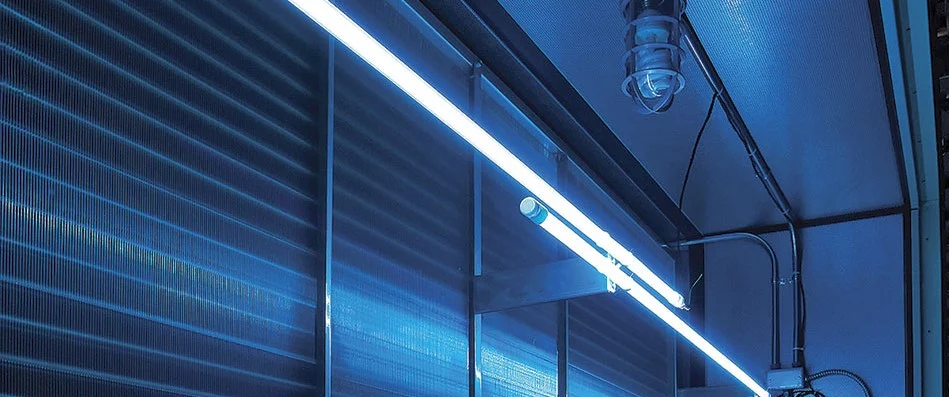
- Coil Cleaning (Surface Disinfection): Low-intensity, continuous-operation UV-C lamps are installed downstream of cooling coils and above drain pans. Their primary function is to prevent the accumulation of biofilm, mold, and bacteria. By keeping coils pristine, heat transfer efficiency is restored, pressure drops are minimized, and fan energy is conserved.
- In-Duct Air Disinfection: High-intensity UV-C systems are installed within the ductwork to sterilize air moving at high velocities. Because exposure time is very short (often a fraction of a second), these systems require high-output lamps and optimized reflective chamber designs to ensure sufficient cumulative dosage.
- Upper-Room (Upper-Air) Disinfection: Fixtures are mounted at a height of roughly 7 feet or higher in rooms with high occupancy rates (classrooms, waiting rooms, offices). Louvers direct the UV-C beam horizontally across the upper layer of the room, preventing direct exposure to occupants below. Natural thermal currents and mechanical ventilation continuously lift indoor air into the upper zone, where pathogens are neutralized.
- Portable Units (Standalone Air Scrubbers): Equipped with internal fans, HEPA filters, and shielded UV-C chambers, these mobile units provide rapid, targeted air purification for temporary spaces, quarantine zones, or rooms experiencing sudden spikes in occupancy.
Official Responses and Regulatory Guidance
The widespread endorsement of UVGI by authoritative public health and engineering bodies provides facility managers with the confidence needed to invest in these technologies.
The Centers for Disease Control and Prevention (CDC)
Throughout the COVID-19 pandemic and in ongoing guidance for indoor air quality, the CDC has explicitly recognized UVGI as an important engineering control. The agency notes that upper-room UVGI and in-duct UV systems can significantly reduce the concentration of infectious aerosols in indoor environments. The CDC emphasizes that when combined with adequate outside air ventilation and high-efficiency particulate filtration (such as MERV 13 or higher filters), UVGI forms a robust, multi-layered defense against respiratory pathogens.
ASHRAE (American Society of Heating, Refrigerating and Air-Conditioning Engineers)
ASHRAE has long been the definitive voice for HVAC system design. In its position documents on infectious aerosols and filtration, ASHRAE endorses UVGI as an effective adjunct technology for microbial control. The society’s technical committees provide rigorous calculation methodologies to help engineers design systems that deliver the precise UV dosage required for specific airflow rates and duct geometries. ASHRAE underscores that while filtration captures particulate matter, UVGI actively destroys biological contaminants, making them complementary rather than competing strategies.
Occupational Safety and Health Administration (OSHA) and Environmental Protection Agency (EPA)
While promoting the benefits of UV-C technology for disinfection, regulatory bodies such as OSHA and the EPA emphasize safety protocols. Because germicidal UV-C wavelengths can cause acute injury to human skin and eyes (photokeratitis and erythema), regulatory standards mandate that systems be properly engineered, interlocked, and shielded. In-duct and coil-cleaning systems must automatically shut off when access panels are opened, and upper-room systems must be precisely calibrated and installed to ensure that stray radiation does not exceed safe exposure limits in the occupied zone below.
Implications for Facilities, Operations, and Public Health
The adoption of Ultraviolet Germicidal Irradiation has far-reaching implications that extend well beyond immediate infection control. Implementing UVGI transforms building operations across economic, environmental, and human dimensions.
Economic and Energy Efficiency Implications
A common misconception among building owners is that adding UVGI systems will dramatically increase facility energy consumption. In reality, the opposite is often true when considering whole-building energy dynamics.
Cooling coils fouled by biological growth act as thermal insulators, reducing heat transfer efficiency and forcing chillers and air handlers to work harder. Furthermore, biofilm accumulation increases the pressure drop across the coil, requiring fans to consume more electrical energy to maintain required airflow. By maintaining pristine, sterile coils through continuous UVGI application, facilities experience:
- Restored Heat Transfer: Chiller and air handler loads are optimized, reducing electrical consumption.
- Lower Fan Energy: Maintained static pressure keeps fan motors operating at peak efficiency.
- Reduced Maintenance Costs: The frequency of manual chemical coil-cleaning cycles is drastically reduced, saving on labor and harsh cleaning chemicals that can degrade coil fins over time.
Public Health, Productivity, and Absenteeism
Indoor air quality is directly linked to human health, cognitive function, and workplace productivity. Buildings equipped with robust UVGI systems experience lower rates of airborne pathogen transmission, resulting in:
- Decreased Absenteeism: In office environments and educational institutions, healthier indoor air translates to fewer sick days for employees and students.
- Mitigation of Allergy and Asthma Triggers: By neutralizing mold spores and biological allergens circulating through the HVAC system, occupants experience fewer respiratory irritations.
- Enhanced Peace of Mind: Visible and certified deployment of advanced IAQ technologies reassures occupants, clients, and staff regarding the safety of shared indoor spaces.
Future-Proofing Building Automation
As building codes evolve to mandate higher ventilation rates and stringent IAQ standards, integrating UVGI into a centralized Building Automation System (BAS) future-proofs real estate assets. Smart sensors can monitor lamp output degradation, track operating hours, and alert maintenance teams when replacement is required—ensuring continuous, uncompromised performance.
Conclusion and Next Steps for Facility Managers
Ultraviolet Germicidal Irradiation has transitioned from a specialized medical application to an indispensable pillar of modern building automation and indoor air quality management. Backed by rigorous endorsements from the CDC and ASHRAE, UVGI offers a scientifically proven, energy-efficient method for neutralizing airborne pathogens, safeguarding occupant health, and optimizing HVAC operational efficiency.
Whether your facility requires upper-room disinfection for high-density public spaces, portable air scrubbers for dynamic zones, or in-duct and coil-cleaning systems to enhance mechanical performance, selecting and installing the right configuration requires expert technical guidance.
If you or your engineering team would like to learn more about how UVGI can be seamlessly integrated into your infrastructure, or if you need professional assistance in selecting and installing the ideal UVGI application for your facility, please reach out to us today. Our team of specialists is ready to help you create a safer, healthier, and more energy-efficient indoor environment.