Main Facts
Against the backdrop of one of the 20th century’s most breathtaking architectural triumphs, top procurement and supply chain executives from across Australia and New Zealand gathered last week for the 2026 Australia Forum. Hosted at the iconic Sydney Opera House, the premier event brought together regional leaders to grapple with the industry’s most pressing contemporary challenge: the rapid, chaotic, and transformative integration of artificial intelligence (AI) into enterprise operations.
The event featured high-profile case studies and keynote contributions from prominent Chief Procurement Officers (CPOs), including Kimberley Fisk of dairy giant Fonterra and Angela Connolly of the Commonwealth Bank of Australia (CommBank). Discussions centered not merely on technological adoption, but on the profound organizational redesign required to harness AI effectively. Rather than treating AI as a superficial software upgrade, these leaders emphasized that the technology is fundamentally reshaping human capability, workforce dynamics, and operational workflows.
The forum concluded with a private, behind-the-scenes architectural tour of the venue—a fitting metaphor for an industry currently navigating its own structural revolutions, budgetary constraints, and soaring ambitions.
Chronology: From Architectural Tragedy to Modern Transformation
The Sydney Opera House: A Legacy of Ambition and Resilience
The choice of venue for the 2026 Australia Forum carried deep symbolic weight. The story of the Sydney Opera House is one of unabridged ambition, sheer determination, collaboration, intense budgetary strain, and eventually, major global controversy.
Designed by visionary Danish architect Jørn Utzon, whose iconic exterior sail structure became a masterpiece of modern expressionism, the building’s construction was fraught with political and financial friction. Utzon’s radical designs pushed structural engineering to its absolute limits, resulting in massive budget overruns and subsequent political battles.
Tragically, these pressures forced Utzon into resigning before the building’s completion in 1973. He never returned to Australia and never got to see his completed masterpiece in person. Today, the World Heritage-listed building stands as a global symbol of Australian culture—yet its turbulent genesis serves as a timeless reminder that true innovation requires enduring immense uncertainty, skepticism, and structural friction.
For the CPOs and procurement leaders walking its halls last week, the parallel was unmistakable: steering an enterprise through the tumultuous waters of the AI revolution demands the same stubborn vision, resilience, and willingness to court controversy that built the sails of the Opera House.
The 2026 Australia Forum: Day One Unfolds
The morning sessions kicked off with intense focus, bridging the gap between high-level strategic vision and ground-level execution.
- Opening Insights (Morning): Kimberley Fisk, CPO of New Zealand-headquartered dairy giant Fonterra, took the stage alongside Angela Connolly, CPO of the Commonwealth Bank of Australia. Both executives immediately zeroed in on the dual tracks of digital transformation: deploying new AI technologies while simultaneously evolving human roles, skills, and capabilities to match.
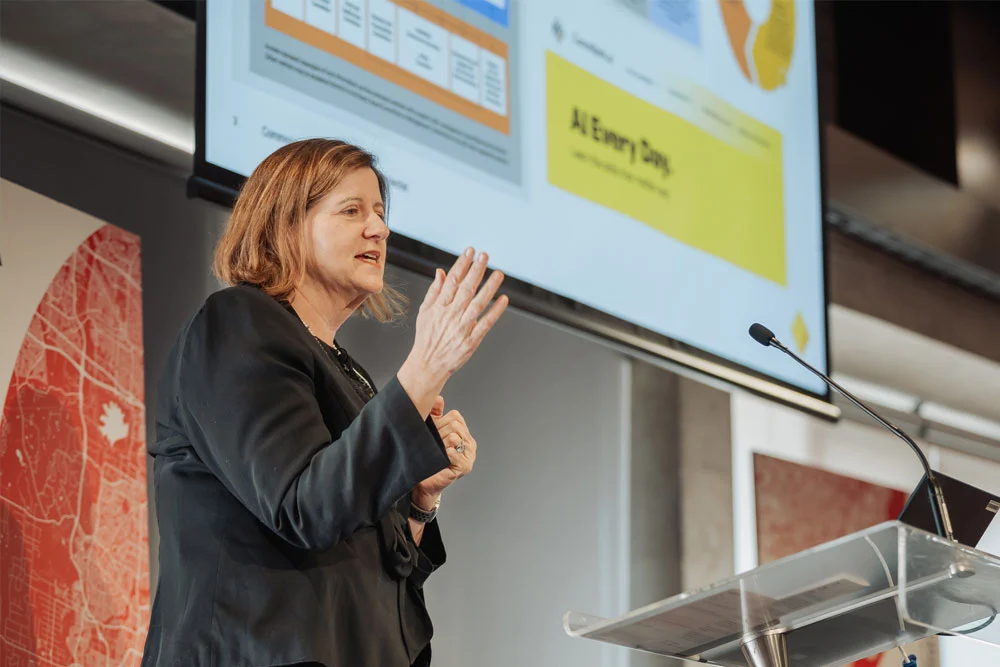
- Framework Presentations (Mid-Day): Connolly unveiled CommBank’s structured, methodical framework designed to tame the hype cycle and operationalize AI across the enterprise.
- Strategic Synthesis (Afternoon): Transurban’s Mark Sheldrick offered a grounding counter-perspective during panel discussions, cutting through the industry noise to advise peers on maintaining operational equilibrium amidst unprecedented technological shifts.
- The Architectural Tour (Evening): Delegates were treated to an exclusive tour of the Opera House’s famous concert halls and internal architecture, linking the venue’s historic struggles with innovation to the modern-day challenges facing enterprise leadership.
Supporting Data and Strategic Frameworks
The modern corporate landscape is inundated with AI jargon, vendor pitches, and existential anxieties regarding workforce displacement. To cut through this noise, leaders at the 2026 Australia Forum presented structured methodologies designed to transition organizations from experimentation to industrialization.
CommBank’s "Democratize, Scale, Redesign, Leverage, Scan, Rinse and Repeat" Framework
Angela Connolly outlined a rigorous, repeatable framework that CommBank utilizes to govern its AI journey. The model rests on several distinct pillars:
- Democratize: Putting AI tools directly into the hands of every employee. This involves breaking down silos, sharing both successes and public failures, and encouraging a grassroots culture of inquiry. Employees are continuously prompted to ask a foundational question: "How can AI help me today?"
- Scale: Capturing localized breakthroughs and industrializing them across the enterprise. This requires maintaining a centralized repository of verified use cases, reusable prompts, specialized AI agents, and proven design patterns. The core strategic question here is: "How do we make one person’s breakthrough everyone’s starting point?"
- Redesign: Challenging legacy processes and workflows. Rather than simply automating broken or inefficient manual tasks, teams are instructed to ask: "If we started from scratch, would we design this process the same way?" In nearly all instances, the answer is a resounding "probably not," paving the way for radical process re-engineering.
- Leverage, Scan, Rinse, and Repeat: Establishing a continuous feedback loop. Organizations must constantly scan the horizon for emerging capabilities, leverage external partnerships, and institutionalize adaptation as a permanent state of being rather than a one-off project.
While frameworks of this nature provide vital clarity and corporate governance, they also highlight a broader industry convergence. Similar methodologies are currently being deployed by reader communities across the global procurement space, reflecting a maturing consensus on how enterprises must manage technological transitions.
Official Responses and Expert Insights
Navigating the AI boom requires more than just technical frameworks; it requires psychological fortitude and pragmatic leadership.
When asked for his single most critical piece of advice for CPOs tasked with rolling out complex AI transformation programs, Mark Sheldrick of Transurban offered a refreshingly grounded perspective:
"Fairly simply, I’d say ‘keep calm.’"
While maintaining composure is easier said than done amid surging board-level expectations, vendor hyperventilation, and rapid market disruption, Sheldrick’s advice resonated deeply with the audience. Panic-driven adoption often leads to fragmented software deployments, security vulnerabilities, and employee burnout. A calm, measured, yet deliberate approach allows procurement leaders to evaluate return on investment (ROI) objectively and focus on long-term value creation.
Similarly, Fonterra CPO Kimberley Fisk emphasized that technology is ultimately an amplifier of human intent. During her session, Fisk highlighted that dairy supply chains—traditionally viewed as intensely physical, logistical, and asset-heavy domains—are undergoing a cognitive shift. AI is no longer just about predicting milk yields or optimizing global shipping routes; it is about augmenting the decision-making capacity of procurement professionals, allowing them to manage complex geopolitical and environmental risks with unprecedented agility.
Implications for the Procurement and CPO Community
The insights emerging from the 2026 Australia Forum carry profound implications for Chief Procurement Officers and supply chain leaders worldwide.
1. The Death of the Legacy Workflow
As CommBank’s framework highlights, retrofitting AI onto outdated processes yields marginal returns. The true power of artificial intelligence is unlocked only when organizations possess the institutional courage to tear down legacy workflows and rebuild them from the ground up. For procurement—a function historically bound by rigid compliance, legacy ERP systems, and heavy paperwork—this represents an existential mandate. Contract management, supplier discovery, risk assessment, and negotiations must be reimagined for a world where generative and agentic AI handle routine cognitive loads.
2. Workforce Evolution over Workforce Reduction
A recurring theme across all presentations was the evolution of human capability. As automation handles transactional tasks, the value of the procurement professional shifts toward relationship management, ethical sourcing, strategic problem-solving, and complex stakeholder influence. CPOs must actively invest in upskilling their teams, fostering an internal culture where experimentation is safe, and ensuring that employees are empowered to act as co-designers of their own automated future.
3. Emotional Resilience in Leadership
Mark Sheldrick’s call to "keep calm" is perhaps the most vital leadership takeaway for the modern executive. The pressure to deliver immediate bottom-line impact through AI can lead to reckless implementation strategies. CPOs must act as anchors within their organizations, filtering out external market noise and guiding their teams through periods of ambiguity with steady, strategic resolve—much like the architectural pioneers who endured decades of controversy to bring Utzon’s vision of the Sydney Opera House to life.
To receive weekly insights from the Procurement Leaders community, sign up to the CPO Crunch newsletter using the link at the top of this page.