WASHINGTON — In an ongoing effort to curtail preventable workplace fatalities and severe injuries, the National Institute for Occupational Safety and Health (NIOSH) has released a comprehensive new toolbox talk focused on skid-steer loaders. Ubiquitous across construction sites, agricultural operations, landscaping projects, and industrial yards, these versatile machines are paradoxically among the most hazardous pieces of equipment found in modern workplaces.
The newly published guidance aims to recalibrate how employers and operators approach skid-steer safety. By combining real-world incident narratives, interactive discussion prompts, and actionable safety protocols, NIOSH seeks to bridge the gap between regulatory compliance and everyday operational mindfulness.
Main Facts: Understanding the Risks of Skid-Steer Loaders
Skid-steer loaders are compact, rigid-frame, machine-powered vehicles characterized by lift arms that can be fitted with a wide variety of labor-saving attachments, from standard buckets and trenchers to forks and augers. Because their wheels on the left and right sides can be driven independently at different speeds or in opposite directions, skid-steers can turn within their own footprint. While this maneuverability makes them exceptionally useful in tight spaces, it also introduces unique mechanical and kinematic hazards.
According to federal safety data, the primary hazards associated with operating or working in proximity to skid-steer loaders include:
- Crushing and Pinch Points: Operators and ground crew members frequently suffer catastrophic injuries when caught between the loader arms, the frame, and the body of the machine.
- Rollovers and Tip-overs: Operating on uneven terrain, hauling overloaded buckets, or making sharp turns at high speeds can destabilize the vehicle.
- Struck-by Incidents: Workers on foot are routinely struck by moving loaders, particularly when operators are backing up or experiencing severe blind spots.
- Falls: Workers face significant fall risks when mounting and dismounting the machine, especially if steps, tracks, or grab handles are slick with mud, oil, or ice.
- Structural Collapse: Unsupported raised lift arms can fail unexpectedly, crushing anyone working or passing underneath them.
The NIOSH toolbox talk serves as an educational intervention designed to be deployed directly in the field, empowering foremen, safety managers, and frontline workers to discuss these hazards openly before starting work.
Chronology: The Evolution of Skid-Steer Safety Regulations
The hazards associated with compact utility equipment are not new, but the regulatory and educational framework surrounding their safe operation has evolved significantly over the past several decades.
Early Adoption and Unregulated Risks (1960s–1980s)
Skid-steer loaders gained widespread commercial popularity in the late 1960s and 1970s. Initially, these machines lacked many of the standardized safety features common today. Early models frequently lacked enclosed rollover protective structures (ROPS) and falling object protective structures (FOPS), leaving operators vulnerable to ejected materials and tip-over accidents. Furthermore, safety interlocks—such as systems that require the operator to be seated with a fastened lap bar before the controls become active—were virtually nonexistent.
The Push for Engineering Controls (1990s–2000s)
As epidemiological data compiled by federal agencies like NIOSH and the Occupational Safety and Health Administration (OSHA) began to highlight alarming fatality trends involving compact loaders, manufacturers and safety bodies initiated a push for standardized engineering controls. Industry consensus standards (such as those developed by SAE International and ISO) began mandating enhanced ROPS/FOPS designs, seat belts, and interlock systems. During this period, OSHA intensified its enforcement of general industry and construction standards regarding machinery guarding and employer-provided training.

Modern Interventions and Digital Resources (2010s–Present)
In recent years, the focus has shifted toward behavioral safety, situational awareness, and accessible micro-learning tools. Recognizing that formal classroom training often fails to resonate with fast-paced construction and agricultural crews, safety organizations have pivoted toward "toolbox talks"—short, focused safety meetings held at the job site. The release of the 2026 NIOSH skid-steer toolbox talk represents the culmination of decades of accident analysis, translating historical incident data into targeted, digestible prevention strategies for today’s workforce.
Supporting Data: The Statistical Reality of Machine-Related Injuries
To fully grasp the urgency behind the NIOSH initiative, one must examine the empirical data tracking equipment-related incidents across industrial sectors.
Fatality and Injury Demographics
Data from the Bureau of Labor Statistics (BLS) and the Census of Fatal Occupational Injuries (CFOI) consistently rank machinery-related incidents among the leading causes of workplace death. Within that category, compact equipment—specifically skid-steer loaders—accounts for a disproportionate share of "caught-in" and "struck-by" fatalities.
- The Most Vulnerable Population: Smaller businesses, agricultural operations, and independent landscaping contractors statistically record higher rates of skid-steer incidents compared to large, highly regulated industrial plants. This disparity is often attributed to varying levels of formal safety management systems, inconsistent equipment maintenance, and a lack of dedicated safety personnel.
- Bystander Risk: A significant percentage of severe injuries and fatalities do not happen to the operator, but rather to ground workers who are working too close to the operating radius of the machine. Poor communication and obstructed visibility are primary contributors to these bystander incidents.
Economic and Human Toll
Beyond the tragic loss of life and permanent physical disabilities—ranging from amputations to traumatic brain injuries—the economic impact of skid-steer accidents is immense. Direct costs, including workers’ compensation claims, medical expenses, and legal liabilities, routinely run into millions of dollars annually for affected employers. Indirect costs—such as lost productivity, equipment damage, OSHA fines, and the psychological toll on surviving co-workers—magnify these losses exponentially.
Official Responses and Industry Perspectives
Federal regulators, safety advocates, and equipment manufacturers have responded to the release of the NIOSH toolbox talk with widespread endorsement, emphasizing that safety must be a shared responsibility between management and labor.
The NIOSH Perspective
In releasing the guidance, public health analysts at NIOSH stressed that technology alone cannot eliminate workplace tragedies. While modern skid-steer loaders are equipped with advanced safety interlocks, warning decals, and robust ROPS cabs, human error and procedural shortcuts continue to undermine these safeguards.
"Equipment safety features are only as effective as the worker operating them and the culture of the organization supporting them," a NIOSH spokesperson noted. "Our goal with this toolbox talk is to spark vital conversations on the job site—discussions that challenge complacency and remind every worker of the immense physical forces at play when operating heavy machinery."
Industry and Trade Association Reactions
Trade associations representing construction, landscaping, and agriculture have welcomed the resource, noting its practical applicability. Representatives from major contractor networks have pointed out that small- and medium-sized enterprises (SMEs) often struggle to develop engaging safety training materials from scratch. By providing a ready-to-use package complete with real incident narratives and discussion prompts, NIOSH has lowered the barrier to entry for effective daily safety briefings.

Furthermore, equipment manufacturers have continually refined their designs in response to historical accident data. Modern units frequently incorporate rear-view cameras, proximity sensors, and enhanced glass visibility panels. However, manufacturers uniformly stress that technological aids are designed to supplement operator vigilance, never to replace it.
Implications for Employers, Operators, and Safety Professionals
The introduction of the new NIOSH skid-steer safety resource carries profound implications for safety professionals, operational managers, and field workers across multiple industries. Implementing the guidance effectively requires a proactive, multi-faceted approach to risk management.
1. Elevating Job Site Communication
Safety managers should immediately integrate the NIOSH toolbox talk into their regular safety meeting schedules. Because the resource includes real incident narratives, it provides a powerful emotional and cognitive hook that standard rule-recitation fails to achieve. Discussing how a real worker was injured helps break through safety fatigue and makes abstract rules concrete.
2. Reinforcing Pre-Operation Inspections
A cornerstone of skid-steer safety is the pre-shift inspection. Operators must verify that:
- All safety interlock systems (e.g., seat bars, seat switches, armrest controls) are functioning correctly and have not been bypassed or modified.
- Backup alarms and warning lights are operational.
- Windows and mirrors are clean and unobstructed.
- Quick-attach mechanisms for buckets and other tools are fully engaged and locked.
3. Establishing Strict Exclusion Zones
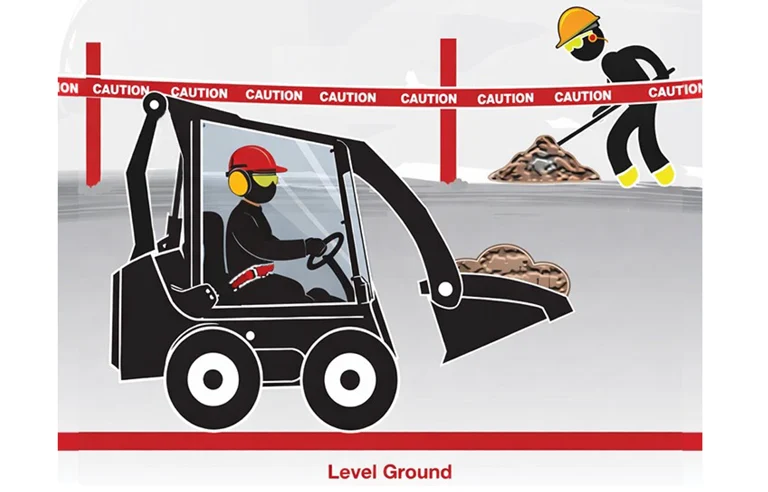
To mitigate struck-by and crushing hazards involving ground crew, worksites must enforce strict operational radiuses. Workers should never approach a working skid-steer loader without first making eye contact with the operator and receiving a clear signal that it is safe to approach. Operators must never lift loads over personnel, and bystanders must remain entirely outside the swing and travel path of the machine.
4. Eliminating the "Bypass" Culture
One of the most dangerous habits identified in historical incident reports is the practice of bypassing safety interlocks—such as tying down seat bars or attempting to exit the cab while the engine and hydraulics are still engaged. Employers must foster a zero-tolerance culture regarding the tampering of safety devices. Furthermore, workers must be trained never to exit a machine while lift arms are raised unless a mechanical lift-arm support device (or solid locking mechanism) is securely in place.
5. Professional Development and Recertification
For safety professionals holding credentials through organizations like the Board of Certified Safety Professionals (BCSP), staying abreast of new federal guidance and integrating resources like the NIOSH toolbox talk into company programs demonstrates a commitment to continuous improvement. Utilizing educational content and participating in related safety webinars and quizzes not only helps maintain professional certifications but also ensures that an organization’s safety practices remain aligned with current federal recommendations.
Conclusion
The release of the new NIOSH toolbox talk on skid-steer loaders is a timely reminder that vigilance is the price of safety in high-hazard industries. While skid-steer loaders remain indispensable tools for modern construction, landscaping, and agriculture, their compact size and immense power demand absolute respect. By leveraging official federal resources, fostering open dialogue during daily toolbox talks, enforcing strict engineering and administrative controls, and maintaining a culture of accountability, employers and workers can dramatically reduce the incidence of catastrophic injuries—ensuring that every worker returns home safely at the end of the shift.