





Main Facts
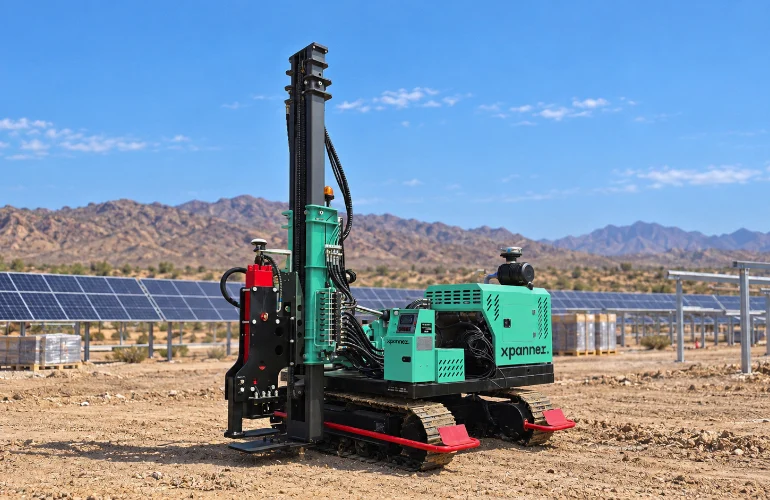
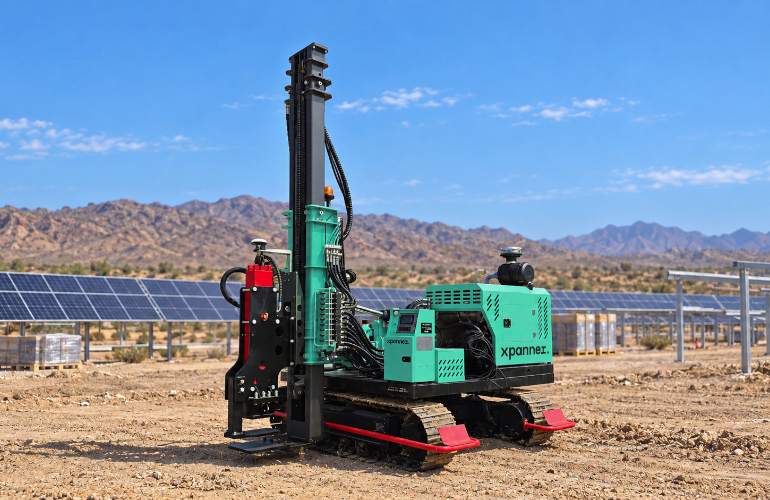
Construction automation pioneer Xpanner has officially announced the commercial launch of the X1 Piling R6, a groundbreaking fully automated pile driving system engineered specifically for utility-scale solar energy installations and battery energy storage system (BESS) sites. Combining Xpanner’s proprietary, field-proven automation technology with the robust Everstar R6 crawler base machine, the X1 Piling R6 is designed to address severe labor shortages, accelerate project timelines, and drastically improve safety standards across renewable energy jobsites.
The system streamlines the historically labor-intensive and multi-stage process of pile driving into a single, automated cycle. Rather than relying on traditional two-person operational crews alongside separate survey, marking, and ground preparation teams, the X1 allows a single operator to manage the entire workflow. By uploading a digital pile plan, walking the machine to the designated row, and pressing a single button, the operator initiates a fully automated sequence. The machine autonomously navigates to each precise coordinate, aligns the structural member, hammers it to the exact required depth, and holds the pile perfectly plumb—all while the human operator supervises safely from a remote controller, completely removing personnel from the immediate danger zone near the mast.
Powered by high-precision Global Navigation Satellite System (GNSS) antennas and receivers, advanced spatial sensors, and an Xpanner-developed automation controller, the X1 Piling R6 achieves unprecedented levels of accuracy regarding location and elevation. Furthermore, it integrates seamlessly with Xpanner Connect, a centralized web-based project management dashboard. This digital ecosystem allows project managers to upload schedules, assign equipment, track real-time installation metrics, and generate automated progress reports, effectively replacing legacy workflows defined by manual counts, phone calls, spreadsheets, and lagging end-of-day documentation.
The commercial rollout is slated for October 26, 2026, and will be delivered via Xpanner’s comprehensive subscription model. This all-inclusive agreement bundles the physical machinery, the X1 automation kit, the Xpanner Connect software platform, and dedicated on-site support—covering everything from initial site validation and demo phases to continuous operation, training, and maintenance.
Chronology of Development and Technological Evolution
The journey toward the release of the X1 Piling R6 represents years of iterative engineering, field testing, and market validation by Xpanner’s development teams.
The Foundation: The PD10 Platform
Xpanner’s footprint in the renewable energy construction sector was initially established through the commercial deployment of its PD10 automation platform. Designed to test the viability of automated positioning and driving in variable field conditions, the PD10 rapidly gained the trust of top-tier engineering, procurement, and construction (EPC) firms across the United States.
Over the course of its deployment lifecycle, the PD10 automation stack was rigorously tested and proven across more than 67 active U.S. jobsites, working in collaboration with over 10 of the nation’s leading solar and energy storage EPCs. This extensive real-world deployment generated invaluable operational data, highlighting both the immense demand for heavy equipment automation and the specific mechanical limitations of legacy carrier vehicles.
Transitioning to the Everstar R6 Crawler Base
Recognizing the need for a more powerful, versatile, and high-performance carrier, Xpanner engineers integrated their refined automation stack into the Everstar R6 crawler base machine. This strategic marriage of software and heavy machinery resulted in the X1 Piling R6.
By upgrading the underlying hardware platform, Xpanner succeeded in dramatically enhancing performance metrics. Most notably, the X1 delivers a 45% faster cycle time compared to its predecessor, the PD10 platform, dramatically increasing the linear footage of piles installed per shift.
Future-Proofing the Platform
Even prior to its official commercial launch, Xpanner has mapped out an aggressive roadmap for the X1 architecture. The company has confirmed that future software updates and hardware attachments will expand the platform’s utility beyond standard pile driving. Upcoming capabilities slated for the system include automated screw driving and pre-drilling functionalities, positioning the X1 Piling R6 as an all-in-one foundation installation tool capable of tackling complex geotechnical conditions without requiring specialized auxiliary equipment.
Supporting Data and Technical Specifications
The economic and operational viability of utility-scale solar and BESS projects heavily relies on the velocity and precision of civil construction phases. Delays in structural foundation installation ripple across the entire project schedule, inflating soft costs and delaying commercial operation dates (COD). The X1 Piling R6 is engineered to dismantle these bottlenecks through a combination of advanced software integration and heavy-duty mechanical engineering.
Operational Efficiency and Labor Transformation
- Cycle Time Improvement: The integration of the X1 automation stack onto the Everstar R6 crawler base yields a 45% increase in cycle speed relative to previous-generation technology.
- Crew Optimization: Conventional pile driving operations demand a minimum two-person crew on the machine, in addition to dedicated personnel for layout, surveying, and pre-marking. The X1 collapses these roles, requiring only a single operator to supervise the automated sequence.
- Safety Milestones: By eliminating the need for workers to stand adjacent to the heavy moving mast during driving operations, the system virtually eliminates struck-by and crush injuries—historically some of the most common and severe hazards on heavy construction sites.
Digital Integration via Xpanner Connect
The Xpanner Connect dashboard serves as the digital nerve center for jobsite logistics. Key data-driven features include:
- Instantaneous Setup: Project teams can load comprehensive pile schedules, coordinate maps, and machine assignments within minutes of arriving on site.
- Real-Time Telemetry: As the X1 drives each pile, the system autonomously logs precise data points—including exact geographic position, final driving depth, and plumb verticality—and instantly publishes them to a live, cloud-based project map.
- Automated Reporting: The platform replaces error-prone manual headcounts, voice-call updates, and disjointed spreadsheets with transparent, automated end-of-day compliance and progress reporting.
- Fleet Management: Project managers can monitor machine operational states, real-time cycle counts, and predictive maintenance alerts across entire multi-machine fleets from a centralized remote portal, reducing the necessity for physical site visits.
Comprehensive Subscription Service Framework
Rather than traditional heavy machinery sales models, Xpanner is deploying the X1 Piling R6 under a vertically integrated subscription model. This service-first approach encompasses:
- All-Inclusive Licensing: A single commercial agreement covers the machinery, the proprietary X1 automation hardware/software kit, cloud software access, and continuous on-site technical support.
- End-to-End Partnership: Xpanner personnel manage service delivery directly, guiding clients from initial site validation and demonstrations through operator training, ongoing maintenance, and regular software enhancements.
- Rigorous Validation: During the pre-construction site validation phase, Xpanner engineers thoroughly review customer pile schedules to verify and optimize planned reveal heights and embedment depths before a single track rolls onto the dirt.
Official Responses and Industry Perspectives
The commercial launch of the X1 Piling R6 comes at a critical juncture for the North American energy market, where the exponential growth of utility-scale generation assets and power-hungry artificial intelligence (AI) data centers has collided with an unprecedented skilled labor crisis in the construction sector.
Addressing the Industry Labor Shortage
Henri Lee, co-founder and Chief Executive Officer of Xpanner, emphasized the socio-economic and logistical pressures facing modern renewable energy developers during the product unveiling.
"Solar and BESS builders are racing to bring new power online for the grid and for AI data centers, and they can’t find enough skilled crews to keep up," stated Henri Lee, co-founder and CEO of Xpanner.
"X1 lets one operator drive every pile plumb with a single touch, keeps people away from the mast, and logs each pile as it goes in. It takes the automation EPCs already trust on PD10 and puts it on a more powerful, more versatile machine."
Lee’s remarks underscore a growing industry consensus: traditional labor recruitment and training pipelines are no longer capable of scaling at the pace required to meet national decarbonization targets and the surging electrical demands of next-generation computing infrastructure. By substituting scarce manual labor with reliable, high-precision automation, technology developers like Xpanner are becoming indispensable partners in the energy transition.
Broader Implications for the Renewable Energy and Construction Sectors
The widespread adoption of fully automated foundation installation systems like the X1 Piling R6 carries profound implications for the future of utility-scale solar and battery storage development.
1. Accelerating Time-to-Market for Critical Infrastructure
With the proliferation of AI data centers requiring massive, uninterrupted blocks of clean energy, the speed at which renewable energy assets can be brought online has become a paramount national security and economic priority. Civil construction—specifically the driving of thousands of steel H-piles or C-piles per megawatt—frequently serves on the critical path of project schedules. A 45% reduction in pile-driving cycle times translates directly into compressed construction schedules, allowing developers to achieve commercial operation months ahead of historical timelines.
2. Radical Improvements in Jobsite Safety and Risk Mitigation
Heavy civil construction remains one of the most hazardous industries in the world. Operating heavy hydraulic pile drivers involves significant risks, including equipment rollovers, structural collapses, and catastrophic pinch-point injuries around the mast and hammer assembly. By removing workers from the danger zone and placing them behind remote supervision interfaces, automation technology drastically reduces workers’ compensation claims, lowers project insurance premiums, and fosters a culture of uncompromising safety on corporate ESG (Environmental, Social, and Governance) scorecards.
3. Data Integrity and Quality Control
In utility-scale solar farms containing hundreds of thousands of individual piles, minor deviations in depth, alignment, or plumb can create cascading alignment issues when mounting solar tracker torque tubes or structural racking systems. Manual surveying and paper logs are notoriously vulnerable to human error, miscommunication, and falsification. The automated digital logging provided by the Xpanner Connect ecosystem ensures absolute quality control and traceability. Every single pile installed is accompanied by an unalterable digital footprint confirming its exact structural integrity, satisfying rigorous engineering specifications and providing permanent auditing documentation for asset owners and institutional financiers.
4. Overcoming Structural Labor Deficits
Rather than displacing human workers, automation in this context serves as a force multiplier that addresses demographic realities. As experienced equipment operators age out of the workforce and younger generations gravitate toward technology-driven fields, systems that bridge the gap between heavy machinery and digital interfaces (such as video-game-style remote controllers and tablet dashboards) make heavy construction careers vastly more appealing to a broader, more technologically adept talent pool. One skilled operator can now oversee the output equivalent of an entire legacy crew, mitigating the bottlenecks imposed by regional labor shortages.
Conclusion
As Xpanner prepares for the commercial launch of the X1 Piling R6 on October 26, 2026, the heavy civil construction landscape stands on the precipice of a permanent paradigm shift. By bridging robust heavy machinery with intelligent software automation, unified project dashboards, and subscription-backed lifecycle support, the company is not merely introducing a new tool to the market—it is helping redefine how the physical infrastructure of the clean energy economy is built.