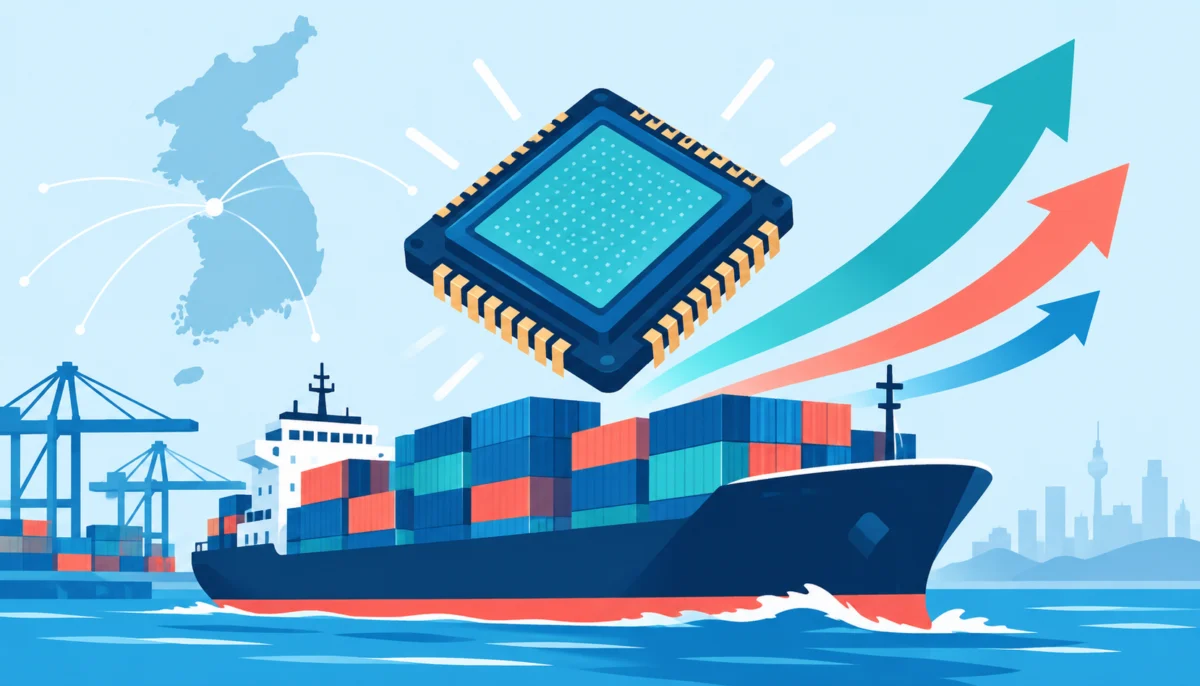
South Korea’s economic engine is firing on all cylinders, reaching a historic zenith as September export figures shattered previous benchmarks. According to the latest data released by the Ministry of Trade, Industry and Resources (MOTIE), the nation recorded a staggering $120.94 billion in monthly exports, an 83.5% surge compared to the same period last year. With imports rising by 26.0% to $71.09 billion, the country secured a record-breaking trade surplus of $49.85 billion.
These figures represent more than just a statistical anomaly; they serve as a definitive indicator of the global appetite for Korean high-technology manufacturing. However, beneath the headline-grabbing numbers lies a nuanced economic reality. While the semiconductor boom acts as a massive tailwind, analysts are increasingly scrutinizing the underlying concentration risks and the distinction between nominal revenue growth and actual domestic value-added production.
The Chronology of a Historic Quarter
The September data serves as the culmination of a year of unprecedented performance. When viewed in the context of the first nine months of the year, the scale of the expansion becomes even more apparent. Cumulative exports from January through September hit $814.5 billion, officially surpassing the $709.3 billion recorded for the entirety of 2025.
Passing an entire year’s worth of historical export volume within just nine months provides necessary context for the September performance. Yet, this trajectory raises fundamental questions regarding sustainability. While the momentum is undeniable, the government’s official accounts—corroborated by reports via Korea.net—highlight that such explosive growth often invites volatility. For investors and policymakers, the transition into the fourth quarter will be a critical litmus test to see if the nation can maintain this accelerated pace or if the current figures represent a temporary peak in a cyclical industry.
Dissecting the Semiconductor Dominance
At the heart of this export surge is the semiconductor industry, which accounted for a massive $60.30 billion in September—representing nearly 49.9% of total export receipts. The MOTIE attributed this expansion to a "perfect storm" of favorable conditions: surging memory demand, increased shipment volumes, and a robust appreciation in contract prices.
The Nuance of Pricing vs. Volume
It is vital for market observers to distinguish between volume-driven growth and price-driven growth. The ministry noted that both factors were at play, but their implications for the future differ significantly. Increased volume often signals robust end-user demand or a strategic replenishment of global inventories. Conversely, rising contract prices often reflect supply-side constraints or a transition toward high-margin, advanced technological products.
Because the current release lacks granular detail on the split between these two drivers, predicting the longevity of the trend remains speculative. If the growth is fueled primarily by supply constraints, a sudden increase in global production capacity could lead to price normalization. If driven by structural shifts toward AI-integrated hardware, the growth may possess greater durability.
The AI Infrastructure Nexus
A secondary, yet equally explosive, data point was the 435.3% surge in computer exports, which reached $7.00 billion. The ministry explicitly linked this to the global adoption of agentic artificial intelligence and the requisite build-out of AI data center infrastructure. This creates a potential "concentration trap." Because both the semiconductor and computer sectors are heavily dependent on the same cohort of global tech giants, the economy’s diversification is more cosmetic than structural. Should global AI spending slow down, these two pillars of the Korean economy would likely experience a synchronized downturn.
Calendar Adjustments and Daily Realities
Headline figures are often susceptible to distortion due to the number of working days in a given month. To provide a more accurate picture of economic health, the ministry published calendar-adjusted figures. Average daily exports rose by 105% to $5.63 billion, confirming that the growth is not merely a result of a favorable shipping schedule but a reflection of deep-seated market demand.
However, even the adjusted daily export value is a dollar-denominated metric. It does not account for fluctuations in the exchange rate or the "imported content" within finished goods. For instance, if a Korean-made server is exported at a high price, but requires massive imports of specialized raw materials or foreign-made components, the net contribution to the domestic economy is significantly lower than the headline export value suggests.
The Energy Price Paradox
The September report offers a masterclass in how global commodity prices can mislead observers regarding physical trade volume. Despite a 72% increase in petroleum product export values, actual physical shipment volumes declined by 6.9%. Similarly, petrochemical exports rose 5.1% in value while volumes plummeted by 19.1%.
These figures demonstrate the impact of global shipping disruptions and rising crude prices. While the increase in export receipts is favorable for the balance of payments, it does not necessarily translate into higher profitability for the refining sector. Refiners face a complex calculus: they must balance the increased cost of importing crude oil—which rose 38% to $12.96 billion—against the price they can command for their finished products. For a manufacturer with fixed-price, long-term contracts, these soaring energy costs represent a direct hit to margins, highlighting that "strong exports" can mask underlying stress in corporate balance sheets.
Geographical Distribution: Global Partners
Korea’s export success remains tethered to its two largest trading partners: China and the United States. Together, these markets accounted for 41.6% of total September shipments. While the growth was geographically broad—with the ministry reporting expansion in six of nine major destination markets—the concentration in the U.S. and China necessitates caution.
Destination statistics are notoriously opaque regarding final consumption. A component shipped to a manufacturing hub in Southeast Asia might be destined for an American end-user, while a product sent to China might be integrated into a supply chain that eventually reaches Europe. As protectionist policies and geopolitical tensions rise, Korean firms face the looming risk of supply chain fragmentation. The ministry has rightly flagged Middle East tensions and global trade policy shifts as primary risks, though it has provided no quantitative assessment of how these risks might manifest in financial losses.
Implications: A Strategic Assessment
For stakeholders, the September trade figures necessitate a shift in how they evaluate the "Korea Story."
1. For Corporate Credit
Lenders should look past the headline growth rates. The correlation between export success and cash availability is not linear. A company may be reporting record-breaking shipments while simultaneously suffering from a liquidity crunch due to the long lead times between production, shipment, and payment collection. Investors should prioritize cash flow statements over income statements and closely scrutinize the capital expenditure cycle of major tech manufacturers.
2. For Sovereign and Currency Risk
While the trade surplus provides a solid foundation for the Korean Won, it does not guarantee a stronger currency. The current account, which includes services and financial transfers, remains the true driver of currency strength. Furthermore, companies may choose to retain foreign currency receipts abroad to hedge against volatility rather than repatriating them, decoupling trade success from currency performance.
3. For Market Sentiment
The current export boom is undeniably strong, but investors should avoid extrapolating this month’s growth rate into the future. The record-setting figures are as much a product of a specific investment cycle in AI and memory chips as they are a testament to Korean industrial competitiveness.
In conclusion, South Korea has delivered a monumental performance, but the path forward is complex. The economy is currently benefiting from a massive, singular investment wave. The true challenge will be managing the transition from this record-breaking peak to a more sustainable, diversified, and profitable growth model in the quarters to come. For now, the "headline" is impressive, but the "fine print" remains the true indicator of long-term economic resilience.