By Zaki Laïdi
Published: October 12, 2026
Main Facts
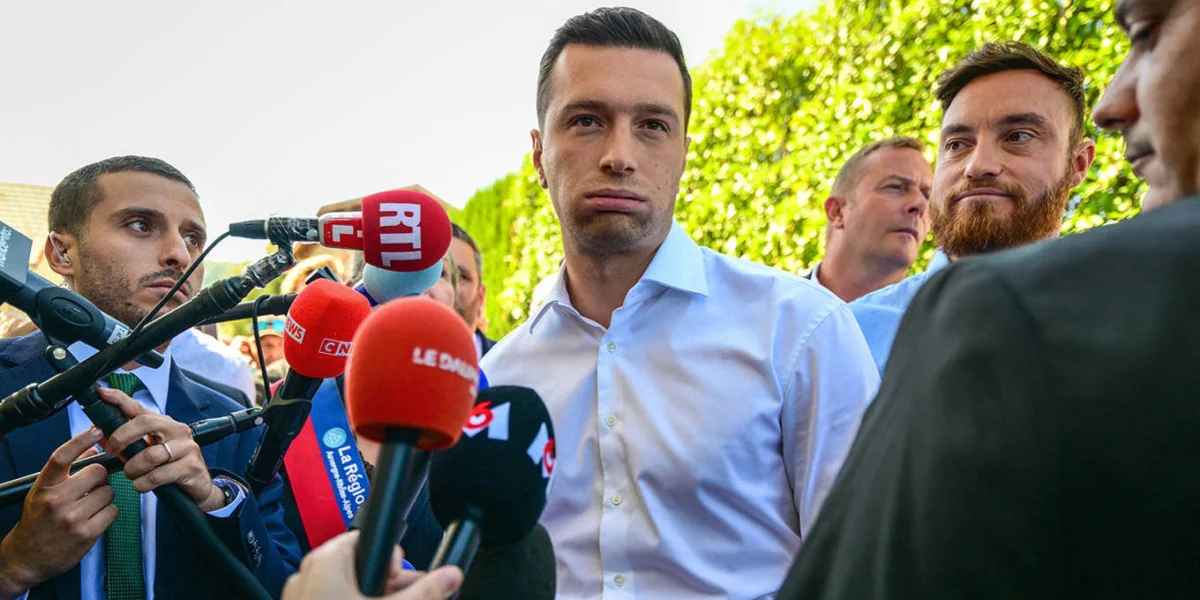
As France looks toward the high-stakes presidential election of spring 2027, the political landscape is dominated by a singular, increasingly probable trajectory: the ascent of Marine Le Pen to the Élysée Palace. For years, the leader of the far-right Rassemblement National (National Rally, or RN) has meticulously engineered a strategy of mainstream normalization, scrubbing the party’s historic associations with xenophobia and antisemitism. Central to this calculated packaging is Jordan Bardella, the youthful, slick, and publicly ubiquitous president of the RN.
To the international community, Bardella remains a relatively unfamiliar figure. Yet, within France, he is a household name, heavily promoted by Le Pen as the designated prime minister of her prospective administration. This carefully scripted succession plan, however, has hit a severe turbulence following a wave of explosive revelations regarding antisemitic comments linked to or defended by Bardella’s inner circle and his past political trajectory.
The core crisis centers on whether this mounting scandal will force a strategic rupture between Le Pen and her protégé, or if the party’s resilient core electorate—and a desensitized public—will simply shrug it off. Political analysts currently weigh three distinct scenarios:
- The Quick Fade: The scandal dissipates under the weight of news fatigue, allowing Le Pen to proceed uninterrupted with her joint ticket.
- The Strategic Discard: The pressure becomes politically unsustainable, forcing Le Pen to sideline Bardella to protect her overarching presidential ambitions.
- The Ideological Fracture: The revelations trigger deeper infighting within the RN, alienating moderate conservatives whom Le Pen has spent years courting.
Regardless of which trajectory materializes, the current crisis exposes the fragility of the RN’s rebranding effort, dragging historical ghosts back to the forefront of French political discourse.
Chronology of a Crisis: How the Scandal Unfolded
To understand the gravity of the current political moment, it is necessary to trace how the National Rally’s image management collided with persistent historical realities.
Phase 1: The Rebranding and the Rise of Bardella (2021–2024)
Following her defeat in the 2022 presidential runoff to Emmanuel Macron, Marine Le Pen doubled down on her dédiabolisation (detoxification) strategy. She officially stepped down as party leader, handing the reins to Jordan Bardella—then just 27 years old. Bardella represented the modern face of the RN: technocratic, hyper-focused on purchasing power, immigration, and security, and seemingly detached from the overtly neo-fascist origins of the party’s predecessor, the National Front (FN) founded by Jean-Marie Le Pen. Under Bardella’s stewardship, the RN triumphed in the 2024 European Parliament elections, setting the stage for his positioning as the inevitable prime minister in a 2027 Le Pen government.
Phase 2: The Cracks in the Facade (Late 2025–Mid 2026)
As the RN’s poll numbers continued to climb, investigative journalists and political opponents began scrutinizing Bardella’s early political associations and the digital footprints of key figures within his youth movement. Old social media posts, questionable academic networks, and associations with radical nationalist student groups resurfaced. While Bardella attempted to project an image of absolute civic republicanism, critics pointed to persistent ambiguities regarding the party’s historical minimization of Vichy collaboration and the Holocaust.
Phase 3: The Boiling Point (September–October 2026)
The crisis escalated sharply in the autumn of 2026 when new documentation emerged linking members of Bardella’s immediate political circle to explicit antisemitic tropes and online subcultures. The revelations forced the RN into a defensive posture reminiscent of the party’s darkest historical eras. Rather than treating the incidents as isolated anomalies, opponents framed them as evidence that the party’s detoxified exterior was merely a superficial veneer masking deep-seated ideological continuity with its extremist past.
Supporting Data and Polling Insights
Despite the gravity of the allegations, the political resilience of the National Rally remains one of the most studied phenomena in contemporary European politics.
- Electoral Momentum: According to recent polling aggregators, including tracking data from the IFOP group, Marine Le Pen commands a commanding lead in hypothetical first-round matchups for the 2027 presidential election, often polling between 33% and 36% of the vote.
- The Prime Ministerial Factor: Surveys indicate that a significant portion of Le Pen’s electorate views Jordan Bardella as an asset who broadens the party’s appeal among younger, tech-literate voters who might otherwise be hesitant to vote for traditional figures. However, recent focus groups show that moderate and center-right voters—crucial for securing a majority in a potential legislative election—are deeply sensitive to scandals involving antisemitism and historical revisionism.
- Voter Desensitization: Political scientists note a growing phenomenon of "scandal fatigue" among the French electorate. Years of political crises, high inflation, and polarizing social debates have created an environment where normative boundaries of political behavior are frequently tested, sometimes blunting the impact of traditional media exposés.
Official Responses and Political Reactions
The fallout from the scandal has triggered sharp reactions across the French political spectrum, forcing both the ruling establishment and the opposition to recalibrate their strategies.
The National Rally Defense
Internally, the RN has adopted a dual strategy of aggressive denial and media management. Marine Le Pen has publicly stood by her protégé, dismissing the allegations as a coordinated "smear campaign" orchestrated by a panicked political establishment desperate to halt her momentum. Bardella himself has issued categorical condemnations of antisemitism, framing his political project as fully compliant with the republican values of the French Republic. RN spokespersons argue that the media is dredging up ancient history to distract from the failures of the current government on security and the economy.
The Center and Left Outcry
Predictably, opponents from both the left-wing Nouveau Front Populaire (NFP) and the centrist parliamentary bloc have seized upon the controversy. They argue that the scandal proves the RN’s rebranding is a sham.
- "You can change the packaging, but the product inside remains fundamentally toxic," remarked a prominent centrist lawmaker during a National Assembly debate.
- Left-wing leaders have called for heightened vigilance, arguing that normalizing the far right poses an existential threat to France’s democratic fabric and minority communities.
Civil Society and Community Leaders
Representative institutions of the French Jewish community, such as the Conseil Représentatif des Institutions Juives de France (CRIF), have expressed profound alarm. While acknowledging the RN’s tactical efforts to distance itself from its founder Jean-Marie Le Pen—who was repeatedly convicted for Holocaust denial and antisemitic remarks—community leaders emphasize that old habits, dogwhistles, and questionable associations continue to plague the party’s ranks.
Implications for France’s 2027 Horizon
The unfolding scandal surrounding Jordan Bardella is far more than a transient media controversy; it is a stress test for the entire French political architecture ahead of 2027.
Scenario A: The Resilient Ticket
If the scandal burns out quickly—absorbed by an electorate increasingly numb to political outrage—Marine Le Pen will emerge politically emboldened. It will demonstrate that the RN’s core narrative has achieved structural immunity to historical critiques. In this outcome, Bardella remains prime minister-designate, and the party continues its steady march toward the Élysée, altering the geopolitical orientation of France and the European Union.
Scenario B: The Sacrificial Lamb
Should the political cost become too steep, Le Pen may be forced to make a ruthless calculation. To secure the elusive moderate and center-right voters necessary to win a second-round presidential runoff, she could sideline Bardella, replacing him with a more technocratic, scandal-free figure. While this would temporarily disrupt the party’s internal hierarchy, it could successfully neutralize the opposition’s most potent line of attack.
Scenario C: The Ideological Fracture
The most dangerous scenario for the RN involves deep internal polarization. If the revelations provoke an open factional war between the party’s hardline ideological traditionalists and its modernizing technocrats, Le Pen’s disciplined facade could fracture. This would open a vital window of opportunity for a revitalized center or left-wing coalition to reassert itself before the ballots are cast in 2027.
Conclusion
As France navigates this turbulent political climate, the Bardella paradox serves as a stark reminder of the complexities of democratic resilience. Whether the far right succeeds in completing its march to power or stumbles over the ghosts of its past will depend largely on how the French electorate weighs the polished promises of the present against the dark echoes of history.