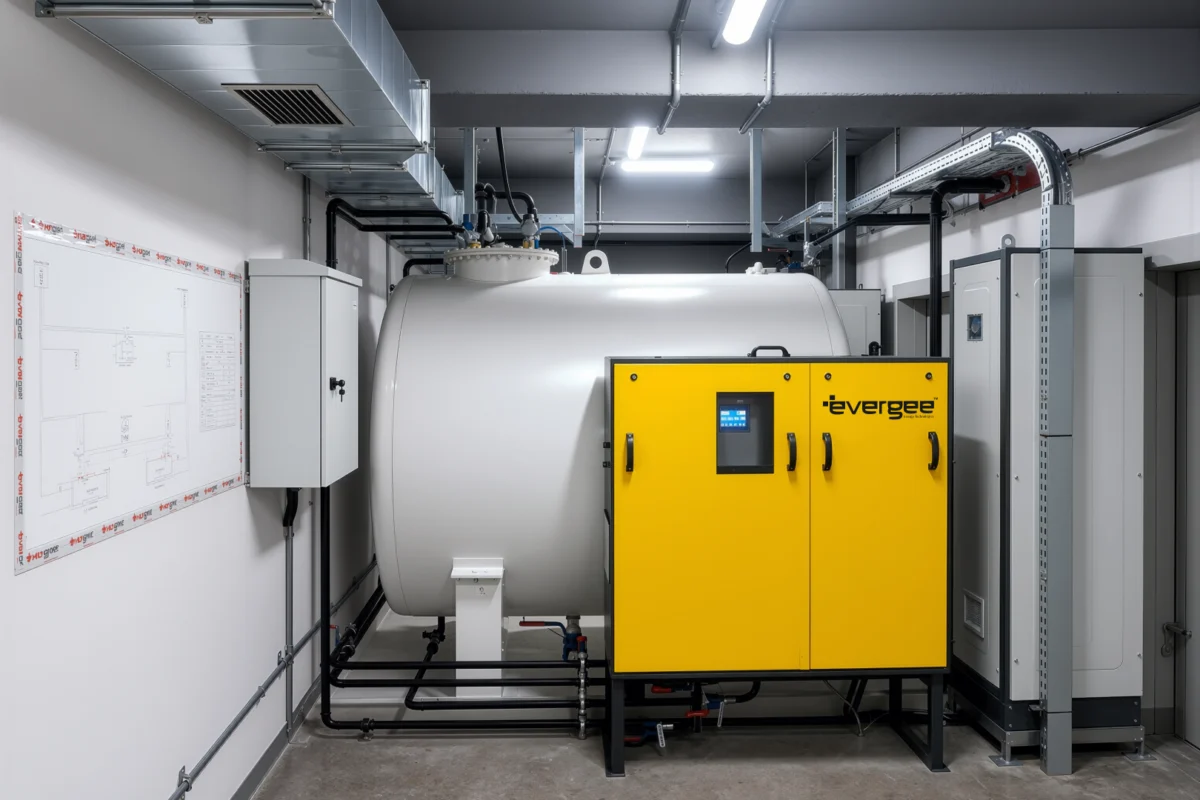
Most enterprise architecture diagrams are masterpieces of digital planning. They map the complex relationships between ERP systems, production planning modules, transport software, and the intricate web of integrations that hold a modern enterprise together. They meticulously detail the server racks, the cloud instances, and the redundancy protocols. However, these diagrams almost always stop at the physical layer of the server rack.
Buried beneath the floorboards of the server room—or hidden in the utility yard—lies a critical component that rarely appears on any boardroom slide deck: the fuel supply for the standby power system. In the world of high-availability infrastructure, we operate under a comforting assumption: when the grid fails, the Uninterruptible Power Supply (UPS) will bridge the gap, the generator will roar to life, and business will continue as usual.
But what if the generator, perfectly serviced and tested, refuses to run? The risk is not that the fuel is absent; the risk is that the fuel is present, but it has become a chemical liability.
The Illusion of Continuity: The Handover Gap
In a data center environment, battery autonomy is a luxury of time, usually measured in mere minutes—often between ten and fifteen. This brief window is not intended for long-term operations; it is a tactical bridge designed for one sole purpose: to keep the servers running until the standby generator starts, synchronizes, and assumes the full electrical load.
If the generator performs as expected, the transition is seamless; the end-user remains blissfully unaware that a power outage ever occurred. However, if the generator fails to pick up that load, the UPS batteries reach their chemical limit, the servers suffer an ungraceful shutdown, and the enterprise effectively goes dark mid-transaction.
The entire model of modern business resilience rests on this high-stakes, sub-ten-minute handover. When viewed through this lens, the generator is not merely a "facilities" asset; it is a fundamental pillar of the IT infrastructure. If the generator fails, the IT strategy fails.
What Stops When the Servers Go Dark?
The consequences of a power failure are rarely limited to the IT department. The cascading effects are immediate and severe. When the servers stop, data in flight is frequently corrupted or left in an inconsistent state. Financial penalties associated with Service Level Agreements (SLAs) are triggered, but the operational cost is far higher.
The enterprise architecture that goes dark is the nervous system of the company. Order entry systems vanish. Production planning halts, leaving the factory floor paralyzed. Warehouse management systems lose the ability to allocate stock or print shipping labels, and logistics software loses contact with the transport fleet. A localized power failure in one building can, within minutes, manifest as a total supply chain collapse.
Furthermore, recovery is rarely as simple as flipping a switch. When power is restored, the "real work" begins: databases must be verified for integrity, interfaces must be restarted in a specific sequence, and half-completed transactions must be reconciled. The cost of this recovery process is measured in lost productivity, damaged reputation, and significant man-hours.
The Chemistry of Decay: What Happens to Diesel While It Waits?
Diesel fuel is often treated as an inert, stable commodity, but in reality, it is a complex organic mixture that degrades over time. When stored in a tank for years, the fuel undergoes a predictable, destructive transformation.
1. Oxidation
When diesel is exposed to oxygen over extended periods, it undergoes oxidation. This chemical process results in the formation of gums and fine sediments. These materials are essentially the "tars" of the fuel world, and they are notorious for clogging fuel filters and injectors.
2. Moisture Accumulation
Tanks are not hermetically sealed; they "breathe" as ambient temperatures fluctuate. As the tank draws in air, moisture condenses on the cold internal walls and drips into the fuel. Because water is denser than diesel, it sinks to the bottom of the tank, creating a stagnant pool of water beneath the fuel supply.
3. Microbial Proliferation
Diesel fuel naturally contains trace amounts of bacteria and fungi. These organisms are largely dormant until they encounter a water-fuel interface. This boundary provides both the hydration and the carbon-based food source required for rapid colonization. The resulting microbial mats can grow at an alarming rate, further contributing to the degradation of the fuel.
4. Sludge Formation
The combination of oxidation products, water, and dead microbial biomass settles at the bottom of the tank as a dark, viscous sludge. While the fuel gauge may show a "full" tank, the reality is that a significant percentage of that volume is no longer burnable fuel. It is a toxic cocktail that, if drawn into the engine, will inevitably cause a mechanical failure.
The False Security of the Monthly Test
The most dangerous misconception in facility management is the reliance on the monthly generator test.
During a routine, unloaded, or lightly-loaded test, the generator runs for a few minutes. Because the engine is not under significant stress, it consumes very little fuel. The contaminated sludge at the bottom of the tank remains undisturbed, and the fuel system—even with degraded fuel—is often capable of passing the light-load test. The maintenance team signs the logbook, and the organization checks the "resilience" box.
However, a real-world outage is fundamentally different. When the generator is required to carry the full site load for several hours, fuel consumption spikes. The high flow rate creates a vortex that draws the accumulated sludge from the bottom of the tank toward the suction line. Filters that were sufficient for a five-minute test become instantly clogged by the mobilized sediment. The injectors, struggling to atomize contaminated fuel under high-pressure, high-load conditions, begin to fail.
The generator might start, hum along for a few minutes, and then die as the filters blind over. By then, the UPS batteries are already depleted, and the data center crashes.
| Feature | Routine Monthly Test | Real Power Outage |
|---|---|---|
| Run Time | A few minutes | Hours (Duration of outage) |
| Load | Minimal or None | Full site load |
| Fuel Flow | Low | High and continuous |
| Sediment | Undisturbed at tank base | Agitated and drawn into lines |
| What it Proves | The engine can start | The fuel can sustain the engine |
Implications for Critical Infrastructure
The implications of this oversight extend far beyond corporate ERP systems. In environments such as hospitals, the failure of a backup power supply is not just a commercial disaster; it is a life-safety crisis. Intensive care units, surgical theatres, and life-support systems depend entirely on the reliability of that fuel.
Similarly, airport runway lighting, radar systems, telecommunications, and military command centers all rely on the same "fire-and-forget" mentality regarding their fuel. They assume that because they have a generator, they have power. They do not realize that the fuel is the single point of failure in their entire resiliency chain.
Establishing a Standard of Care: Fuel Maintenance and Polishing
The industry standard for mitigating this risk is twofold: rigorous testing and active fuel maintenance (polishing).
Standards like ASTM D975 (North America) and EN 590 (Europe) provide the benchmarks for diesel quality. Organizations should adhere to NFPA 110, which mandates that stored fuel be tested at least annually. Crucially, the sample must be drawn from the very bottom of the tank. A sample taken from the middle of a tank will almost always appear clean, masking the danger lurking below.
Testing, however, is merely diagnostic; it does not solve the problem. The solution is fuel polishing. This process involves cycling the stored fuel through a series of staged filters and water separators. It removes the moisture before it can support microbial growth and strips out the particulates before they reach the engine.
While a one-time cleaning of the tank can reset the clock, the nature of a storage tank—the breathing, the condensation, the degradation—means this is a continuous process. Implementing a scheduled fuel maintenance program is the only way to ensure that the fuel is as ready for the outage as the engine itself.
Critical Questions for the Next Continuity Review
As organizations update their business continuity and disaster recovery plans, the following questions must be integrated into the agenda:
- When was the last time a fuel sample was drawn from the bottom of our storage tank, and what was the lab result?
- Does our current generator testing protocol involve a load bank test that mimics a real-world power outage?
- What is our RTO (Recovery Time Objective) if the standby generator fails to start during a primary power failure?
- Is our fuel management policy documented, budgeted, and audited with the same rigor as our server uptime protocols?
If the stakeholders in the room cannot provide a definitive answer to the first question, that is where the resilience plan begins to break down.
Conclusion: Bridging the Gap
Enterprise resilience is often measured exclusively at the application layer: failover times, database replication, and RTO/RPO metrics. Yet, all of these advanced technical safeguards are predicated on the assumption that the physical infrastructure will hold.
If the generator is the heartbeat of the data center during a crisis, the diesel fuel is the blood. Just as an engine requires clean fuel to function under load, an enterprise requires a proactive strategy to maintain the health of its backup energy supply. The time to discover that your fuel is compromised is not during a catastrophic grid failure. By shifting the perspective of fuel maintenance from a minor "facilities task" to a mission-critical IT imperative, organizations can ensure that when the lights go out, the business continues to shine.