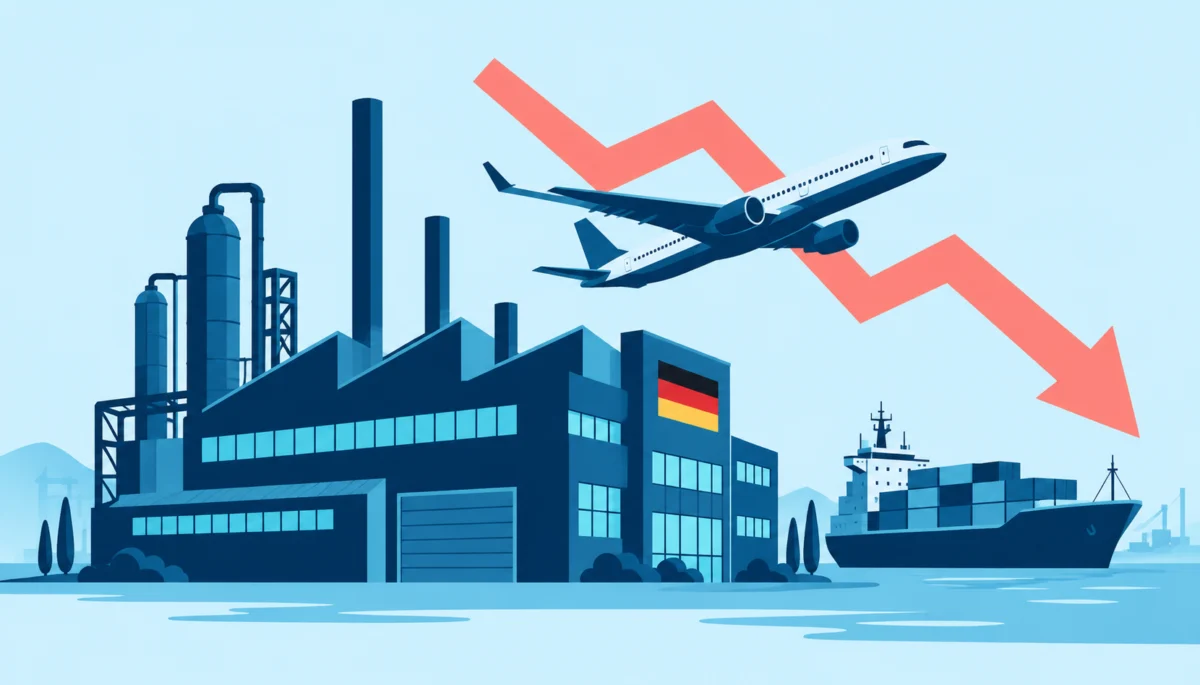
Executive Summary: A Misleading Headline
On October 6, Germany’s federal statistical office, Destatis, released provisional, price-adjusted data revealing a 10.6% contraction in manufacturing orders for August compared to July. At face value, the figure suggests a harrowing collapse in the industrial engine of the Eurozone. However, beneath this headline number lies a complex narrative of volatility, heavily skewed by the "lumpy" nature of large-scale transport contracts.
When these erratic, high-value orders are stripped away, the decline narrows to a negligible 0.1%. This discrepancy underscores a critical analytical challenge for investors, lenders, and policymakers: the aggregate headline figure serves as a poor proxy for the true breadth of industrial health. For those tasked with assessing credit risk or forecasting economic output, the data demands a granular decomposition of order books rather than a reactive interpretation of broad indices.
Chronology of Recent Industrial Data
The German industrial landscape has been defined by a series of revisions and contrasting performance metrics over the third quarter of 2026:
- September 17: Destatis released the July backlog report, showing a 1.5% monthly increase in outstanding orders and a robust 10.9% year-on-year rise, suggesting that prior to the August shock, manufacturing firms were sitting on substantial work-in-progress.
- Late September: Destatis reported a 1.1% fall in real industrial output for July, with automotive production taking a 9.2% hit, highlighting that even when orders were strong, operational output was already facing headwinds.
- October 6: The release of August manufacturing orders. The 10.6% drop was revealed as a direct mathematical reversal of July’s "exceptional" 129.4% surge in "other transport equipment" orders (a category that typically includes ships, aircraft, and trains).
- The Three-Month Trend: When smoothing the volatility across the June–August period, total orders rose by 1.3%. However, even this modest gain is challenged by the fact that orders excluding large contracts fell by 2.6%, suggesting a quiet, underlying erosion of demand that is being masked by the occasional "mega-contract."
Supporting Data: Why "Lumpiness" Distorts Reality
The "other transport equipment" sector—notorious for its irregular order patterns—is the primary culprit behind the headline distortion. A single multi-billion-euro contract for a fleet of aircraft or a series of commercial ships can swing monthly national data by double digits.
The Composition of the Decline
The August data reveals a sharp fragmentation in the manufacturing sector:
- Capital Goods: This segment, which is highly sensitive to interest rates and business confidence, saw orders plummet by 15.3%.
- Domestic vs. Foreign: Domestic orders dropped by 17.3%, while foreign orders saw a more moderate decline of 5.4%. This suggests that the current weakness is significantly concentrated within the German internal market, potentially reflecting domestic fiscal uncertainty or high energy costs.
- The Revised July Base: It is essential to note that July’s total manufacturing gains were revised upward to 3.2% from an initial 2.5%, further emphasizing that the August drop is, in large part, a "mean reversion" from an unusually strong mid-summer performance.
Official Perspective and Contextual Nuance
Destatis’s framework for manufacturing indicators is designed to distinguish between new orders, outstanding orders (the backlog), production, and turnover (sales). The confusion often arises when market observers conflate these categories.
The Role of the Backlog
A significant backlog can act as a shock absorber. Even as new demand weakens, manufacturers can remain operational by burning through orders secured months or years prior. The 10.9% year-on-year increase in backlogs reported in September suggests that, for many firms, the August order slump does not translate into an immediate cessation of production.
However, the "conversion" of this backlog is the true point of risk. For a credit committee, the question is not "how many orders are in the book," but "how effectively can the borrower convert that work into cash?" This depends on:
- Milestone Billing: Does the contract allow for cash inflows during the construction phase, or is payment tied to final delivery?
- Cancellation Rights: Can the client walk away from the contract if the economic environment sours?
- Working Capital Intensity: Does the long delivery schedule require the manufacturer to fund significant upfront costs before the final invoice is settled?
Implications for Credit and Investment
For institutional investors and lenders, the August data provides a warning against relying on macroeconomic aggregates.
The Lender’s Perspective: Risk Mitigation
A company exposed to a delayed ship delivery faces an idiosyncratic risk—a liquidity crunch caused by a single client’s inability to pay. Conversely, a supplier losing repeat orders across hundreds of small customers faces a systemic decline in demand. The aggregate Destatis index cannot distinguish between these two risks.
Lenders should shift their focus toward:
- Customer Concentration: Identifying if a significant portion of the order book is tied to a single, potentially vulnerable entity.
- Order Conversion Timing: Evaluating the cash-flow cycle of the backlog.
- Stress Testing: Separating the risk of a "delayed contract" from a "cancelled contract." A delay may justify extending a working-capital facility, whereas a cancellation may leave a firm with specialized, illiquid inventory.
Sovereign Risk and the Wider Economy
While the media often frames these releases in terms of an impending "national recession," the data does not support such a binary conclusion. The decline in new orders does not immediately equate to job losses. Manufacturers, fearing the difficulty of rehiring in a tight labor market, are often willing to "buffer" their workforce for several months using existing backlogs.
Sustained industrial weakness, however, eventually exerts pressure on the tax base. If the trend of falling orders persists for several quarters, the German government may face mounting pressure for public support or industrial subsidies. Currently, the evidence is too thin to warrant a fundamental shift in sovereign debt outlooks.
Macroeconomic Environment: The ECB and Financing Constraints
The European Central Bank’s (ECB) September 10 decision to raise policy rates to 2.5% creates a challenging backdrop for manufacturers. It is critical to recognize the timing: the August order data precedes this rate hike. Therefore, the decline cannot be blamed on the latest round of monetary tightening, but rather on the environment of elevated rates that preceded it.
The Cost of Capital
Higher financing costs impact manufacturers differently based on their capital structure.
- Fixed-rate debt: Firms that locked in lower rates previously may be shielded from the immediate impact of the ECB’s hiking cycle.
- Floating-rate reliance: Companies financing inventory through floating-rate facilities will see their margins compressed, regardless of the strength of their order book.
The ECB’s stance—that it will remain data-dependent—means that industrial releases like this one are merely inputs into a broader mosaic that includes services activity, inflation, and financial conditions. A weak manufacturing print may bolster the "dovish" camp within the ECB, but it is unlikely to trigger a pivot on its own.
Analyst’s Concluding View
The August manufacturing report is a study in "signal vs. noise." The 10.6% drop is an artifact of timing and contract structure, not an indicator of a sudden industrial collapse.
Moving forward, market participants should prioritize the following:
- Persistence: We need to see if the weakness in "orders excluding large contracts" continues over the next three months. A consistent decline here would be far more indicative of structural demand decay than a single volatile month.
- Conversion Efficiency: Monitor whether firms are successfully delivering on their backlogs. A high backlog is only valuable if the firm has the liquidity to see the projects to completion.
- Operational Resilience: Watch for news regarding order cancellations or shifts in utilization rates. If companies begin to report that customers are invoking penalty-free cancellation clauses, that is the moment to signal a shift from caution to defensive positioning.
Ultimately, the German industrial sector is navigating a period of transition characterized by high capital costs and global trade uncertainty. The current data provides a mandate for closer, firm-level scrutiny rather than a justification for broader market panic. Manufacturers that demonstrate strong contract protections and stable cash-flow cycles will remain viable, even as the aggregate headline continues to capture the headlines.