By Romario Gumulia
In the high-stakes world of industrial fabrication, a silent crisis has been brewing. As global demand for precision components in electric vehicles (EVs), aerospace, and advanced industrial automation reaches a projected market valuation of US$67.0 billion by 2026, manufacturers find themselves caught in a paradox. They are sitting on a goldmine of opportunity, yet they are increasingly unable to capitalize on it due to a widening gap between human capacity and industrial requirements.
The path forward for competitive manufacturing no longer lies in adding more floor space or buying more rigid, traditional machinery. Instead, it lies in a fundamental paradigm shift: bridging human ingenuity with machine intelligence.
The Triple Bottleneck: Why Traditional Automation is Failing
Modern original equipment manufacturers (OEMs) are currently battling a "perfect storm" of structural constraints. The primary obstacle is a staggering labor shortage. According to data from the American Welding Society, the U.S. manufacturing sector will face a deficit of 320,500 welding professionals by 2029. This is not merely a quantitative loss of labor; it is a qualitative loss of "tribal knowledge." Expert welders possess the cognitive ability to interpret visual cues and adjust their technique—changing travel speed, weave width, and torch angles—in response to heat fluctuations or material irregularities. As this demographic retires, the industry is struggling to backfill those critical skills.
The second bottleneck is the scarcity of expert robot programmers. Traditional industrial automation is brittle. It requires highly specialized technicians to spend hours on teach-pendants, manually coding every path. In high-mix, low-volume shops—where no two assemblies are ever identical—the time spent programming often outweighs the time spent welding.
Finally, there is the issue of "real-world messiness." Traditional robots are designed for the clinical environment of an automotive assembly line, where parts are stamped to sub-millimeter precision. In heavy fabrication, however, parts vary. Flame-cut edges fluctuate, fit-up gaps are rarely perfect, and thermal distortion during welding creates a dynamic environment that renders static, pre-programmed robotic paths obsolete. When a robot is programmed to follow a fixed trajectory, it cannot "see" when a joint geometry changes; it simply continues the path, often resulting in costly rework, lack of penetration, or catastrophic burn-throughs.

Chronology of an Industrial Pivot
The trajectory of welding automation has evolved through three distinct eras:
- The Era of Manual Craft (Pre-1980s): Welding was entirely dependent on human skill. Productivity was limited by the physical endurance and cognitive load of the welder.
- The Era of Rigid Automation (1980s–2020): Manufacturers adopted industrial robots to achieve consistency. While these machines excelled in high-volume, low-variety scenarios, they required an expensive infrastructure of jigs, fixtures, and constant manual programming to remain functional.
- The Era of Intelligent Adaptability (2020–Present): We have entered the age of "Physical AI." This transition, marked by the integration of high-speed computer vision, deep learning, and real-time motion control, allows robotic cells to move from "blind" execution to autonomous perception.
Platforms such as Novarc Technologies’ NovAI have emerged as the vanguard of this shift. By transforming rigid cells into flexible, intelligent systems, these platforms represent a departure from the "set-it-and-forget-it" mentality that has hindered the industry for decades.
The Science of "Physical AI": How It Works
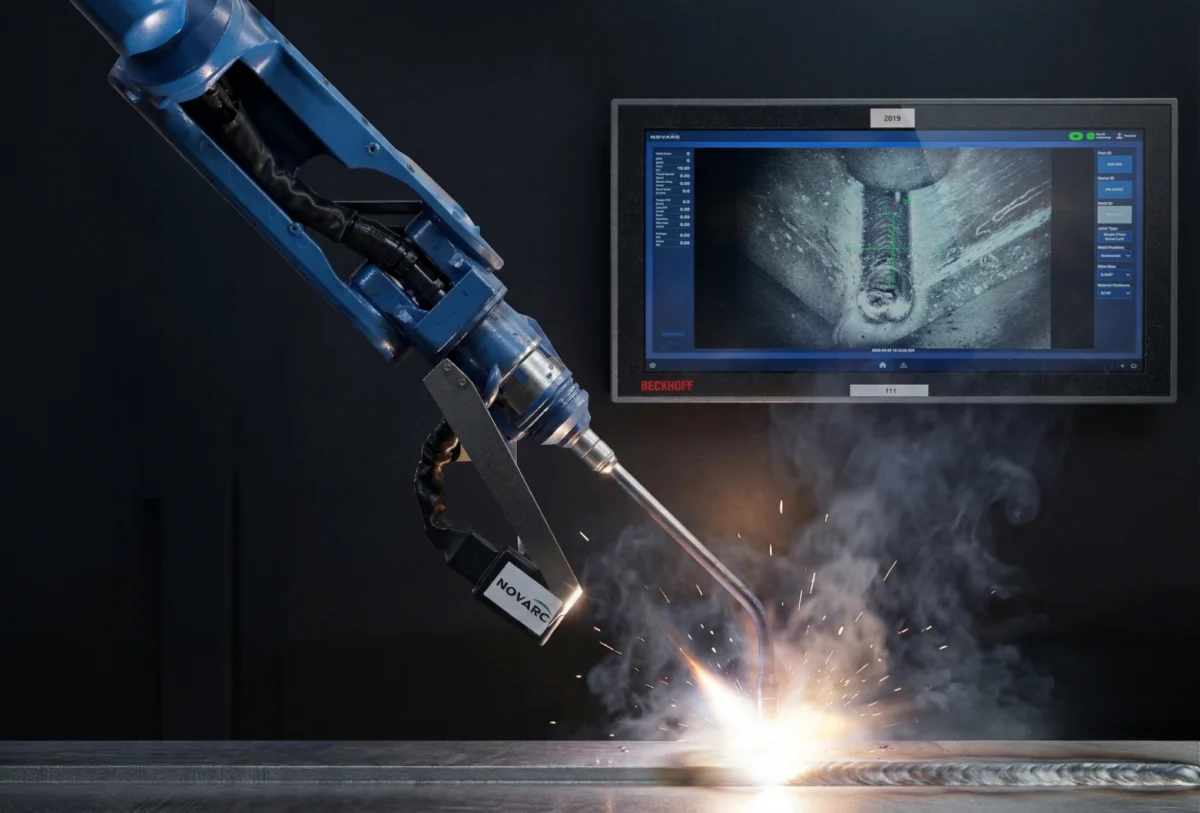
At the heart of this transformation is a sophisticated sensory suite. In advanced adaptive systems, an optical sensor is mounted directly near the torch. This sensor captures weld seam data at high frequencies, processing information milliseconds ahead of the arc.
The process follows a closed-loop intelligence cycle:
- Vision Capture: The system maps joint geometry, robot trajectory, and the molten weld puddle in real-time.
- Cognitive Analysis: Trained neural networks interpret the visual feed. They identify fit-up variations, root gaps, and tack weld locations that would cause a traditional robot to fail.
- Autonomous Modulation: The system makes micro-adjustments to arc voltage, wire feed speed, weave amplitude, and torch travel speed.
- Continuous Feedback: The data gathered during the weld is logged, providing a historical trail that allows for the continuous optimization of future production runs.
If a root gap widens mid-pass, the AI does not stop the machine to wait for a technician. Instead, it seamlessly expands the weave pattern and adjusts wire delivery. This is the hallmark of human-like adaptability, applied to a robotic scale.
Supporting Data and Technical Implications
The technical implications of replacing static programming with AI-driven autonomy are profound. By utilizing tools like NovPlan, fabricators can move from CAD-based design directly to the shop floor, bypassing the tedious manual teaching process.

Efficiency Metrics:
- First-Pass Quality: Adaptive systems significantly reduce the frequency of defects such as undercuts, lack of penetration, or blow-throughs.
- Fixture Reduction: Because the AI dynamically compensates for part placement, the need for ultra-precise, expensive, and rigid custom jigs is drastically reduced. This lowers the entry barrier for shops handling complex, high-variety projects.
- Arc-On Time: By minimizing the need for manual intervention and rework, these systems maximize the "arc-on" time—the primary metric for profitability in welding.
The Role of the Human Operator
A common misconception regarding AI in manufacturing is that it intends to replace the human element. In reality, the most successful implementations are those that "up-skill" the human worker.
In an AI-augmented shop, the role of the welder evolves. Instead of performing the grueling, repetitive task of manual welding, the operator acts as a "Cell Manager." A single operator can oversee multiple automated cells, managing the logistics of parts and supervising the AI’s performance. This allows manufacturers to retain the expertise of their veteran welders in high-value, complex roles while junior staff are trained to operate high-tech, intelligent systems. It turns a manual labor job into a technical, high-value career path, which is crucial for attracting the next generation of manufacturing talent.
Retrofitting vs. New Deployment: A Scalable Path
One of the most significant barriers to industrial innovation is the cost of capital equipment. Many shops have millions of dollars invested in legacy robotic cells.
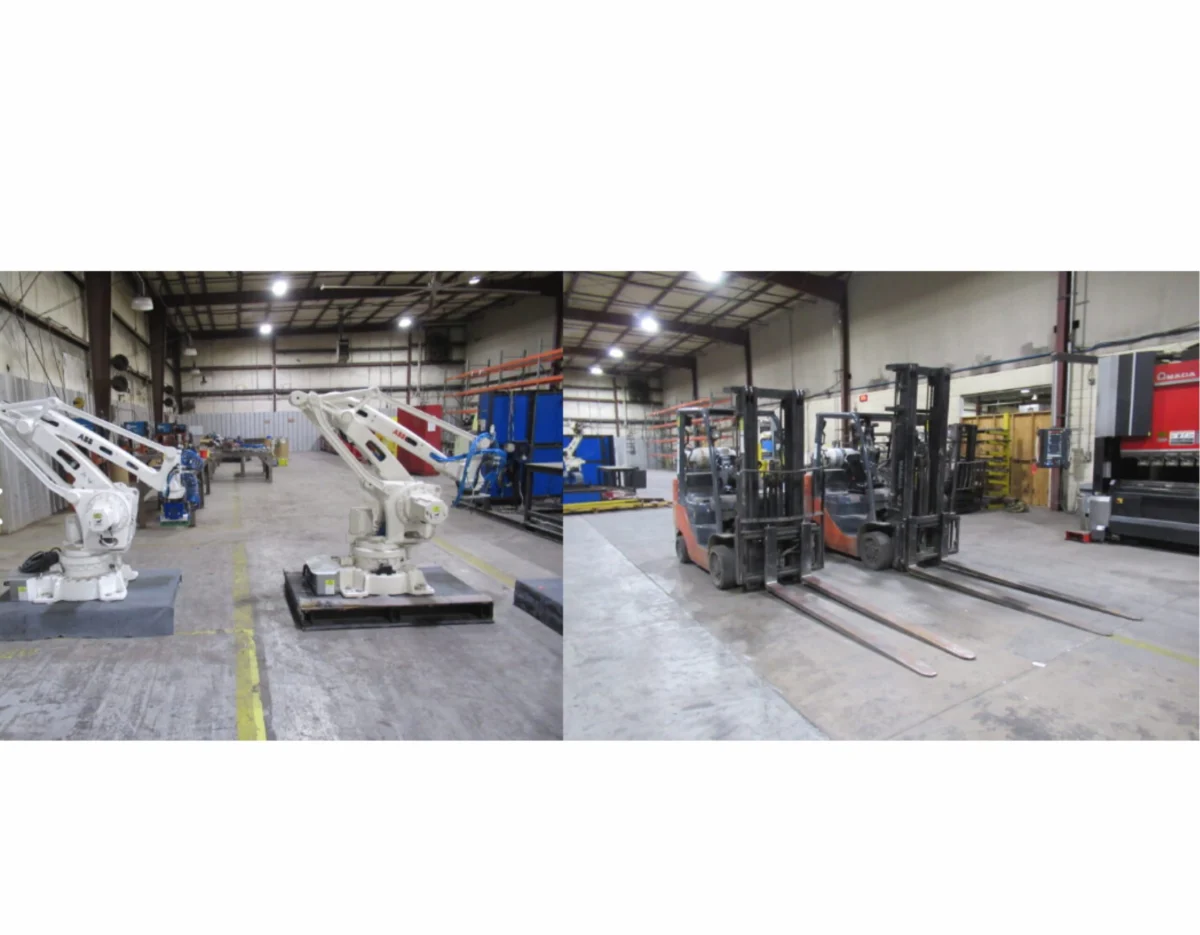
The industry is responding with a "modular intelligence" approach. Advanced AI suites are being engineered for retrofitting onto existing, "blind" 6-axis robot platforms. By installing specialized sensor hardware and a central computing module, a legacy workstation can be transformed into an adaptive, high-precision unit.
Furthermore, these systems are being designed with multi-robot compatibility, integrating with industry leaders like ABB and Yaskawa. This allows a shop with a diverse fleet of robots to standardize their operations under one software umbrella. Whether a shop is building structural steel frames, modular electrical skids, or heavy machinery, the ability to deploy the same intelligent platform across different hardware makes the ROI of AI adoption significantly more attractive.

Implications for Market Competition
In the coming years, the divide between manufacturers will be defined by their adoption of these technologies. Shops that remain constrained by the "three bottlenecks"—labor shortages, programming scarcity, and part variability—will find themselves unable to compete on speed or cost.
Those who embrace adaptive welding, however, gain three distinct competitive advantages:
- Bid Competitiveness: With predictable, scalable capacity, firms can bid on larger, more complex projects that competitors would deem too risky or labor-intensive.
- Resilience: The ability to absorb variations in materials and fit-up makes a shop more resilient to supply chain inconsistencies.
- Quality Assurance: As industries like aerospace and EV manufacturing demand higher levels of traceability and quality, the digital logs provided by AI-driven systems become a competitive differentiator in themselves.
Future-Proofing the Shop Floor
The path toward the "Smart Factory" is no longer a theoretical exercise; it is a necessity driven by the realities of global demographics and market demand. By converting rigid industrial arms into flexible, self-adjusting systems, manufacturers are essentially giving their machines "eyes" and a "brain."
As we look toward 2026 and beyond, the integration of vision and intelligence will define the winners of the manufacturing race. The technology is already here, capable of turning the most chaotic, variable, and difficult-to-weld parts into standardized, high-margin production runs. For the forward-thinking fabricator, the message is clear: the future of manufacturing is not about choosing between human or machine—it is about the power of their convergence.
By investing in adaptive welding technology today, manufacturers are not just solving a production bottleneck; they are building a foundation for long-term viability in an increasingly automated world. The tools are ready. The question is, which fabricators will be the first to truly harness them?