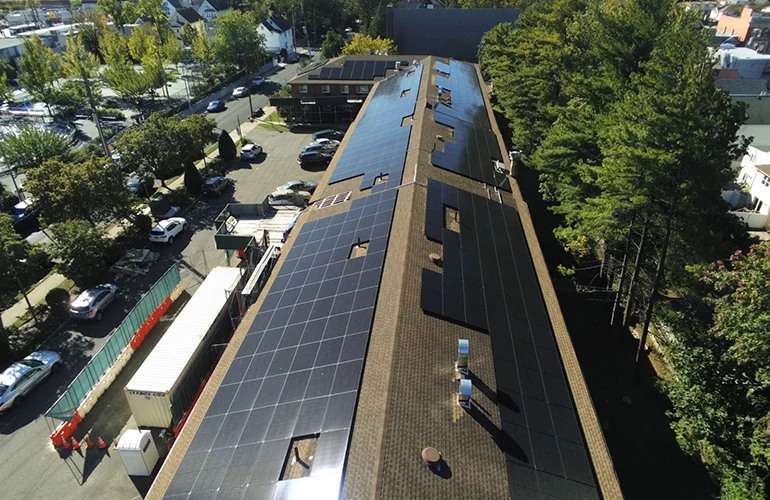
In the heart of Staten Island, New York, a groundbreaking 279-kilowatt solar energy initiative is transforming the landscape of affordable and rent-stabilized housing. Spearheaded by the Sisters of Charity of New York—a Catholic mission group with a long history of advancing healthcare and housing initiatives—this installation provides critical financial relief to elderly residents while achieving vital decarbonization goals.
Developed in strategic partnership with photovoltaic consultancy Crauderueff Solar and subscription manager Power Market, the project introduces a dual-array configuration that merges two distinct methodologies: a behind-the-meter net-metered system and an in-front-of-the-meter community solar project.
Operating under exceptionally tight financial margins typical of rent-stabilized properties, the initiative creates a replicable blueprint for non-profit organizations nationwide. By establishing a dedicated non-profit subsidiary called "Charity Solar" to own and manage the assets, the project insulates the primary housing infrastructure from liability while generating a sustainable, long-term revenue stream for the mission.
Tenants across the 75-unit complex are slated to begin seeing direct benefits, enjoying an estimated 10% reduction on their monthly utility bills starting in August 2026. Through aggressive financial engineering—including the strategic stacking of federal bonus tax credits, direct pay mechanisms, and New York State solar grants—the project proves that clean energy transitions are not only environmentally imperative for vulnerable populations, but economically viable.
Chronology
The realization of the Staten Island solar project required years of cross-industry collaboration, regulatory navigation, and meticulous planning.
Early Strategic Planning: Recognizing the dual imperatives of environmental stewardship and financial sustainability, the Sisters of Charity of New York initiated efforts to evaluate their portfolio for decarbonization potential. Facing slim operational margins in their affordable housing complexes, leadership sought ways to minimize rising utility expenses.
Partnership Formation: The mission group brought on Crauderueff Solar as a technical assistance provider. Together, the teams designed an innovative financial and operational model that would allow the non-profit to act simultaneously as an off-taker, leaseholder, property owner, and power generator.
Entity Restructuring and Financing: To protect the primary real estate from risk, the stakeholders established a separate third-party non-profit entity named Charity Solar to hold ownership of the systems. Concurrently, the team maximized federal and state incentive programs, securing a 20% federal bonus tax credit via direct pay and leveraging New York State’s robust solar grant allocations.
Installation and Interconnection: Contractors completed the physical installation of the 279-kW rooftop array. However, the project encountered typical bureaucratic hurdles during the utility interconnection phase, requiring extensive coordination with local grid operators.
Tenant Outreach and Subscription Campaign: In the fall, subscription management firm Power Market launched an outreach campaign targeting the 75 units in the Staten Island complex. The campaign exceeded expectations, securing over 50 tenant subscriptions—far outpacing initial projections.
Deployment of Savings: With utility approvals finalized, structured billing integrations were scheduled to reflect direct financial relief for residents beginning in August 2026.
Future Expansion Planning: Building on the success of the Staten Island complex, the Sisters of Charity have already begun applying lessons learned to future initiatives, including a resilience-focused solar and battery storage project in Rockland County, New York, backed by storm-recovery grant funding.
Supporting Data
The technical and financial metrics behind the Staten Island project highlight the complexity and success of modern urban solar deployments:
System Capacity: The total combined capacity of the rooftop installation is 279 kW, structured across dual behind-the-meter and front-of-the-meter arrays.
Property Scope: The housing complex comprises 75 units primarily housing elderly, rent-stabilized tenants.
Subscription Rate: More than 50 out of 75 households successfully subscribed to the community solar portion during the initial outreach phase, reflecting a robust adoption rate exceeding 66%.
Financial Savings: Participating tenants are slated to receive a consistent 10% discount on their monthly electricity bills.
Federal Incentives: The project capitalized on the federal bonus tax credit, which provided a 20% bonus for both the in-front and behind-the-meter components, culminating in a 50% total tax credit structure optimized through direct pay mechanisms tailored for non-profits.
State Incentives: New York’s targeted solar grant programs delivered substantial baseline funding, offering $1.60 per watt for behind-the-meter applications and $2.00 per watt specifically designated for affordable housing developments.
Official Responses
The success of the Staten Island initiative relies heavily on the close coordination between mission-driven leadership and technical experts.
Xiomara Pedraza, representing the Sisters of Charity, emphasized the core motivations behind the organization’s pivot toward renewable energy:
"I think a part of our mission was in recognition of environmental realities to decarbonize our portfolio, and renewable energy was a part of that strategy. In affordable housing, we do try to minimize utility expenses because we’re working with slim margins. Oftentimes, rents are affordable, so whatever we can do to keep the cost pressures down so that we can run the housing efficiently and make sure that we can keep the building affordable is really the goal."
Addressing the operational structure of the project, Pedraza noted the intentional separation of assets to mitigate institutional risk:
"We did set up a third-party entity called Charity Solar, to own the systems. So we have a non-profit subsidiary that’s owning the system and then the building owner is separate and that takes the liability and some of the other risks off the building itself, which is helpful. On the non-profit sustainability standpoint, we’re also able to use it as an income source."
Rob Crauderueff, CEO and founder of Crauderueff Solar, detailed the unique financial engineering required to bridge the gap between institutional solar developers and social service non-profits:
"We’re a technical assistance provider partner with organizations such as Sisters of Charity. A lot of the excitement around our work was based on the ability to implement a model where Sisters of Charity could be on multiple sides of a deal in terms of being an off-taker, the leaseholder and the property owner of the PPA, but then also being able to generate its own source of income — that can be very powerful for not-for-profits."
Highlighting the intricate stacking of incentives, Crauderueff added:
"Something that is very interesting about this project is being able to capture federal and state incentives. We received them for both the behind-the-meter and the front-of-the-meter projects, and the values are different… The federal bonus tax credit provided a 20% bonus for both the in-front and the behind-the-meter projects. So, these were a total of 50% tax credit projects. They were able to utilize direct pay, so as a not-for-profit, they’re able to capitalize and monetize those benefits."
Implications
The deployment of the 279-kW dual-array solar system on Staten Island carries far-reaching implications for the intersection of clean energy policy, social equity, and urban housing management.
Bridging the Institutional Divide
Historically, the solar industry and the affordable housing sector have operated in entirely separate silos. Solar developers often struggle to understand the strict regulatory frameworks, multi-agency oversight, and tight compliance metrics governing affordable housing. Conversely, housing providers frequently lack the technical expertise required to evaluate interconnection agreements, navigate permitting, or optimize tax credits.
The collaboration between the Sisters of Charity and Crauderueff Solar demonstrates that successful bridging of these worlds is possible through dedicated technical assistance. By establishing clear organizational and financial frameworks, non-profits can build institutional capacity from within, equipping their teams with the knowledge needed to oversee future green infrastructure projects effectively.
Financial Resilience for Rent-Stabilized Tenants
For elderly residents living on fixed incomes in rent-stabilized apartments, utility cost fluctuations represent a constant threat to housing security. By securing a guaranteed 10% reduction in electricity bills, the project delivers tangible material relief directly to vulnerable households. Furthermore, because community solar subscriptions allow renters to benefit from clean energy generation without needing to own a suitable roof, the initiative democratizes access to the economic advantages of photovoltaics—a benefit traditionally reserved for single-family homeowners.
A Replicable Model for Non-Profits Nationwide
The creation of "Charity Solar" as a distinct, third-party non-profit subsidiary offers a vital legal and financial precedent. By separating asset ownership from real estate management, the project effectively shields property owners from structural liabilities while transforming a standard energy expense into a revenue-generating asset.
When combined with the strategic capitalization of federal direct-pay provisions and enhanced state grants—such as New York’s $2.00/W affordable housing incentive—the model proves that high upfront capital costs can be heavily mitigated. This blueprint is already proving its adaptability; the Sisters of Charity are actively replicating lessons learned from Staten Island in Rockland County, where upcoming developments will integrate solar paired with backup battery storage to combat storm-induced power outages.
Ultimately, the Staten Island project illustrates that decarbonization and social justice are mutually reinforcing goals. By lowering operating overheads, safeguarding housing affordability, and championing environmental justice, this initiative sets a high standard for community-centric clean energy development across the United States.