As the physical world undergoes rapid digitalization, the race to imbue robots and autonomous systems with human-like intelligence has hit a significant bottleneck: data. While AI teams have successfully leveraged large-scale language models and image recognition, the ability to translate raw, messy, real-world video into actionable, high-fidelity robotics training data has remained an elusive "holy grail."
TwelveLabs Inc., a Seoul-based pioneer in video intelligence, is looking to dismantle this barrier. Today, the company announced the launch of Pegasus 1.6, a sophisticated AI model specifically engineered to navigate and interpret complex real-world environments. By focusing on "egocentric" (first-person) video, TwelveLabs is providing the missing link between human experience and machine learning, enabling robots to "see" and "reason" about the world with unprecedented precision.
The Core Challenge: Making Sense of the Real World
For decades, AI research has thrived on curated datasets—broadcast television, cinematic footage, and internet videos. However, robotics experts have long known that these formats are fundamentally different from the "wild" footage captured by head-mounted cameras or industrial sensors.
"Our mission has always been to help machines understand how the world works through video," says Jae Lee, co-founder and CEO of TwelveLabs. "Physical AI is the next expression of that mission. Most of what humans know about performing physical tasks—such as adjusting a grip when an object slips or recovering from an unexpected collision—has never been captured in a form a machine can actually learn from."
The problem, Lee explains, is that raw video is essentially a stream of pixels without context. To train a robot to perform a task, you cannot simply dump millions of hours of video into a model. You need a "video understanding layer" that identifies objects, recognizes specific actions, tracks hand-tool interactions, and notes changes in the environment over time. Pegasus 1.6 is designed to automate this labor-intensive process, turning hours of unstructured footage into clean, annotated, and reviewable knowledge.
Chronology: From Foundation to Physical Intelligence
TwelveLabs was founded in 2021 with the vision of building a "full-stack video intelligence platform." The company’s journey reflects the rapid maturation of the generative AI landscape:
- 2021–2023: Establishing the Foundation. The company introduced its initial models, Marengo and Pegasus, aimed at general video search and understanding. These tools allowed developers to search through massive video archives using natural language, effectively creating a "Google for video."
- 2024: Refining Video-Native Understanding. As the industry shifted toward multimodal AI, TwelveLabs pivoted to improve temporal reasoning—the ability of a model to understand not just what is in a frame, but what is happening across a sequence of frames.
- 2025: The Move Toward Physical AI. Recognizing the surge in humanoid robotics and industrial automation, the company began adapting its models for egocentric video, which is notoriously difficult for standard models to parse.
- October 2026: The Launch of Pegasus 1.6. With this release, TwelveLabs officially enters the Physical AI space, providing a specialized, scalable solution for training robotics and autonomous systems.
Pegasus 1.6: A New Paradigm for Egocentric Video
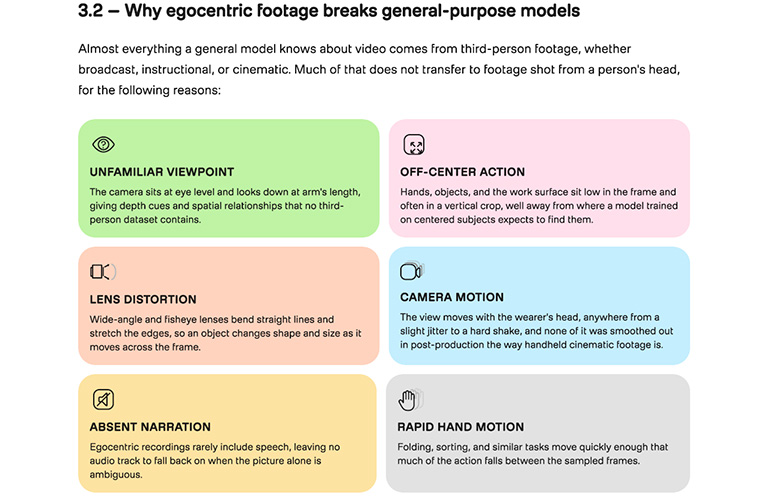
The centerpiece of the 1.6 update is its focus on egocentric (first-person) perspective. Unlike cinematic footage, which is staged and stable, egocentric video is often shaky, occluded, and chaotic—the exact type of data a robot needs to navigate a factory floor or a home kitchen.
Key Technical Advancements
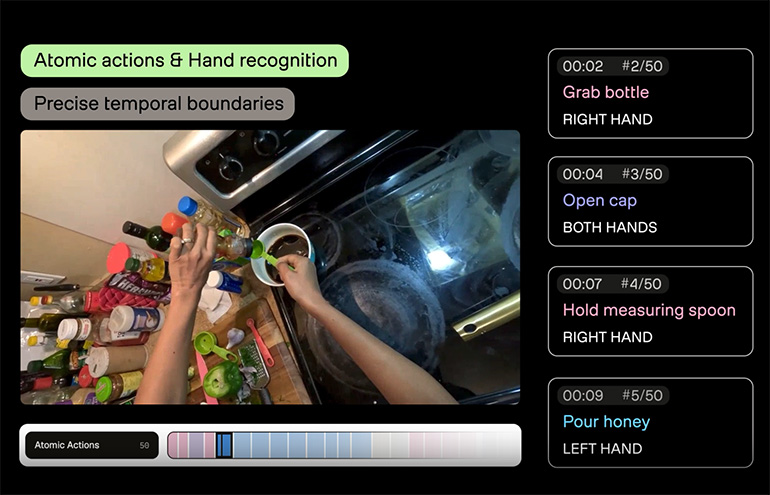
- Temporal and Spatial Reasoning: Pegasus 1.6 does more than identify objects; it judges whether a task was completed. It can distinguish between an attempt to pick up a tool and the successful execution of that action.
- Entity Recognition: The model features improved tracking of hands, tools, and objects across frames. This allows it to maintain continuity even when an object is temporarily hidden behind a hand or a piece of equipment.
- Time-Based Metadata (TBM): By allowing users to define custom schemas, the system automatically generates timestamped, structured metadata. This is critical for robotics engineers who need to map specific behaviors to precise micro-seconds of motion.
- Hardware Agnostic: In a major win for accessibility, the model does not require proprietary sensors or specific cameras. It works with standard video feeds, making it compatible with existing robotics hardware stacks.
"We aren’t asking robotics teams to overhaul their hardware," says Lee. "What matters is capturing the actions and interactions from the operator’s point of view. Whether it’s a factory worker assembling parts or a technician operating a remote drone, our model extracts the intent behind the motion."
Implications for the Robotics Industry
The implications of this technology are vast, particularly for industries struggling with labor shortages and the need for automation.
Scaling Robot Training
Currently, many robots are trained via "teleoperation," where a human remotely controls a robot to perform a task, recording every movement. This is prohibitively expensive and hard to scale. By using Pegasus 1.6, companies can instead record thousands of hours of humans performing tasks naturally, and then use the AI to segment, analyze, and convert that footage into training data. This effectively democratizes data collection.
Specialized Applications
TwelveLabs is already seeing adoption in high-stakes fields:
- Semiconductor Manufacturing: Using video to ensure quality control protocols are being followed by automated systems.
- Dexterity and Manipulation: Training robots to handle delicate packaging or assembly tasks that were previously thought to be "too human" for machines.
- Autonomous Navigation: Helping drones and vehicles understand the behavior of bystanders or other moving entities in their path.
Official Responses and Expert Outlook
The reception from the robotics community has been optimistic, if cautious. As the industry moves toward the "Physical AI" era, the ability to interpret video at scale is becoming as critical as battery life or motor torque.
"You can’t just take millions of hours of video and feed it into a robotics model and expect useful training data to come out," Jae Lee emphasized during a press briefing. "You first need to understand what’s happening in the video… how the behavior changes over time, and when other people or bystanders appear in the field of view. Pegasus 1.6 provides that precise understanding."
Industry analysts note that while TwelveLabs is not trying to replace a robot’s tactile or actuator-level sensing, it is solving the "cognition" gap. By providing a "brain" that can digest visual behavior, the company allows engineers to focus on the mechanical execution of tasks rather than the fundamental problem of visual perception.
Looking Ahead: The Future of Physical AI
As TwelveLabs continues to refine its models, the barrier to entry for building intelligent robots is lowering. By turning human experience—the most abundant data source on the planet—into machine-readable intelligence, the company is accelerating the transition of AI from the server room to the real world.
The next year will be pivotal. As developers integrate Pegasus 1.6 into their existing workflows, the industry expects to see a surge in robots that can learn by watching, rather than being programmed through tedious lines of code.
For those interested in seeing this technology in action, TwelveLabs will be a central topic of discussion at the upcoming RoboBusiness 2026 conference, held on October 20-21 in Santa Clara, California. As the robotics industry gathers to celebrate 20 years of innovation, the focus will undoubtedly be on how tools like Pegasus 1.6 are finally helping machines understand, navigate, and act within our complex, physical world.
The era of the "observant" robot has arrived, and according to TwelveLabs, it is just the beginning.