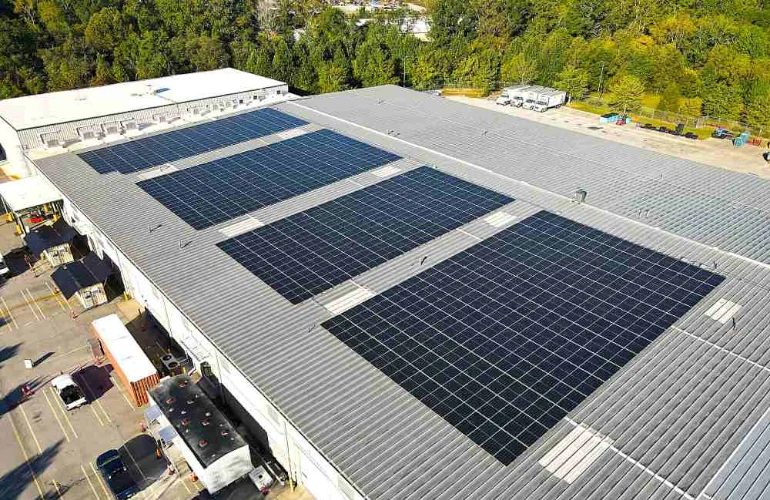
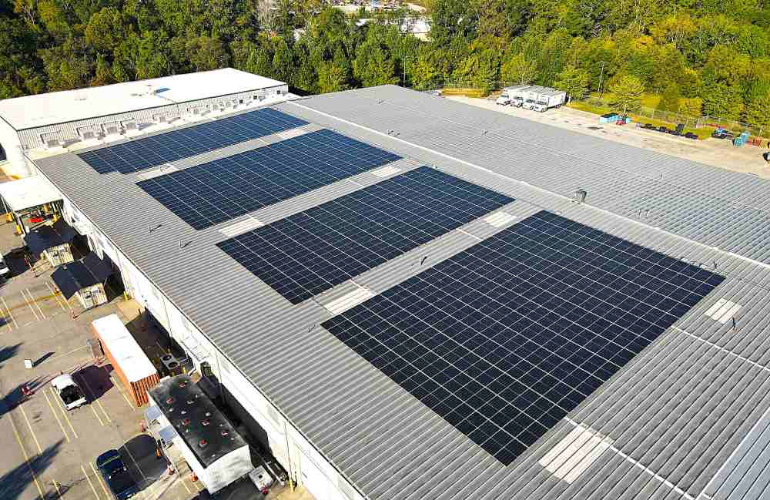
MILLS RIVER, N.C. — In an era where non-profit organizations face unprecedented operational hurdles, innovative infrastructure investments are proving to be the ultimate lifeline. North Carolina’s renowned MANNA FoodBank has officially taken a monumental step toward long-term financial and environmental resilience. The organization recently completed and brought online a robust 514-kilowatt (kW) rooftop solar energy system at its primary office and warehouse facility in Mills River.
Designed to slash overhead utility costs, the clean-energy project transforms idle roof space into a high-yield power plant. More importantly, it serves a deeply humanitarian purpose: by drastically reducing monthly electricity expenditures, MANNA can safeguard and redirect critical funding directly back into its core mission—sourcing, storing, and distributing emergency food supplies to families facing hardship across Western North Carolina and the Qualla Boundary.
The project is the culmination of meticulous planning, regional partnerships, and strategic funding maneuvers. Executed by Asheville-based renewable energy firm Pisgah Energy, the installation features state-of-the-art SEG solar panels paired with high-efficiency SolarEdge inverters. Industry analysts project that the array will generate in excess of 643,000 kilowatt-hours (kWh) of clean electricity annually.
For a regional food bank navigating a landscape defined by historically high demand and inflationary pressures, the financial relief offered by the solar array is both timely and transformative.
Main Facts
The core components of MANNA FoodBank’s new solar initiative highlight a masterclass in non-profit asset management and sustainable engineering:
- System Capacity: A 514-kW rooftop photovoltaic (PV) solar system.
- Location: MANNA FoodBank’s central office and warehouse facility in Mills River, North Carolina.
- Projected Energy Generation: More than 643,000 kWh of clean, renewable energy annually.
- Key Partners: Installed by Pisgah Energy, featuring hardware from SEG (panels) and SolarEdge (inverters). Additional strategic partners include the Footprint Project, Enstall (which provided a $55,000 solar panel racking donation), and a $200,000 BuildUS grant.
- Financial Impact: Bolstered by federal clean energy incentives (specifically the nonprofit direct pay mechanism) and targeted grants, MANNA anticipates a remarkably fast investment payback period of approximately 4.5 years.
- Operational Reach: MANNA and its network of over 300 community partners serve an average of roughly 220,000 client visits every month across 16 Western North Carolina counties and the Qualla Boundary.
Chronology: From Concept to Clean Energy
The realization of a half-megawatt rooftop solar installation on a sprawling food bank warehouse is rarely an overnight achievement. It represents a multi-year trajectory of strategic foresight, grant-seeking, and engineering collaboration.
Phase 1: Identifying the Need for Resilience
Long before the first solar panel was hoisted onto the Mills River roof, leadership at MANNA FoodBank recognized a growing divergence between the rising operational costs of running a large-scale cold-storage warehouse and the fluctuating availability of philanthropic donations. Warehouses that house perishable goods require massive amounts of continuous electricity to power industrial refrigeration and freezing units. As utility rates climbed across the region, energy expenses threatened to eat away at capital that should have been spent on purchasing and moving food.
Phase 2: Partnering with Pisgah Energy
To address this structural challenge, MANNA engaged Pisgah Energy, a regional renewable energy developer known for helping businesses, municipalities, and non-profits navigate the complex landscape of solar adoption. Engineering assessments confirmed that the expansive roof of the Mills River facility offered an ideal solar canvas—unshaded, structurally sound, and capable of supporting a commercial-scale array.
Phase 3: Securing Grants and Partnerships
Because capital expenditures for large-scale solar can be daunting for non-profit entities, assembling an advantageous capital stack was paramount. Pisgah Energy and MANNA leveraged a coalition of supporters to make the financial model pencil out. This included securing a $200,000 BuildUS grant dedicated to bolstering energy resiliency in rural Western North Carolina, as well as a generous in-kind contribution from Enstall, which donated $55,000 worth of solar panel racking equipment. Additional collaborative efforts from the Footprint Project helped streamline the development process.
Phase 4: Construction and Interconnection
Installation of the 514-kW system commenced under the technical oversight of Pisgah Energy’s installation teams. The project integrated advanced SEG photovoltaic modules with SolarEdge string inverters, ensuring optimized energy harvest and module-level monitoring capabilities. Following rigorous safety inspections and utility interconnection approvals, the system was brought online, instantly shifting a significant percentage of the facility’s daily electrical load to self-generated solar power.
Supporting Data and Economic Analysis
To fully grasp the significance of MANNA FoodBank’s transition to solar energy, one must examine the socio-economic backdrop of the region it serves, alongside the hard financial metrics of the installation itself.
Surging Regional Need
Western North Carolina has weathered severe economic headwinds in recent years. Households across the 16 counties and the Qualla Boundary served by MANNA continue to grapple with compounding cost-of-living increases. Skyrocketing expenses tied to housing, utilities, transportation, and basic groceries have stretched lower- and middle-income family budgets to a breaking point.
Consequently, MANNA and its extensive network of over 300 frontline community partners—including local pantries, soup kitchens, and mobile food markets—are witnessing historical demand. Serving an average of 220,000 visits every single month places an immense logistical and financial burden on the food bank’s supply chain. Every dollar saved on administrative and overhead costs directly translates to more meals secured and distributed.
The Financial Breakdown: A 4.5-Year Payback
Commercial solar installations are fundamentally long-term financial investments, but the financial mechanics of this specific project yield unusually rapid returns for a non-profit organization:
- Energy Offset: By generating upwards of 643,000 kWh annually, the facility will dramatically reduce its reliance on grid electricity, insulating MANNA from future utility rate hikes.
- The "Direct Pay" Advantage: Thanks to provisions under federal clean energy legislation, tax-exempt entities like MANNA are eligible for "direct pay" (or elective pay) provisions. This allows non-profits to receive a cash equivalent payment from the federal government for building renewable energy projects, effectively functioning as a direct tax credit reimbursement.
- Grant Leverage: The inclusion of the $200,000 BuildUS grant and the $55,000 Enstall racking donation drastically lowered the initial out-of-pocket capital requirements for the non-profit.
- Accelerated ROI: Combining the direct pay incentive, grant funding, and immediate utility bill offsets, MANNA is projected to achieve a full return on its net investment in roughly 4.5 years.
Once the system pays for itself, it will continue to generate free, clean electricity for decades, providing MANNA with a permanent budgetary cushion.
Official Responses and Perspectives
Leadership from both MANNA FoodBank and Pisgah Energy emphasized that the project is much more than an exercise in environmental stewardship; it is a vital operational strategy designed to maximize community support during turbulent times.
Perspectives from MANNA FoodBank
Claire Neal, CEO of MANNA FoodBank, underscored the moral and financial imperative behind the renewable energy transition:
"Every dollar we can use more efficiently is a dollar that can go further in serving our communities," said Neal. "At a time when neighbors across Western North Carolina are turning to MANNA and our partner network at historic rates for food support, we have a responsibility to think about the long-term sustainability of our work. Investments like this help us reduce ongoing costs while building a stronger, more resilient food bank that can continue meeting the needs of our region for years to come."
Neal’s remarks capture the modern reality of non-profit management. In the face of fluctuating donation streams and unpredictable economic cycles, organizations must leverage modern technology to control what they can—chiefly, internal overhead costs. By fixing their energy expenditures through solar generation, MANNA creates a predictable financial baseline that protects its food-procurement budgets from market volatility.
Perspectives from Pisgah Energy
For the local contractors who designed and engineered the system, the project represented an opportunity to align technical expertise with profound social impact. Evan Becka, President of Pisgah Energy, expressed pride in completing the installation:
"It was an honor to install these systems for MANNA," remarked Becka. "Using solar energy to help power operations is just one more way this incredible organization is supporting the health and well-being of Western North Carolina families."
Becka’s sentiments highlight a growing trend within the regional business community: commercial solar developers increasingly view non-profit installations not merely as standard construction contracts, but as force multipliers for community welfare. By lowering the operating costs of organizations that care for vulnerable populations, renewable energy companies actively contribute to regional public health and economic stability.
Broader Implications for the Non-Profit Sector and Rural Infrastructure
MANNA FoodBank’s successful deployment of a 514-kW solar array serves as a powerful case study for non-profit organizations, food banks, and rural enterprises across the United States. The project illustrates several critical lessons regarding modern infrastructure and organizational resilience.
1. Decoupling Operations from Utility Volatility
For cold-storage facilities, warehouses, and agricultural distribution centers, electricity is a non-negotiable, fixed operational necessity. Refrigerators and freezers cannot be turned off to save money. By installing on-site solar generation paired with high-efficiency inverters, organizations can effectively decouple a substantial portion of their energy consumption from fossil fuel markets and utility rate inflation. This shields non-profit budgets from sudden price spikes driven by geopolitical events or regional grid constraints.
2. Leveraging Public-Private Partnerships and Grants
The MANNA project demonstrates that non-profits do not have to shoulder the financial burden of renewable energy transitions alone. Through a sophisticated capital stack that combined federal direct-pay mechanisms, philanthropic grants (such as the BuildUS grant), and corporate in-kind equipment donations (such as Enstall’s racking contribution), the project became financially viable and highly attractive. This blueprint can be replicated by other charitable institutions seeking to modernize their facilities without draining programmatic funds.
3. Enhancing Rural Grid Resiliency
Western North Carolina—portions of which have historically been vulnerable to severe weather events, winter storms, and grid disruptions—benefits immensely from localized renewable energy assets. Projects supported by initiatives like the BuildUS grant explicitly target rural energy resiliency. While MANNA’s current installation is designed primarily for grid-tied cost reduction, the expansion of distributed solar infrastructure lays the technical groundwork for future microgrid capabilities, battery storage integration, and emergency disaster response readiness. During power outages, facilities equipped with solar and storage assets can maintain critical refrigeration for life-saving food supplies.
4. Setting a Precedent for Environmental Stewardship
Food banks and hunger-relief organizations exist to promote human health and dignity. By embracing clean energy, organizations like MANNA implicitly recognize the undeniable link between environmental health and community well-being. Burning fewer fossil fuels to power a warehouse means cleaner air for the surrounding Western North Carolina region, reducing carbon emissions while simultaneously feeding the hungry. It is a dual-purpose mission that resonates powerfully with modern donors, corporate partners, and environmentally conscious volunteers.
Conclusion
As MANNA FoodBank’s 514-kW solar system begins its first full cycle of annual energy production, the true measure of its success will not just be found in kilowatt-hours generated or carbon offsets calculated. It will be found in the quiet, dependable continuity of service provided to families in need across the mountains and valleys of Western North Carolina.
In an economic climate where the demand for food assistance remains persistently high, every dollar diverted away from utility bills and redirected toward the purchasing and distribution of nutritious food is a victory. Through visionary leadership, strategic regional partnerships with firms like Pisgah Energy, and smart utilization of federal incentives, MANNA FoodBank has illuminated a path forward—proving that sustainability and social mission are not competing interests, but two sides of the same coin.