By the Industrial Technology Editorial Desk
The aerospace and defense (A&D) manufacturing sector stands at a critical technological crossroads. For decades, the industry has relied on isolated systems, manual handoffs, and paper-heavy workflows to bridge the gap between engineering design offices and shop-floor execution. However, as complex weapon systems, commercial aircraft, and space exploration vehicles become increasingly sophisticated, these traditional methods are hitting a wall.
Enter the Model-Based Enterprise (MBE)—a paradigm designed to use digital models as the central, authoritative source of truth throughout an asset’s entire lifecycle. Yet, while many organizations have successfully implemented MBE at the single-component level, scaling this digital transformation to complex, multi-component assemblies remains a formidable hurdle.
Recent research highlights a crucial, often-overlooked mechanism for overcoming this challenge: Model-Based Process Authoring (MBPA). Serving as the vital common thread connecting design, manufacturing, and decades of field sustainment, MBPA is rapidly becoming the cornerstone of modern A&D production.
Main Facts: The Core of Model-Based Process Authoring
At its foundational level, Model-Based Process Authoring is a discipline and technological framework designed to extend engineering design intent directly into day-to-day shop-floor operations. Rather than treating design specifications, Bills of Materials (BOMs), and Bills of Process (BOPs) as static documents that must be laboriously re-entered into Enterprise Resource Planning (ERP) or Manufacturing Execution Systems (MES), MBPA creates dynamic, interactive digital instructions.
Key operational realities define the current landscape of MBE and Process Authoring:
- The Single-Component Maturity Gap: MBE is mature when applied to isolated parts, functioning largely as an advanced extension of Computer-Aided Design (CAD) and Computer-Aided Manufacturing (CAM). The true frontier—and the major bottleneck—lies in managing multi-component assemblies across global supply chains.
- The High Cost of Manual Data Entry: Companies lagging in their MBE journeys suffer from a massive productivity drain. Highly skilled engineering and manufacturing professionals waste precious time acting as human bridges, manually re-entering data across disconnected PLM, ERP, and shop-floor systems.
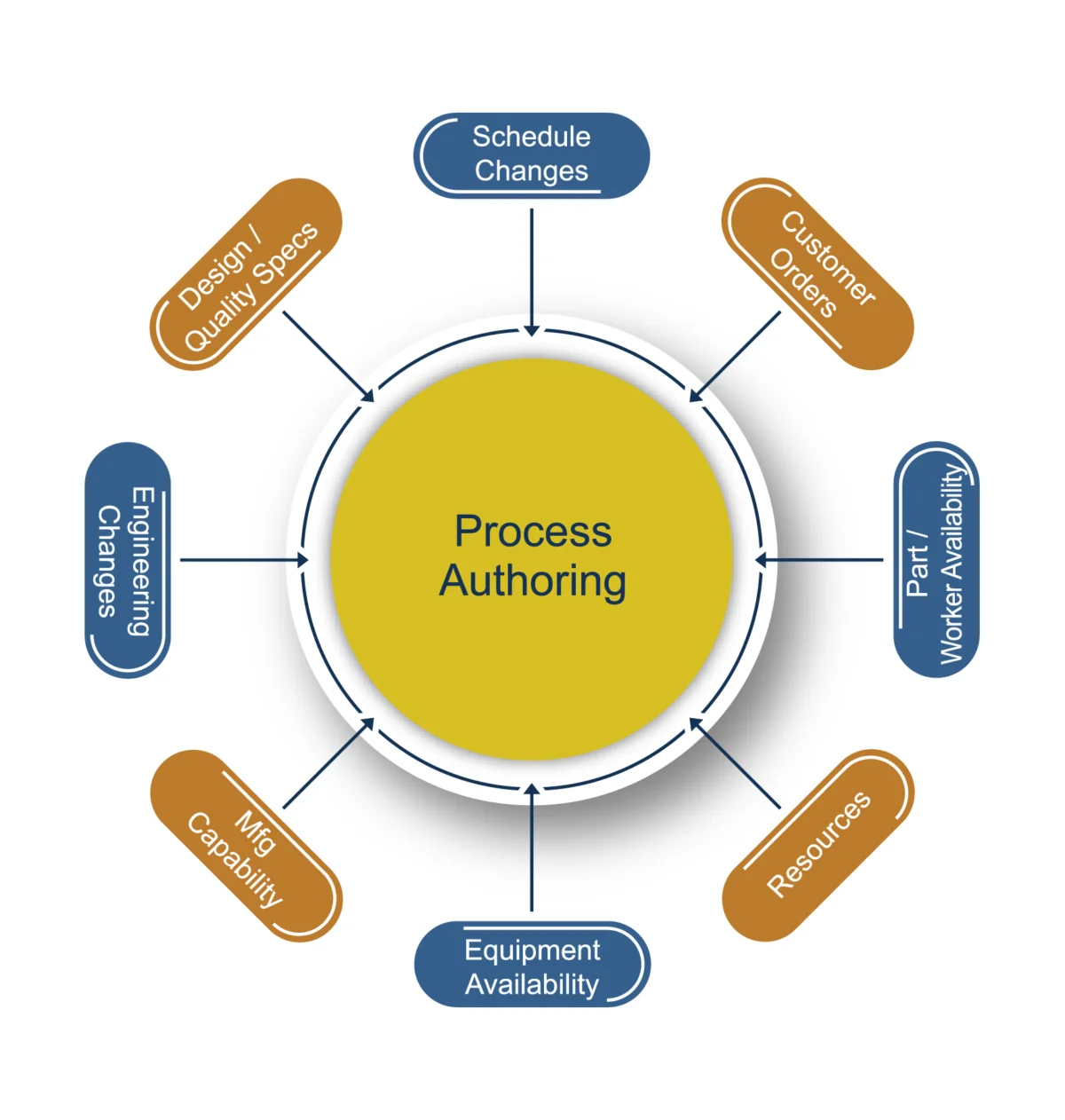
- The Dynamic Nature of the Shop Floor: Manufacturing instructions in A&D cannot be static. They must seamlessly adapt to real-world disruptions, including engineering change orders (ECOs), unplanned equipment downtime, resource shortages, and necessary material substitutions—all while maintaining the integrity of the digital thread.
- Traceability as a Mandate: For flight-critical components, maintaining compliance requires rigorous tracking of Unique Identification numbers (UIDs), Quality Part Identification numbers (QPIDs), and critical-to-quality (CTQ) characteristics from the initial CAD model to final field maintenance.
Chronology of the Digital Thread: From Design to Sustainment
To understand why Model-Based Process Authoring is essential, one must examine the chronological lifecycle of an A&D product. The digital thread must be deliberately woven through three distinct phases: Design Engineering, Manufacturing Execution, and Long-Term Field Sustainment.
Phase 1: Design Engineering and Digital Definition
The journey begins in the engineering department, where digital models are authored using advanced CAD tools. In an MBE environment, these models are enriched with Product and Manufacturing Information (PMI), GD&T (Geometric Dimensioning and Tolerancing), and CTQ parameters. Instead of traditional 2D drawings, the 3D model becomes the master definition of the part or assembly.

Phase 2: Process Authoring and Manufacturing Execution
This is where MBPA enters the picture. Manufacturing engineers take the design definition and link it directly to the enterprise’s BOM and BOP. They author step-by-step, interactive work instructions tailored to the specific capabilities of the factory floor. When an engineering change occurs—such as a mid-production revision to a flight-critical assembly—the change must be instantly propagated to work-in-progress (WIP) instructions without breaking the digital thread.
Furthermore, if a shop-floor exception occurs (e.g., a specific fastener is out of stock and requires an approved substitution), the MES must record this deviation in real-time, ensuring the "as-built" record matches the physical reality of the product.
Phase 3: Field Sustainment and Maintenance
An A&D product—whether a commercial airliner or a defense satellite—often remains in service for decades. Decades down the line, maintenance technicians in remote depots must be able to trace a failing part back through its manufacturing history, identifying the exact batch, material certifications, and assembly steps used to build it. MBPA and its underlying data architecture lay the groundwork for this "as-maintained" digital twin, ensuring safety, reliability, and simplified regulatory compliance over the asset’s lifespan.
Supporting Data and Industry Insights
Industry analysts and research into MBE adoption reveal stark contrasts between organizations that have embraced integrated digital workflows and those stuck in legacy paradigms.
- Resource Allocation Inefficiencies: Studies indicate that manufacturers without an integrated MBE framework lose up to 15–20% of engineering and shop-floor productivity simply to administrative data transcription—manually copying attributes from PLM systems into shop-floor packets.
- Compliance and Quality Reduction: In regulated industries like aerospace and defense, human data re-entry is a primary source of quality non-conformances. Automated process authoring drastically reduces transcription errors, directly correlating with lower scrap rates and fewer audit findings.
- Supply Chain Synchronization: With globalized supply chains handling up to 70% of modern A&D sub-assemblies, disparate data formats cause massive friction. Implementing a federated data architecture linked through MBPA significantly accelerates tier-one and tier-two supplier onboarding and change management turnaround times.
Official Perspectives and Industry Responses
As organizations transition toward fully realized Model-Based Enterprises, industry leaders, systems architects, and software providers have weighed in on the operational shifts required to make MBPA successful.
Manufacturing technology strategists emphasize that technology alone cannot solve the problem. "The challenge is never merely about transferring information between business and manufacturing systems," notes an enterprise software architect specializing in A&D solutions. "The true complexity lies in human collaboration, global supply chain synchronization, and preserving context over thirty years of field operations. If your process authoring tools don’t empower the frontline worker, the technology has failed its primary objective."
Industrial analysts echo this sentiment, pointing out that manufacturing executives frequently fall into the trap of viewing MBE as an engineering-only or IT-only project. In official briefings, digital transformation leaders stress that process authoring must be treated as a cross-functional discipline. It requires continuous, synchronized input from quality assurance, manufacturing engineering, supply chain management, and shop-floor supervisors.
Sponsor organizations, such as iBase-t, highlight that adopting purpose-built manufacturing operations software is critical for bridging the gap between PLM and the factory floor. By establishing a direct link between model definitions, bills of characteristics, and shop floor execution, companies can finally achieve true end-to-end configuration management.

Strategic Implications and Recommendations
For A&D executives, engineering directors, and manufacturing operations managers looking to capitalize on Model-Based Process Authoring, industry experts recommend a four-pillared strategic approach:
1. Keep People at the Forefront
Technology must serve the workforce, not burden it. Frontline assembly workers should spend their time building high-precision products, not wrestling with clerical data entry. By automating the capture of UIDs, QPIDs, and CTQ parameters within the MBPA workflow, organizations can eliminate "swivel-chair" processes and empower operators to make confident, informed decisions.
2. Simplify and Standardize Processes
Organizations must ruthlessly eliminate the phrase "We’ve always done it this way" from their corporate vocabulary. Continuous improvement initiatives should focus on streamlining manufacturing workflows to fit the digital model, rather than forcing modern software to replicate legacy paper-based habits. Process improvements must be designed with the frontline operator’s daily reality in mind.
3. Adopt a Federated Data Architecture
No single software platform can cover every aspect of an enterprise, its global supply chain, and a multi-decade product lifecycle. Rather than chasing the elusive "single pane of glass," companies should focus on a federated data architecture. This relies on robust APIs, well-defined data ontologies, and semantic continuity. By employing a robust data model that fully instantiates parts, subassemblies, and shop orders, companies can curate critical data elements without massive data duplication or error.
4. Deploy Built-for-Purpose Technology
General-purpose enterprise tools often fall short on the factory floor. A&D manufacturers must invest in purpose-built tools across the value chain, ensuring that CAD IDs, characteristic IDs, BOMs, and BOPs flow seamlessly into manufacturing execution systems. This technological continuity guarantees that the "as-designed" intent is flawlessly mirrored in the "as-built" reality.
Conclusion
Model-Based Process Authoring is far more than an advanced documentation tool; it is the vital connective tissue of the modern Model-Based Enterprise. By transforming static design data into dynamic, interactive operational instructions, A&D manufacturers can eliminate costly manual data re-entry, drastically improve compliance, and navigate complex engineering changes with agility.
As the aerospace and defense sectors look toward an increasingly autonomous and digital future, mastering the art and science of process authoring will separate market leaders from those left behind in the paper trail of the past.
*Note: This article is an abbreviated summary of specialized industry research. For deeper insights into Model-Based Process Authoring and digital thread implementation, industry professionals are encouraged to review the full research whitepapers provided through specialized manufacturing technology platforms and sponsors such as iBase-t.