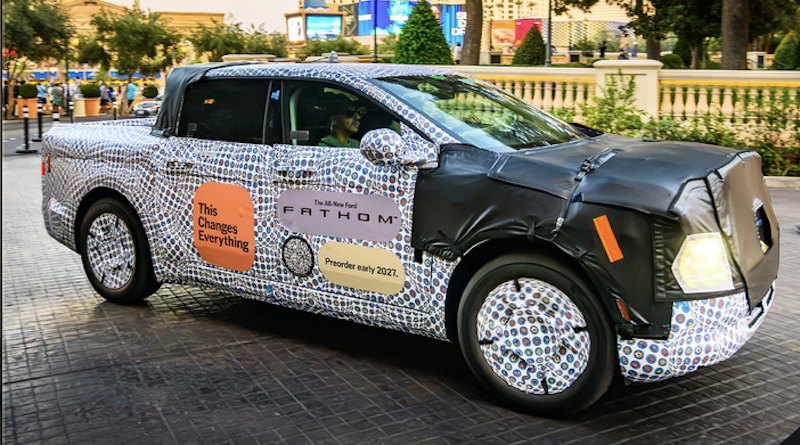
The Ford Motor Company is keeping the exterior of its upcoming all-electric pickup truck—dubbed the Fathom—hidden beneath a heavy layer of camouflage. However, the automaker is proving far more transparent about the revolutionary technology engineered beneath the sheet metal. In a major product and technology disclosure, Ford has announced that the upcoming truck will feature an advanced, integrated bidirectional charging system designed to completely eliminate the need for an expensive external inverter.
Set to launch in 2027 with a targeted starting MSRP of $28,350, the Fathom aims to lower the barrier to entry for both electric vehicle (EV) ownership and residential vehicle-to-home (V2H) energy systems. By integrating the power-conversion hardware directly into the vehicle architecture, Ford is challenging traditional paradigms of home energy backup and shifting the conversation around how everyday drivers interact with the power grid.
Main Facts: The Technology and the Truck
At the core of Ford’s latest announcement is a radical cost-reduction strategy for bidirectional power. Traditionally, utilizing an EV battery as a mobile generator or a home backup power source required a complex ecosystem of expensive additional hardware. Homeowners typically had to purchase a specialized, wall-mounted bidirectional charging station alongside a costly external inverter to convert the direct current (DC) stored in the vehicle’s battery into the alternating current (AC) utilized by household appliances.
The Ford Fathom changes this equation by integrating the conversion process.
No External Inverter Required: The Fathom features an onboard system capable of supplying a projected 10 kilowatts (kW) of AC power directly to a home without requiring a separate wall-mounted inverter unit.
Aggressive Pricing Strategy: Scheduled for a 2027 release, the base model of the Fathom carries a target MSRP starting below $30,000—specifically positioned at $28,350.
Redesigned Ecosystem Hardware: Ford is scaling down costs across its entire residential energy lineup, projecting that its next-generation Home Power Station will cost roughly half as much as its first-generation predecessor, while its Home Backup Power Panel is expected to see a cost reduction of at least 60%.
Chronology of the Announcement and Industry Context
The reveal of the Fathom’s integrated bidirectional charging capabilities arrives during a uniquely crowded and politically charged news cycle in the automotive sector.
Early October 2026: Competitors capture media attention with high-profile stunts and announcements. On October 15, Tesla CEO Elon Musk dominates headlines with a futuristic vehicle showcase. Shortly after, Slate Auto hosts a soft opening for a new Chicago showroom, and General Motors unveils a brand-new fourth-generation EV platform paired with a novel lithium-manganese-rich (LMR) battery formula on October 21.
Late October 2026 (The Audi-Trump Controversy): The geopolitical landscape collides with the automotive industry when Audi CEO Gernot Döllner appears on stage alongside U.S. President Donald Trump at a campaign rally in Georgia on Saturday, October 24. The duo announces that Audi will construct a $4 billion manufacturing facility in Georgia—the brand’s first manufacturing venture in the United States.
October 24–26, 2026: Audi releases official press statements framing the Georgia plant as a cornerstone of its global manufacturing footprint, intended to bolster its U.S. market position. Simultaneously, the move sparks severe backlash in Germany, where critics and the Volkswagen supervisory board question the optics and the timing of establishing new U.S. manufacturing jobs while facing domestic workforce reductions. By October 26, Döllner issues an internal memo defending the move as essential for long-term competitiveness.
Late October 2026 (Ford’s Tech Drop): Amidst the political noise and competitive product drops, Ford quietly shifts focus back to consumer utility, detailing the economic and technical specifications of the Fathom’s bidirectional charging system and opening pre-order invitation lists.
Supporting Data: The Economics of Vehicle-to-Home (V2H) Power
The concept of using an electric vehicle battery to power a home is no longer a futuristic novelty; it is rapidly becoming a practical utility for modern households. However, widespread adoption has historically been stifled by high upfront infrastructure costs. Ford’s latest pricing strategy targets the primary economic hurdles of V2H integration.
The Problem of Peak Demand and Outages
Power grids face unprecedented strain from extreme weather events and rising electricity demands. Bidirectional charging serves two distinct financial and operational functions:
Emergency Backup Power: Unlike noisy, polluting gasoline or diesel generators, EV batteries offer silent, zero-emission emergency power. In extended grid failures, homeowners can theoretically drive to an operational charging station outside the blackout zone, recharge their vehicle, and return home to keep essential household appliances running.
Time-of-Use Arbitrage: Ratepayers utilizing home charging stations can program their systems to pull electricity from the grid during off-peak hours when utility rates are lowest. Conversely, during peak demand hours when electricity prices spike, households can discharge energy from their EV battery back into the home to offset expensive grid power.
Cost Breakdown of Ford’s Next-Gen Energy Ecosystem
According to statements from Ford Model e general manager Kay Hart, the company’s engineering focus has shifted from merely offering bidirectional power to drastically reducing its cost of deployment:
Inverter Elimination: By building the conversion capability into the vehicle architecture, the Fathom removes a multi-thousand-dollar hurdle associated with standalone external inverters.
Home Power Station: The upcoming second-generation Ford Home Power Station is engineered to drop to approximately 50% of the cost of the first-generation hardware.
Backup Power Panel: The redesigned Ford Home Backup Power Panel is slated to cut hardware costs by at least 60% compared to legacy systems, though exact final pricing has yet to be finalized.
Official Responses and Strategic Vision
Ford executives have framed the Fathom not merely as an affordable work truck, but as a democratizing force for decentralized residential energy.
"Our goal wasn’t just to add bidirectional power to our EVs. It was to redesign the system to cost far less so more people can access bidirectional power," explained Kay Hart, general manager of Ford Model e, in a company blog post. "With Fathom offering bidirectional power at an MSRP starting below $30,000, even more people can benefit from potential energy savings and home backup power."
Clarifying the implementation details of the truck’s hardware, Hart noted in subsequent documentation:
"In 2027, the all-new Ford Fathom electric truck will start at $28,350 MSRP and offer available bidirectional AC power. That means it does not need a separate wall-mounted inverter to supply over a projected 10 kW of AC power to a home."
While questions remain regarding whether the bidirectional capability will be included as standard equipment across all trim levels or offered as a specific option package, Ford’s overarching trajectory points toward making energy independence a mainstream consumer feature rather than a luxury add-on.
Broader Implications for the Automotive and Energy Markets
The introduction of the Ford Fathom carries significant implications for both the electric vehicle market and the broader residential energy sector.
Driving Mass Adoption Through Affordability
For years, electric pickup trucks have trended toward high-end, luxury price points, often exceeding $60,000 to $80,000. By targeting a sub-$30,000 entry point with the Fathom, Ford is pushing EVs into a price bracket accessible to a much broader demographic of commercial buyers, fleet operators, and budget-conscious consumers. By packaging high-value features like 10 kW home backup power into an affordable platform, Ford is redefining what entry-level utility looks like.
Decentralization of the Electrical Grid
As more vehicles like the Fathom enter the market equipped with affordable, integrated bidirectional charging, the cumulative impact on the national electrical grid could be profound. A fleet of thousands of Fathom trucks plugged into residential homes acts as a massive, distributed virtual power plant (VPP). These vehicles can absorb excess renewable energy from solar and wind during peak generation hours and feed power back into homes or the grid during emergencies or peak loads, smoothing out supply and demand curves without requiring heavy investments in stationary utility-scale battery storage.
As Ford continues to refine the Fathom ahead of its 2027 market launch—and as pre-order interest climbs—the automotive landscape is watching closely to see if this aggressive pricing and hardware consolidation model will force competitors to rethink their own bidirectional charging strategies.