By Energy and Infrastructure Desk
Updated: Monday, 1:00 PM ET
Main Facts
In the wake of a powerful hurricane that made landfall near the Florida-Alabama border, regional power companies are engaged in massive, round-the-clock restoration efforts. Florida Power & Light (FPL), Duke Energy Florida, and Alabama Power have mobilized tens of thousands of lineworkers to repair extensive grid infrastructure.
While initial estimates suggested a rapid recovery across all impacted service territories, utilities in the hardest-hit regions—particularly Escambia and Santa Rosa counties in the western Florida Panhandle—have had to revise their restoration timelines. The primary culprit behind the delayed estimates is severe, widespread tree damage that has tangled power lines, shattered utility poles, and created hazardous, complex working conditions for repair crews.
Despite these localized setbacks, major utility executives and industry trade groups point to long-term, strategic investments in grid modernization as a decisive factor in mitigating even worse devastation. Smart grid technologies, automated switches, and targeted underground cabling have successfully prevented over 130,000 potential outages.
Concurrently, the storm’s trajectory through the Gulf of Mexico forced temporary shutdowns of significant offshore oil and natural gas production. Energy analysts at AccuWeather reported that nearly two-thirds of offshore oil and more than half of natural gas production in the region were paused ahead of landfall, though market experts anticipate only short-term price volatility rather than prolonged supply shortages.
By Monday afternoon, combined estimates indicated that roughly 160,000 customers across Florida and Alabama remained without electricity, down significantly from the peak of the storm’s impact.
Chronology of the Storm and Response
Pre-Landfall: Mobilization and Offshore Shutdowns
Days before the hurricane made landfall near the Florida-Alabama border, energy markets and utility companies began emergency preparations. Recognizing the storm’s intensifying wind field and potential for catastrophic storm surge, offshore operators in the Gulf of Mexico initiated emergency protocols.
According to AccuWeather data, nearly 63% of offshore oil production and 57% of natural gas production in the Gulf were proactively paused. Furthermore, nearly one-third of all production platforms in the path of the storm were evacuated to safeguard personnel. On land, utilities such as FPL, Duke Energy Florida, and Alabama Power pre-positioned equipment, coordinated mutual assistance agreements, and established staging areas to ensure a rapid post-storm response.
Landfall and Peak Outages
The hurricane struck the Gulf Coast with destructive force, driving high winds and torrential rain inland across the Florida Panhandle and southern Alabama. The initial impact zone triggered widespread power outages, affecting hundreds of thousands of residential and commercial customers.
In Alabama, local media and reporting from AL.com indicated that more than 390,000 customers experienced blackouts at the height of the storm. In FPL’s service territory, the storm knocked out service to hundreds of thousands more, heavily concentrating damage in Escambia and Santa Rosa counties.
Post-Landfall Restoration and Revisions
In the immediate aftermath, utility crews fanned out across the affected states. By Sunday night, FPL reported that it had successfully restored power to more than 70% of its impacted customer base. However, as damage assessment teams penetrated the most remote and heavily forested terrain in the western Panhandle, the true scope of the destruction became apparent.
FPL President and CEO Scott Bores announced that initial recovery estimates for Escambia and Santa Rosa counties had to be revised. What was initially thought to be manageable wind damage revealed itself to be dense tangles of fallen timber, broken poles, and compromised infrastructure requiring specialized heavy equipment.
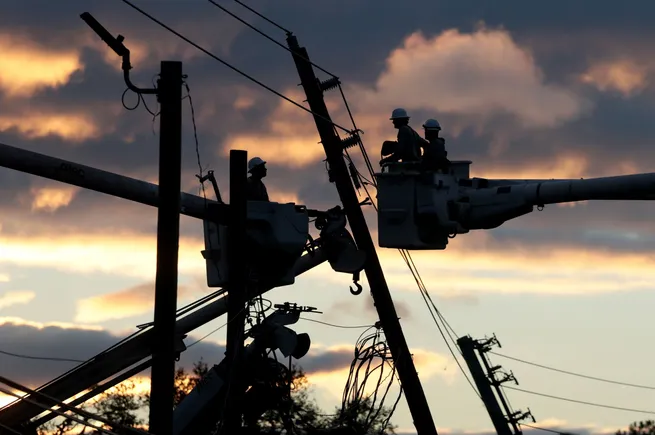
By Monday afternoon, coordinated efforts by FPL, Duke Energy, and Alabama Power narrowed the total number of offline customers down to approximately 160,000 across both states, with individual utilities moving into the final phases of localized repairs.
Supporting Data and Metrics
The scale of the storm response and the performance of the modern electrical grid can be quantified through several key operational metrics released by utilities and forecasting agencies:
- 17,000: The number of personnel deployed by FPL alone, drawn from 29 states to support regional restoration efforts.
- 15: The total number of staging and parking sites established by FPL to position crews, heavy machinery, and critical replacement parts.
- 130,000: The number of potential customer outages avoided entirely due to automated smart grid technology and proactive grid isolation systems.
- 8x: The performance factor by which underground power lines outperformed overhead lines, according to FPL’s initial post-storm forensics.
- 70%+: The percentage of FPL customers who had their power restored by Sunday night, less than 48 hours after the worst of the weather passed.
- 390,000: The peak number of customer outages recorded in the state of Alabama, as reported by local media outlets.
- 63% and 57%: The respective shares of Gulf of Mexico offshore oil and natural gas production that were temporarily shut down ahead of the storm’s arrival.
- 160,000: The updated tally of total customers still without power in Florida and Alabama as of Monday at 1:00 PM ET.
Official Responses and Utility Statements
Utility leaders and industry associations have emphasized the critical role of multi-year infrastructure investments in accelerating recovery times and protecting core grid assets.
FPL President and CEO Scott Bores addressed the challenges faced by assessment crews in the Florida Panhandle, noting the unexpected complexity of the recovery work. "As we continued our damage assessments in the hardest hit areas of the region, we discovered the tree damage to our system was much more severe and widespread than our initial estimates showed," Bores said in a corporate statement. He added that tangled lines, shattered cross-arms, and leaning poles "will require more extensive and complex work" before service can be safely re-energized for every customer.
Drew Maloney, President and CEO of the Edison Electric Institute (EEI), praised the collaborative spirit and preparedness of the broader utility sector. "Year-round planning, close coordination with federal, state, and local partners, and sustained investments in a stronger, smarter grid put thousands of workers in position to restore power quickly and safely," Maloney noted.
Duke Energy Florida announced on Saturday that it was actively wrapping up its restoration operations. Todd Fountain, Duke Energy Florida storm director, pointed directly to engineering choices as the driving force behind their rapid turnaround. "The strategic investments we’ve made in a stronger, smarter grid are delivering clear benefits for customers — reducing outages, limiting their duration and helping us restore power faster when severe weather strikes," Fountain stated.
Broader Economic and Energy Market Implications
While the localized human and infrastructure toll remains the immediate focus for residents in Florida and Alabama, the storm’s journey through the Gulf of Mexico has sparked broader economic discussions regarding energy supply chains and commodity pricing.
Dan DePodwin, Vice President of Forecasting Operations at AccuWeather, highlighted the disproportionate economic footprint of severe weather events in energy-rich waters. "The widespread shutdown of oil and natural gas production shows how a major hurricane can have far-reaching economic consequences beyond near where the storm makes landfall," DePodwin explained via an emailed statement.
However, energy analysts do not anticipate long-term market disruption. Because the storm’s trajectory and most severe impacts were concentrated east of the primary offshore production platforms and coastal refining hubs, the temporary production shut-ins are expected to normalize rapidly as platforms are inspected and personnel are redeployed.
"There might be some short-term increase in gas prices due to the temporary production shut-in," DePodwin observed. "However, since the storm’s worst impacts are expected east of the major production and refining locations, a long-term supply issue is not currently expected."
As utility crews continue clearing the final debris fields, replacing broken poles, and re-energizing the remaining 160,000 homes and businesses, the event serves as both a testament to modern grid resilience and a stark reminder of the compounding challenges posed by heavy foliage and severe wind events in coastal utility corridors.