SWITZERLAND — In modern industrial automation and advanced engineering, the drive system is the beating heart of nearly every machine. Yet, monitoring the health of these complex assemblies has traditionally required a web of external sensors, massive data pipelines, and expensive cloud infrastructure.
Swiss precision-drive specialist maxon is set to disrupt this paradigm with the upcoming commercial release of maxon MIND (Motion Insights and Diagnostics). Scheduled for a full industry rollout in 2027, maxon MIND leverages a powerful premise: the electric motor is already the best sensor in a machine. By intelligently interpreting the existing electrical signals that a controller already reads, maxon MIND can assess the health not just of the motor, but of every mechanical component connected downstream—all without adding weight, wiring, or specialized vibration and temperature sensors.
Main Facts: What is maxon MIND?
maxon MIND is a scalable, software-driven condition monitoring and diagnostics service engineered for machine builders, Original Equipment Manufacturers (OEMs), and plant engineers. Developed over years by an interdisciplinary team at maxon, the system bridges the gap between raw motion control and predictive maintenance.
Core Mechanism: Instead of relying on external hardware, maxon MIND turns existing motor feedback signals into deep diagnostic insights.
Low Data Footprint: Unlike traditional machine learning frameworks that demand vast lakes of data and high computational power, maxon MIND builds precise models using fewer than 100 reference cycles.
Rapid Deployment: Machine learning models can be created in less than 10 minutes, with real-time condition diagnostics taking under a minute.
Seamless Integration: The software operates in the background, utilizing an API that embeds directly into the machine builder’s native user interfaces, preserving the application’s original look, feel, and proprietary workflow.
Strict Privacy and Security: The system ensures robust cybersecurity by relying entirely on anonymized data—such as a drive’s part and serial numbers—meaning maxon has no access to sensitive end-user operational data.
Chronology: From Concept to the 2027 Commercial Launch
The journey toward maxon MIND represents a multi-year investment in advanced, domain-specific artificial intelligence for motion control.
Years of In-House R&D: Recognizing the limitations of legacy condition monitoring systems—which are often cost-prohibitive or too cumbersome for compact machinery—maxon assembled an interdisciplinary team of software engineers, drive specialists, and data scientists to build a lightweight diagnostic model from the ground up.
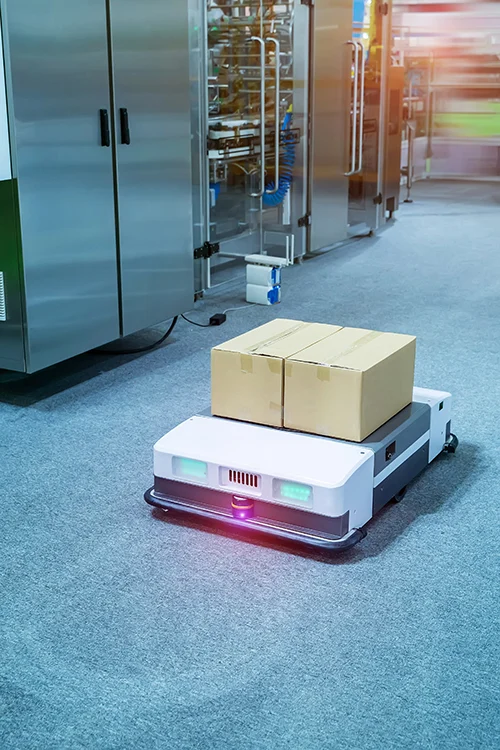
Prototyping and Early Validation: Throughout its development phase, maxon MIND underwent rigorous trials focused on complex motion systems, including Automated Guided Vehicles (AGVs), laboratory automation setups, and precision medical devices.
The Path to 2027: Ahead of its official commercial release, maxon is establishing a structured consultation framework for machine builders.
Consultation: Engineers collaborate with maxon to analyze specific design load profiles, usage cycles, and environmental constraints.
Prototyping & Testing: Rapid prototyping is followed by system testing and validation under real-world operating conditions.
Calibration & Optimization: Models are fine-tuned, and final parameters or reference cycles are locked in ahead of deployment.
Supporting Data: Efficiency, Speed, and Architecture
The true breakthrough of maxon MIND lies in its computational efficiency. Traditional AI applications in industrial settings often stall due to hardware costs and bandwidth limitations. maxon bypasses these bottlenecks through smart architecture.
The Power of Domain-Specific Expertise
Rather than forcing a blank-slate algorithm to learn physical laws from scratch, maxon MIND embeds decades of mechatronic domain expertise directly into its models. The software understands the mathematical and physical relationships linking a motor, gearbox, encoder, coupling, and load.
Performance Metrics at a Glance
Model Creation Time: < 10 minutes
Reference Cycles Required: < 100 cycles
Diagnostic Execution Time: < 1 minute per check
Hardware Footprint: Minimal memory and processing power requirements, making it ideal for edge computing environments.
This lean approach allows the system to differentiate genuine mechanical anomalies from acceptable, gradual wear over time. By establishing an application-tailored initial baseline, the software tracks deviations relative to the system’s specific operating context, eliminating false positives while reliably flagging impending failures.
Official Responses: Q&A with Program Lead Claude Jaquemet
To understand the engineering philosophy behind the platform, we spoke with Claude Jaquemet, Business Development Manager and Program Lead for maxon MIND.
Design World: Early literature detailing maxon MIND explains that it logs machine data during regular operation and compares it to mechatronic models without requiring enormous datasets. What does "domain-specific expertise" mean in this context?
Claude Jaquemet: "In maxon MIND, domain-specific expertise means incorporating the known physical relationships and operating context of the mechatronic drive system into the model. This includes knowledge of the motor, controller, mechanical load, motion cycle, configuration, and relevant environmental conditions. It is interdisciplinary application knowledge, based on the long experience of maxon."
Design World: How does maxon MIND differentiate a real mechanical problem from slight and acceptable wear over time?
Claude Jaquemet: "With application-tailored models and high sensitivity. Therefore, maxon MIND doesn’t apply one universal wear threshold. It tracks the drive system relative to its application-specific initial state and visualizes the progression over time. Together with the machine builder, the model sensitivity and the boundary between acceptable condition and action-required condition are validated for the particular application. The result supports condition-based maintenance decisions."
Design World: How exactly does maxon MIND distinguish problems from normal operating conditions, especially in challenging environments like cleanrooms or machinery subject to vibrations and temperature swings?
Claude Jaquemet: "maxon MIND doesn’t rely on a universal definition of normal. A machine-learning model is created for the specific motor in its actual application and is trained on an initial reference state. Later measurements are compared with this application-specific model to detect deviations and wear trends. Also, various potential fault-modes are considered in the training of the initial reference state, to which the application is continuously compared. For example, to compensate for temperature effects, the applicable payload, the reference cycle itself, and the drivetrain configuration need to remain consistent during data acquisition."
Design World: What are the primary target applications for this technology?
Claude Jaquemet: "maxon MIND is designed for critical applications where an unexpected drive-system failure could affect personal safety, reliability, availability, process quality, or the user experience. Relevant application areas include medical devices, industrial and laboratory automation, and logistics. Technically, the application must allow repeatable diagnostic cycles under controlled and comparable load conditions. maxon MIND generally performs best where high sensitivity of the condition indication is required."
Design World: Can motor signals truly reflect the condition of the whole powertrain, and how can an engineer localize a problem to a specific component?
Claude Jaquemet: "The electrical motor signals contain information influenced by the motor, gearbox, encoder, coupling, and driven mechanics. maxon MIND therefore assesses the condition of the complete drive system rather than only the motor. Component-level detection of faults is generally feasible, but it depends on the particular drivetrain. Beyond general component failure patterns, application-specific validation against known faults, inspections, or service findings help with the interpretation of the condition indication."
Implications: Transforming Maintenance and Machine Design
The introduction of maxon MIND carries profound implications for multiple industries, shifting the paradigm from reactive firefighting to precision predictive maintenance.
1. Eliminating Unexpected Downtime
In high-stakes environments like automated logistics (AGV fleets) and semiconductor manufacturing, unexpected machine stoppages cost tens of thousands of dollars per hour. By providing early warnings derived from subtle shifts in motor behavior, operators can schedule maintenance during planned windows.
2. Safeguarding High-Value Processes
In laboratory automation and medical device manufacturing, equipment failure can compromise entire sample batches or, worse, patient safety. maxon MIND acts as an invisible guardian, protecting sample integrity and device throughput while holding product quality strictly consistent.
3. Sustainability and Resource Optimization
Condition-based maintenance ensures that spare parts are only replaced when genuinely necessary, drastically reducing industrial waste and lowering the total cost of ownership (TCO). Furthermore, by boosting Overall Equipment Effectiveness (OEE), manufacturers can maximize the lifespan of their existing capital investments.
4. Zero-Friction Implementation for OEMs
Because maxon MIND integrates via API into existing software architectures and requires no added physical sensors, machine builders do not need to radically redesign their mechanical enclosures or electrical cabinets. They can simply upgrade their system capabilities, offering advanced diagnostic features as a high-value differentiator to their own end customers.
As industries look toward smarter, more autonomous factories, maxon MIND proves that the most powerful diagnostic tool in a machine might not be an added accessory at all—it’s the motor that was already running it all along.