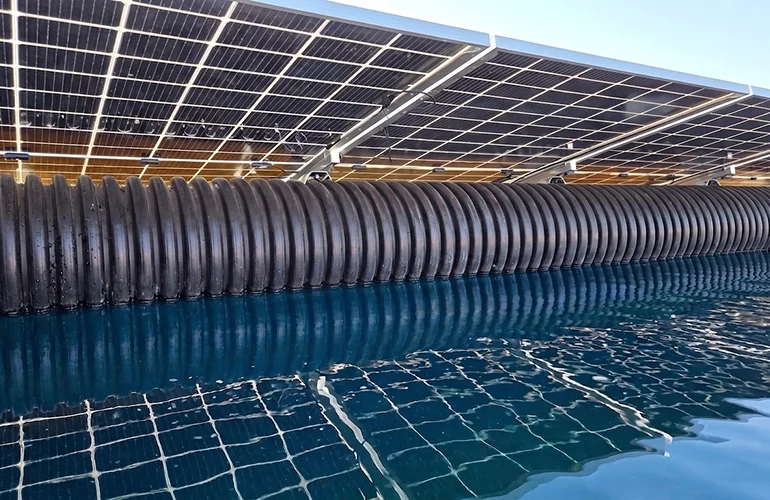
UNITED STATES — Renewable energy pioneer Noria Energy has officially launched Airon, an innovative, U.S.-manufactured single-axis floating solar tracker system designed to maximize clean power generation on underutilized bodies of water. By introducing dynamic solar tracking to aquatic environments—a capability traditionally reserved for land-based photovoltaic (PV) arrays—Noria Energy aims to dramatically alter the economics, efficiency, and scalability of floating solar, commonly known as "floatovoltaics."
The commercial rollout of Airon comes at a pivotal time for the American renewable energy sector. As available land for large-scale solar farms becomes increasingly scarce, expensive, and subject to prolonged zoning battles, developers are casting their eyes toward man-made reservoirs, industrial retention ponds, irrigation canals, and hydroelectric dams. Airon bridges the gap between the high energy-yield benefits of ground-mounted trackers and the spatial efficiency of water-based installations, promising up to 20% more electricity generation within a similar project footprint compared to conventional fixed-tilt floating systems.
Main Facts
- Product Innovation: Airon is a U.S.-made, single-axis floating solar tracker engineered specifically for aquatic environments, allowing photovoltaic panels to actively follow the sun’s trajectory throughout the day.
- Performance Boost: The tracking system yields up to 20% more energy production compared to traditional fixed-tilt floating solar systems, achieving this efficiency without increasing the project footprint or nameplate capacity.
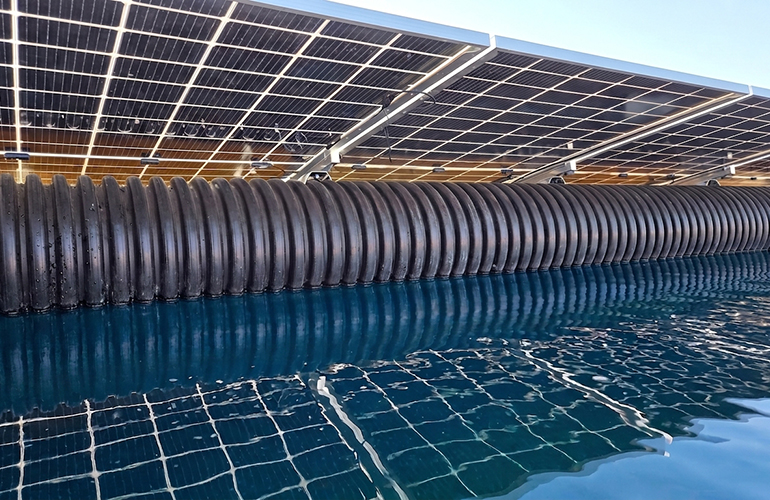
- Robust Engineering: Designed to withstand unique marine and aquatic challenges, Airon incorporates a low-profile architecture, passive stabilizers, and an automated severe-weather stowing mechanism to mitigate wind, wave, and anchoring stresses.
- Supply Chain Compliance: The system is built around a domestic supply chain and regional U.S. manufacturing network, aiding developers in meeting stringent U.S. domestic content requirements and Foreign Entity of Concern (FEOC) regulations.
- Market Applications: Airon is targeted at both utility-scale deployments and distributed generation projects serving commercial, industrial, agricultural, and public-sector energy consumers.
- Timeline to Market: A commercial pilot is slated for late 2026, with full commercial shipments to customer sites scheduled to commence in mid-2027.
Chronology: The Evolution of Airon and Noria Energy
Noria Energy’s journey to the launch of Airon reflects a deliberate, multi-year path of research, engineering, and rigorous testing.
2018–2021: Laying the Groundwork
Noria Energy entered the floatovoltaics sector early, recognizing the untapped potential of water-based solar installations. During these formative years, the company focused on understanding the mechanical and environmental stressors unique to water bodies—such as continuous wave action, fluctuating water levels, and corrosive moisture environments. The team developed and tested early-generation concepts through small-scale pilot projects, gathering empirical data on durability and anchoring loads.
2022–2024: Scaling Up and Prototyping
Building on its initial data, Noria expanded its research into larger pilot installations. The engineering team realized that while fixed-tilt floating solar systems successfully avoided land-use conflicts, they suffered from the same thermodynamic limitations as fixed land arrays: they only captured optimal sunlight for a fraction of the day. Adapting single-axis tracking—proven technology on land—to float securely on water became the primary company objective. This era saw the design, computer-aided fluid dynamics modeling, and physical prototype testing of what would become the Airon system.
2025–2026: Commercialization and Pilot Announcements
By late 2025 and into 2026, Noria finalized Airon’s engineering blueprint, focusing heavily on a domestic supply chain strategy to align with evolving U.S. federal clean energy incentives. Noria announced that its first commercial pilot project utilizing the Airon system will break ground in late 2026, supplementing existing demonstration projects.
Mid-2027 and Beyond: Full Commercial Rollout
Following the evaluation of the late-2026 commercial pilot, Noria Energy is scheduled to open full-scale product shipments of certified Airon units to customer sites by mid-2027. This milestone marks the formal commercial transition of the technology into the mainstream American solar market.
Supporting Data and Market Context
To fully understand the significance of Airon, it is necessary to examine the broader landscape of floating solar energy, both domestically and internationally.
Global Growth and U.S. Potential
While floatovoltaics remain an emerging asset class in the United States—where permitting frameworks, insurance models, and operating standards are still actively evolving—the technology has experienced explosive growth globally. According to research led by the National Laboratory of the Rockies (NLR), global floating solar capacity surpassed 13 gigawatts (GW) by 2022.
Furthermore, NLR geospatial and technical analyses estimate that federally controlled reservoirs in the United States alone possess the technical capacity to support hundreds of gigawatts of floating solar energy. If fully realized, this capacity could single-handedly power millions of American homes while preserving millions of acres of arable land and natural habitats.
The Tracking Advantage
Traditional floating solar farms rely on fixed-tilt configurations, typically angled south (in the Northern Hemisphere) at a static degree to capture average annual sunlight. While structurally simple, fixed systems miss out on morning and evening solar yields. Single-axis trackers, widely utilized in terrestrial utility-scale solar farms, rotate the PV modules slowly from east to west throughout the day.
By bringing this capability to water surfaces, Airon bridges the gap between fixed-tilt floatovoltaics and advanced land-based trackers. According to company specifications, Airon delivers up to a 20% increase in energy production while maintaining a similar capital expenditure and installation footprint to traditional fixed systems. This fundamentally shifts the levelized cost of energy (LCOE) for floating solar, making it economically competitive with, or superior to, traditional ground-mounted developments in regions with high land costs.
Supply Chain and Domestic Sourcing Realities
The U.S. solar market is heavily influenced by federal policies, including the Inflation Reduction Act (IRA), which provides lucrative tax bonuses for projects meeting domestic content thresholds. Additionally, stringent regulations regarding Foreign Entities of Concern (FEOC) have complicated material sourcing for developers.
Noria Energy’s proactive decision to anchor Airon’s manufacturing within a regional U.S. supply chain network positions the product strategically. Developers utilizing Airon can streamline compliance with federal tax credit requirements, de-risking their supply chains against international trade disruptions and regulatory shifts.
Official Responses and Industry Perspectives
The announcement of the Airon system has drawn strong reactions from company leadership and the broader renewable energy engineering community.
Alex Mayer, Chief Executive Officer of Noria Energy, emphasized the strategic transformation that Airon represents for clean energy developers:
"Floating solar can turn underused water surfaces into productive energy assets without competing for valuable land," said Mayer. "With Airon, we are bringing the energy-production advantages of solar tracking to the water—giving customers up to 20% more energy at the same installed cost as a fixed-tilt system. This makes floating solar more productive, scalable, and commercially attractive."
Engineering and procurement experts have also praised the practical design choices embedded in Airon. Unlike complex, highly customized offshore marine equipment that requires specialized, costly maritime labor, Airon was engineered to utilize familiar installation methods. Solar Engineering, Procurement, and Construction (EPC) firms can deploy the system using standard construction equipment and techniques they already master on land-based projects, significantly lowering soft costs and labor training barriers.
Implications for the Future of Renewable Energy
The introduction of Noria Energy’s Airon system carries profound implications for the trajectory of American and global clean energy infrastructure.
1. Land Preservation and Dual-Use Water Bodies
As communities push back against utility-scale solar developments that consume agricultural acreage or pristine natural habitats, floatovoltaics offer a friction-free alternative. By placing solar arrays on man-made water bodies—such as municipal water treatment reservoirs, cooling ponds at thermal power plants, agricultural irrigation storage, and hydroelectric dams—developers utilize otherwise sterile space.
Moreover, floating solar arrays provide a secondary environmental benefit: they shade the water surface, reducing evaporation rates in drought-prone regions (such as the American Southwest) and mitigating the growth of algae blooms, which can lower water treatment costs for municipalities.
2. Overcoming Historical Engineering Hurdles on Water
Water is a dynamic, corrosive, and mechanically demanding environment. Early iterations of floating solar occasionally struggled with extreme wind uplift, wave resonance, and mechanical fatigue on anchoring lines. Airon addresses these vulnerabilities directly through:
- Low-Profile Architecture: Minimizes wind drag and sail effects during high-wind events.
- Passive Stabilizers: Dampens wave-induced oscillations to protect structural integrity and PV module solder joints from micro-cracks.
- Automated Severe-Weather Stowing: Automatically locks panels into a protective horizontal or flat position when wind speeds exceed safe operational thresholds.
3. Broadening the Commercial and Industrial Market
While massive utility-scale installations command headlines, Airon is specifically designed to scale down for distributed generation projects. Commercial, industrial, agricultural, and public-sector entities often own or operate retention ponds and water basins adjacent to their facilities. By deploying Airon on these localized water bodies, businesses can directly power their operations with clean, tracking solar energy, enhancing corporate sustainability metrics and hedging against volatile utility electricity prices.
4. Regulatory and Financial Maturation
As pilot projects like Noria’s upcoming late-2026 deployment generate hard operational data, insurance underwriters and project financiers will gain deeper confidence in floating tracking technology. Historically, insurance rates for floating solar have sometimes carried a premium due to a lack of long-term actuarial data in the U.S. market. Proven, highly engineered systems like Airon—backed by rigorous wind-tunnel testing, robust anchoring science, and domestic manufacturing quality control—are expected to accelerate the standardization of insurance products and project debt financing for floatovoltaics.
Conclusion
Noria Energy’s debut of the Airon single-axis floating solar tracker marks a maturing milestone for the American renewable energy landscape. By successfully merging the high-yield dynamics of solar tracking with the spatial liberation of water-based infrastructure, Noria has addressed one of the solar industry’s most persistent dilemmas: how to generate more clean power without compromising valuable land.
With its first commercial pilot scheduled for late 2026 and broad commercial shipments anticipated by mid-2027, Airon stands ready to unlock the vast, largely untapped energy potential of America’s reservoirs and water bodies. Backed by a robust U.S. supply chain, thoughtful engineering designed to withstand aquatic extremes, and compatibility with standard EPC installation practices, Airon is poised to propel floatovoltaics from an emerging niche into a cornerstone of the modern clean energy grid.