At the 2026 International Manufacturing Technology Show (IMTS), the landscape of robotic material removal shifted significantly with the introduction of the STC0440-BT40. Unveiled by PushCorp, a WALTER Surface Technologies company, this high-performance robotic servo spindle marks a new benchmark for heavy-duty industrial applications. By delivering a robust 40 horsepower (30 kW) in a package optimized for robotic integration, the STC0440-BT40 addresses the long-standing industry need for increased power and rigidity in automated casting, foundry, and material-removal environments.
The Evolution of Material Removal: Core Facts
For decades, robotic material removal has been hampered by a trade-off between the flexibility of a robot arm and the raw power of a stationary machine tool. While traditional CNC spindles offered the power required for heavy-duty metal removal, their size and weight often made them incompatible with the payload capacities and dynamic requirements of industrial robots.
The STC0440-BT40 bridges this gap. Designed specifically for the rigors of automated deflashing, gate removal, and heavy-duty grinding, the spindle leverages a liquid-cooled 40-horsepower servo motor. This architecture allows manufacturers to transition from manual, labor-intensive finishing tasks to fully automated, high-throughput processes without compromising on power or precision.
Key Technical Specifications
- Power Output: 40.0 hp (30 kW) sustained.
- Spindle Interface: Standard BT40 tapered toolholder.
- Speed Range: Reversible and adjustable up to 4,000 rpm.
- Speed Regulation: +/- 5% for consistent performance under varying load.
- Bearing Configuration: Quad-bearing front and duplex-bearing rear to handle extreme radial and axial loads.
- Cooling System: Integrated liquid-cooled thermal management.
- Compatibility: Mounts to PushCorp AFD1240 and AFD92 active and passive force-compliance devices.
Chronology of Innovation: From Garland to IMTS 2026
The journey to the STC0440-BT40 is rooted in PushCorp’s three-decade history of perfecting end-of-arm tooling. Founded in 1993 in Garland, Texas, the company spent years refining the science of robotic force control.
The timeline of this innovation accelerated following the 2024 acquisition of PushCorp by WALTER Surface Technologies. This merger combined PushCorp’s specialized expertise in robotic motion and force control with WALTER’s extensive knowledge of abrasive technology and surface finishing. The STC0440-BT40 represents the first major "synergy product" to emerge from this partnership, synthesized over two years of R&D focused on the demands of heavy foundry work.
Following rigorous field testing in automotive and aerospace casting facilities throughout 2025, the unit was finalized for public debut at IMTS 2026, signaling a strategic pivot toward heavy-duty, high-torque industrial automation.

Engineering for Rigidity: Supporting Data
In automated machining, rigidity is the silent partner of quality. A tool that deflects under pressure produces inconsistent surface finishes and accelerated tool wear. The design philosophy of the STC0440-BT40 prioritizes structural integrity through its unique bearing architecture.
By utilizing a quad-bearing configuration at the front of the spindle, the unit is able to withstand the intense lateral forces generated when grinding large, complex castings. This is further supported by the duplex-bearing rear setup, which provides the necessary axial stability for plunge-cutting or gate removal operations.
Furthermore, the integration of the BT40 standard interface is a strategic choice for modern integrators. By utilizing the same tooling standard found on many CNC mills, factories can consolidate their inventory. This allows for the use of standard off-the-shelf end mills, grinding wheels, and custom-engineered abrasive solutions, reducing the "tooling gap" between manual grinding bays and robotic cells.
Official Perspectives: Bridging the Power Gap
The release of the STC0440-BT40 is viewed by industry experts as a response to the "automation bottleneck" found in heavy industry. Eddie Erlbacher, Vice President of Engineering & Operations at PushCorp, emphasized that the unit was developed with the integrator in mind.
"The STC0440-BT40 now gives manufacturers and integrators a high-power platform for material-removal tasks," Erlbacher noted during the IMTS press briefing. "Its 40-horsepower servo motor will help teams build automated processes for the highest demanding applications. We aren’t just selling a spindle; we are providing the foundation for a total system that can finally handle the heavy lifting that previously required a human operator with a handheld grinder."
WALTER Surface Technologies, through this product launch, has reinforced its commitment to "Total Process Control." By providing the spindle (the motor) and the abrasives (the tool), the company aims to offer a unified ecosystem where the robot, the spindle, and the media are calibrated to work in perfect synchronization.

The Implications for Industry 4.0
The introduction of such a powerful spindle has far-reaching implications for the factory floor, particularly in the context of the "Fourth Industrial Revolution."
1. Eliminating the Human Factor in High-Risk Zones
Foundry work—specifically the removal of flash and gates—is historically one of the most dangerous and ergonomically taxing jobs in manufacturing. Exposure to vibration, silica dust, and high noise levels creates significant turnover and safety challenges. By moving to an automated platform capable of handling the physical requirements of heavy-duty grinding, companies can remove human operators from the direct hazard zone, shifting them into supervisory roles.
2. Standardizing Surface Quality
Manual finishing is inherently variable; no two human operators perform a grinding task with the exact same contact force or feed rate. The STC0440-BT40, when paired with PushCorp’s AFD (Active Force Device) series, allows for "force-controlled" machining. The system can maintain a constant pressure regardless of the robot’s path, ensuring that every part—from the first to the thousandth—meets the same surface finish specifications.
3. Enabling Flexible Automation
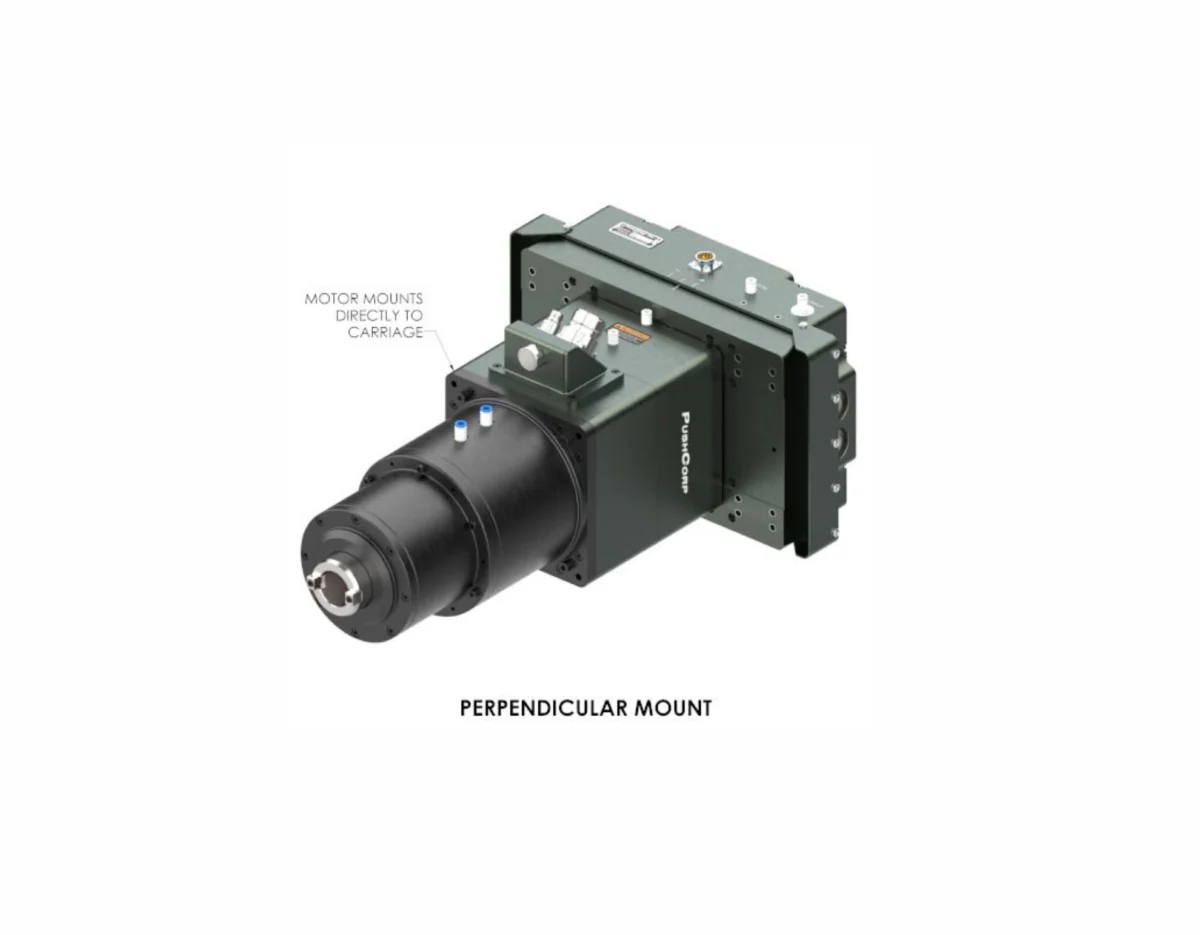
The ability to mount the spindle in both parallel and perpendicular orientations gives integrators unprecedented flexibility. This is critical for complex geometries where the robot must reach into tight apertures or navigate intricate part contours. Because the spindle is a servo-driven, computer-controlled unit, the speed can be adjusted on the fly, allowing the robot to vary its grinding intensity depending on the specific geometry of the part it is currently processing.
The Future of Robotic Material Removal
As manufacturing moves toward smaller batch sizes and higher complexity, the demand for "intelligent" material removal will only increase. The STC0440-BT40 is not merely a high-torque motor; it is a sensor-rich platform. Future iterations and system integrations will likely leverage the data captured by the servo motor to monitor tool life in real-time, predicting when a grinding wheel needs replacing before it degrades the surface finish of a part.
For integrators, the combination of the STC0440-BT40’s power and its seamless compatibility with existing robotic ecosystems represents a significant reduction in project risk. Instead of engineering a bespoke spindle solution from scratch, they can rely on a proven, high-torque, industrial-grade component backed by a global support network.

Conclusion: A New Standard
PushCorp’s STC0440-BT40 is a testament to the maturation of robotic material removal. By successfully integrating 40 horsepower into a robot-mounted spindle, the company has cleared a significant hurdle that has long confined robots to lighter-duty finishing tasks.
As manufacturers continue to struggle with labor shortages and the increasing need for consistent, repeatable quality, technologies like the STC0440-BT40 will become essential. Whether in an automotive casting facility, a heavy-equipment foundry, or an aerospace fabrication plant, the transition to high-power automated grinding is no longer a "future" goal—it is a present-day reality. With the backing of WALTER Surface Technologies and a proven track record in force-compliance, PushCorp has positioned itself at the center of this industrial evolution, providing the tools that will shape the next generation of manufacturing.
For those interested in exploring the technical documentation, integration guides, or application videos, the full suite of resources is available via the official PushCorp portal, offering a roadmap for companies looking to modernize their material removal cells.