FRAMINGHAM, Mass. — In the high-stakes world of commercial property management, timing is everything. For tenants occupying large-scale corporate office spaces, any disruption to climate control systems can translate directly to lost productivity, discomfort, and operational friction. Recognizing these high stakes, the specialized engineering and installation team at Building Automation Systems (BAS) recently pulled off a remarkable logistical and technical feat in Framingham, Massachusetts. Over the course of a single, highly compressed 48-hour weekend, the team successfully replaced, integrated, and commissioned a massive 172-ton Seasons 4 rooftop unit (RTU) atop a sprawling 162,000-square-foot commercial office building.
The operation, executed between Friday night, September 11, and Sunday, September 13, represents a masterclass in modern HVAC engineering, advanced project management, and seamless inter-corporate collaboration. By executing the multi-ton replacement within a strict two-day window, BAS ensured that the building’s workforce returned on Monday morning to a fully conditioned environment with zero operational downtime.
Main Facts: The Scope and Scale of the Framingham Installation
At the core of this project is a colossal piece of industrial climate control infrastructure. The newly installed Seasons 4 rooftop unit is a heavyweight in every sense of the word, scaling in at an impressive 32,300 pounds (over 16 tons of physical weight resting on the structural steel of the Framingham office building).
Key Technical Specifications of the New RTU:
- Cooling Capacity: 172 tons of direct expansion (DX) cooling capacity.
- Compression System: Equipped with 8 high-efficiency scroll compressors to provide staged, reliable cooling modulation.
- Total Physical Weight: 32,300 lbs.
- Manufacturer: Seasons 4, a recognized leader in custom commercial HVAC manufacturing.
- Manufacturer’s Representative: Noble Associates, Inc., who facilitated the supply chain and equipment delivery.
- Building Footprint: Serves a 162,000-square-foot commercial office facility in Framingham, MA.
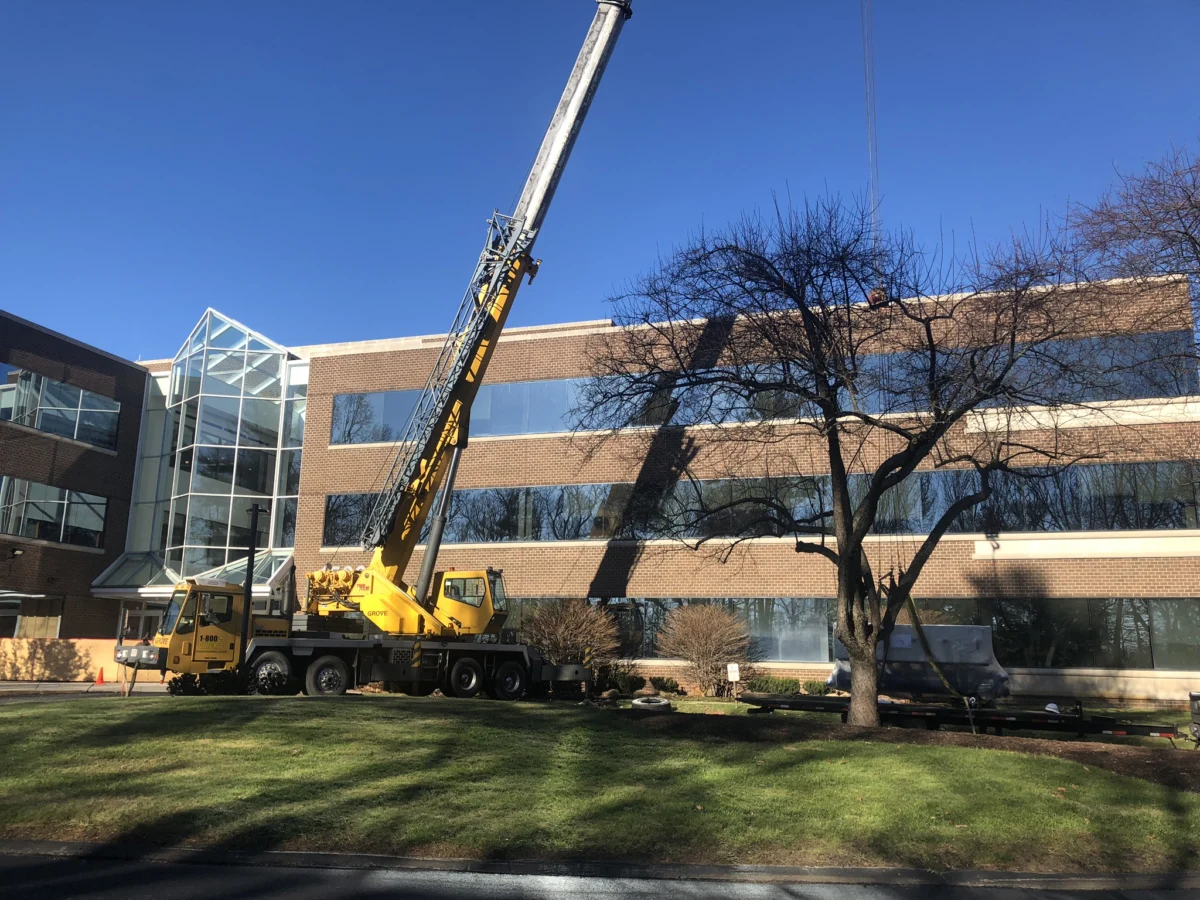
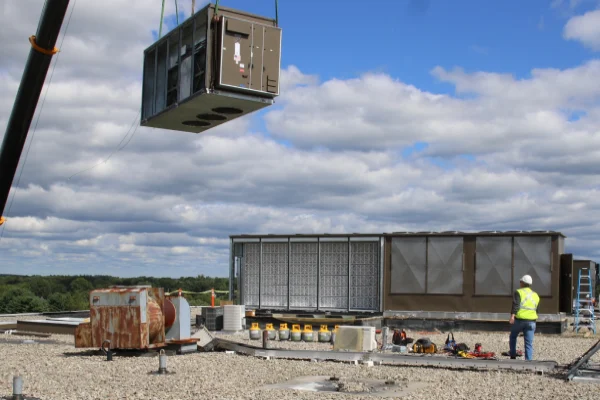
The sheer mass of the unit required meticulous pre-planning. Cranes, structural assessments, and heavy rigging were mobilized under strict safety protocols to lift the old machinery off the roof and hoist the new, custom-engineered Seasons 4 unit into place. Despite the monumental logistical hurdles, the entire evolution—from the arrival of the equipment on Friday evening to the final diagnostic sign-off on Sunday afternoon—was completed without a hitch.
Chronology of Events: A 48-Hour Engineering Sprint
Executing a project of this magnitude in just one weekend requires a military-grade schedule where every minute, resource, and personnel movement is accounted for. The timeline of the Framingham RTU replacement highlights the intense coordination required to achieve zero tenant impact.
Pre-Weekend Preparations (Weeks Prior to September 11)
Months before the crane arrived on-site, BAS engineers and project managers laid the groundwork. This phase included comprehensive structural load assessments, coordination with Seasons 4 engineering teams to tailor the physical dimensions of the unit to match existing building parameters, and pre-fabrication of connection points.
Phase 1: Mobilization and Extraction (Friday, September 11 – Evening)
- 18:00 EST: Heavy crane mobilization begins on-site as office workers depart for the weekend.
- 20:00 EST: Safety perimeters are established around the Framingham facility, and rigging crews secure the existing, outdated rooftop unit.
- 22:00 EST: The legacy unit is systematically disconnected from electrical feeds, control wiring, and ductwork before being safely hoisted off the roof, clearing the way for the new installation.
Phase 2: Rigging and Placement (Saturday, September 12)
- 06:00 EST: Transport flatbeds carrying the 32,300-lb Seasons 4 unit arrive at the site.
- 09:00 EST: Utilizing a high-capacity mobile crane, rigging specialists lift the massive 172-ton capacity RTU into the air, guiding it with millimeter precision onto the existing structural curb.
- 14:00 EST: Mechanical contractors bolt the unit down, ensuring secure structural integration and weatherproofing of the roof penetrations.
- 18:00 EST: Duct connections and pre-aligned electrical/control interfaces are locked into place. Because of meticulous pre-engineering, no extensive field rewiring is required, saving countless hours of labor.
Phase 3: Integration, Commissioning, and Handover (Sunday, September 13)
- 08:00 EST: BAS certified programmers and technicians initiate the low-voltage control systems, syncing the custom RTU sequences with the facility’s existing Building Management System (BMS).
- 11:00 EST: Comprehensive system testing begins. All 8 scroll compressors are cycled through diagnostic checks, airflow rates are measured across the 162,000 sq. ft. footprint, and refrigerant pressures are verified.
- 16:00 EST: Final commissioning is completed. The system is declared fully operational, meeting all design parameters and local building codes.
- 18:00 EST: The site is completely cleared, leaving the roof pristine and ready for the incoming work week.
Supporting Data & Engineering Precision: Behind the Scenes
A successful weekend swap is never a matter of luck; it is the direct result of rigorous engineering design and collaborative problem-solving. Prior to ordering the equipment, BAS conducted a deep-dive survey and assessment of the building’s thermal loads. This analysis guaranteed that the new Seasons 4 unit would neither underperform during peak summer heat waves nor over-cool the space, ensuring optimal energy efficiency.
Curb and Utility Alignment
One of the most complex challenges in rooftop HVAC replacements is matching the physical footprint of new machinery to older, existing structures. Replacing a large commercial unit often risks triggering expensive structural retrofits if the mounting curbs or utility feeds do not line up.
To circumvent this, BAS collaborated closely with Seasons 4 engineers during the design phase. They engineered a custom unit footprint guaranteed to fit onto the building’s existing curb without requiring structural steel modifications. Furthermore, the alignment design meticulously mapped out the legacy unit’s electric power and control feeds. By matching these connection points down to the inch, BAS entirely eliminated the need for complex, time-consuming field wiring during the weekend shutdown window.
BMS Integration and Sequences
Modern commercial real estate relies heavily on intelligent automation to drive energy conservation and maintain indoor air quality. The new Seasons 4 unit was not designed as a standalone appliance; it was engineered to act as an integrated organ within the building’s existing nervous system.
BAS and Seasons 4 co-developed custom RTU operational sequences. These proprietary software algorithms allow the unit to communicate fluidly with the facility’s existing Building Management System (BMS). As a result, property managers retain centralized, real-time control over temperature setpoints, economizer functions, and diagnostic alerts, ensuring long-term reliability and reduced utility expenditures.
Official Responses and Industry Perspectives
The seamless execution of the Framingham project has drawn praise from industry observers and highlights the evolving expectations placed upon modern HVAC service providers.
While commercial property owners traditionally expect minor-to-moderate disruptions during major mechanical overhauls, the paradigm is shifting. Tenants working in Class-A office spaces demand seamless environmental continuity. By achieving a zero-impact installation on a 172-ton industrial asset, BAS has set a new benchmark for regional commercial retrofits.
In a statement following the successful commissioning of the unit, company representatives emphasized the philosophy driving their operational success:
"Property managers throughout the New England region can count on the top-quality engineering and HVAC services available from Building Automation Systems (BAS). With in-house licensed engineers, certified programmers, and technicians, our team can help you complete your most critical HVAC projects."
Industry analysts point out that the partnership between equipment manufacturers like Seasons 4, specialized reps like Noble Associates, Inc., and design-build contractors like BAS represents the gold standard for modern construction and facilities management. When supply chain logistics, custom manufacturing, and on-the-ground engineering synchronize effectively, complex projects that historically took weeks can now be executed within a single standard weekend.
Implications for Commercial Real Estate and Facilities Management
The successful replacement of the Framingham office building’s HVAC infrastructure carries broad implications for commercial real estate (CRE) asset management across New England and beyond.
1. Minimizing Tenant Disruption and Protecting Lease Value
In competitive leasing markets, tenant retention is paramount. Environmental comfort is consistently ranked among the top factors influencing tenant satisfaction. An HVAC failure or a prolonged replacement project that leaves an office building without cooling during transitional weather can strain landlord-tenant relationships. By executing this project over 48 hours, BAS demonstrated that major capital improvements can occur transparently, safeguarding tenant relations and preserving the operational reputation of the property management firm.
2. Energy Efficiency and Sustainability Goals
Older commercial HVAC units are notoriously energy-inefficient, often relying on outdated compressor technologies and pneumatic controls that leak conditioned air and consume excessive electricity. Upgrading to a modern 172-ton unit equipped with 8 advanced scroll compressors significantly reduces the carbon footprint of a 162,000-square-foot facility. Modern scroll compressors offer superior part-load efficiency, drawing only the power necessary to meet current thermal loads rather than running at maximum capacity indiscriminately. This aligns with corporate sustainability mandates and municipal energy-performance standards increasingly being adopted across Massachusetts.
3. The Value of Design-Build Expertise
The project underscores the distinct advantages of the design-build delivery method. By housing licensed engineers, certified programmers, and skilled field technicians under one operational umbrella, BAS eliminated the finger-pointing and communication silos often found in traditional design-bid-build delivery models. When the engineering team that designs the system is also the team responsible for programming the BMS and lifting the unit onto the roof, accountability is absolute, and execution is streamlined.
Looking Forward
As commercial real estate continues to navigate shifting occupancy models, rising energy costs, and stringent environmental regulations, the demand for sophisticated, rapid-turnaround HVAC interventions will only accelerate. The Framingham project serves as a compelling case study for property owners facing aging infrastructure: major capital upgrades no longer require months of logistical headaches. With the right engineering partner, advanced equipment can be seamlessly integrated into existing facilities over a single weekend—leaving tenants blissfully unaware of the monumental engineering feat unfolding just above their heads.
Property managers and building owners seeking to evaluate their own infrastructure, assess thermal loads, or plan upcoming capital replacements are encouraged to reach out to the experts. To request a design-build consultation and project estimate, visit the official Building Automation Systems Contact Page.