In the hyper-competitive landscape of Consumer Packaged Goods (CPG), where consumer loyalty is fleeting and product cycles are accelerating, manufacturers face an invisible but massive fiscal drain. According to industry analysis, a staggering 18% of total product cost in U.S. CPG manufacturing is directly attributable to production delays, unplanned downtime, and inefficient line performance.
While many plant managers are eager to jump onto the Artificial Intelligence (AI) bandwagon to solve these inefficiencies, industry experts argue that the industry is putting the cart before the horse. Neil Smith, Segment President for Consumer Packaged Goods at Schneider Electric, suggests that the "AI revolution" in manufacturing is currently hindered by a foundational flaw: data exists, but it is trapped in silos. Before a single AI model can be deployed effectively, CPG plants must solve the problem of connectivity.
The Cost of Siloed Operations: The Current State of OEE
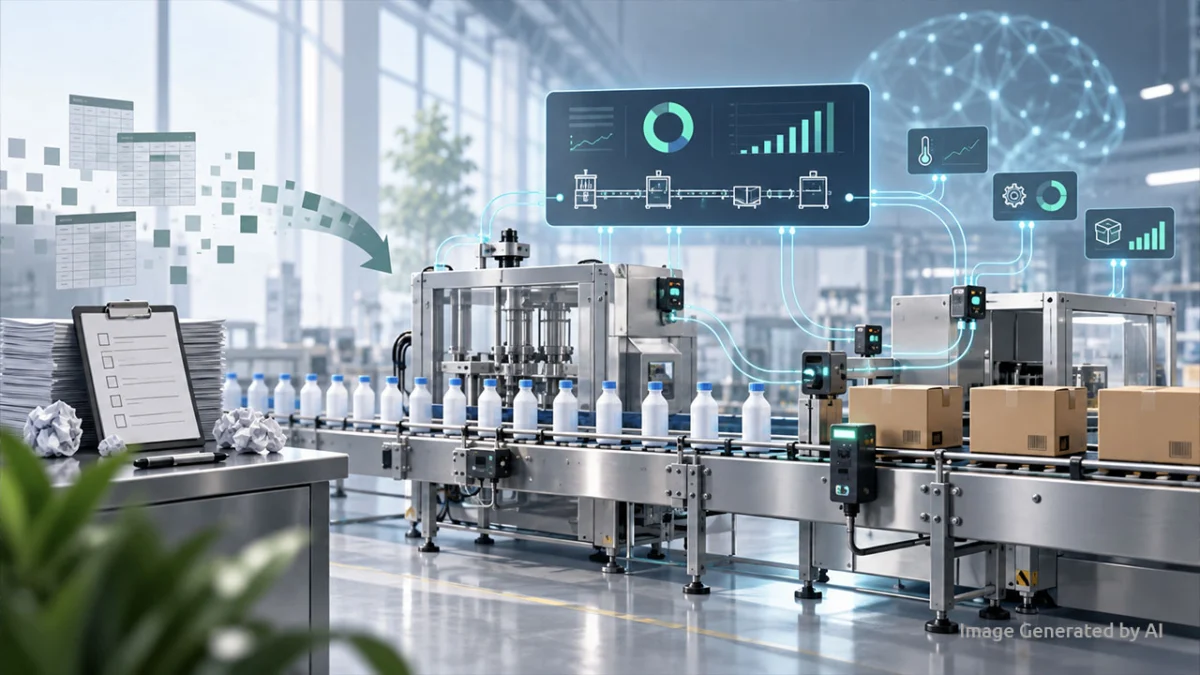
For decades, the benchmark for manufacturing efficiency has been Overall Equipment Effectiveness (OEE). However, the way OEE is tracked in many CPG facilities remains stubbornly archaic. Reliance on manual clipboards, offline spreadsheets, and disconnected software creates a "data desert" where information is gathered but never utilized for actionable insight.
The Manual Bottleneck
When a production line halts, the standard operating procedure typically involves an operator manually assigning a "reason code" to the stoppage. This process is inherently flawed for several reasons:
- Subjectivity: Different operators may interpret a mechanical stall differently, leading to inconsistent data entries.
- Latency: Data recorded on paper or disconnected spreadsheets is not available in real-time for management or analytical systems.
- Isolation: The data stays within the shift or the specific line, failing to provide a holistic view of the enterprise.
Because this information is not digitized or centralized, it cannot reveal the hidden patterns behind recurring production problems. The result is a cycle of "firefighting" where the same issues plague a line week after week, simply because the data required to diagnose the root cause remains buried in physical logs or isolated legacy systems.
Chronology of the Digital Transformation Journey
To understand how CPG manufacturers move from reactive firefighting to proactive optimization, one must look at the evolution of the factory floor.
Phase 1: The Era of Manual Logging
Historically, plant floor management was entirely manual. Performance was tracked by floor supervisors walking the line, taking notes, and compiling end-of-shift reports. This era provided no real-time visibility, making it impossible to perform meaningful cross-shift analysis.
Phase 2: The Emergence of "First-Generation AI"
For years, Advanced Process Control (APC) has acted as the "first generation" of AI in CPG and process manufacturing. APC systems allowed for automated adjustments to set points based on sensor feedback. While powerful, these systems were often limited to specific machines or isolated processes, failing to integrate with broader enterprise business goals.
Phase 3: The Connectivity Pivot (Current Requirement)
We are currently in a transition period. Manufacturers are realizing that adding sophisticated AI on top of legacy, disconnected systems is akin to building a skyscraper on a foundation of sand. The current priority is "digital plumbing"—connecting OEE systems, PLC data, and sensor inputs into a single, unified digital fabric.
Phase 4: The Intelligent Enterprise (The Target State)
The ultimate destination is an environment where AI models act as a force multiplier for human expertise. In this stage, data flows seamlessly between systems, and "software-defined automation" (SDA) acts as the bridge that allows AI-driven insights to manifest as physical changes on the factory floor.
Supporting Data: Mapping the Digital Maturity Model
The gap between current realities and the target state is best illustrated by the following capabilities assessment:
| Capability | Current State | Target State |
|---|---|---|
| OEE Tracking | Offline spreadsheets, clipboards | Connected, automated, real-time systems |
| Reason Codes | Manual, subjective operator entry | Automated pattern detection |
| Data Correlation | Isolated per sensor or PLC | Cross-system, holistic causality analysis |
| Decision Execution | Human-in-the-loop (manual) | Supervised autonomy (AI-assisted) |
By transitioning from the "Current State" to the "Target State," manufacturers can unlock hidden capacity. When data flows across the enterprise, AI can finally correlate seemingly unrelated events—such as a recurring carton jam on an infeed conveyor being tied to specific humidity levels in the facility, outside temperature fluctuations, or unique shift-change fatigue patterns.
Official Perspectives: The Strategic Necessity of Connectivity
In a recent interview with IIoT World, Neil Smith of Schneider Electric emphasized that the obsession with "AI" often distracts from the core requirement of data integrity.
"Who knows your plant better than anyone else in the enterprise? It’s the guys running it," Smith noted. He argues that the primary value of digitalization is not just in replacing humans with robots or AI, but in capturing the institutional knowledge of veteran operators. As the manufacturing workforce ages and the industry faces significant labor shortages, the risk of "knowledge walking out the door" is at an all-time high.
By connecting human expertise with automated systems, manufacturers can preserve decades of operational intuition within digital models. Once this visibility is established, AI becomes an amplification tool for business outcomes rather than just a buzzword.
The Role of Software-Defined Automation (SDA)
A significant hurdle in the digital transformation of CPG plants is the "last mile" problem. Even if an AI identifies that a set point needs adjustment, legacy control systems often lack a native pathway to receive instructions from enterprise AI platforms.
This is where Software-Defined Automation (SDA) enters the narrative. SDA serves as an "action broker." It sits between the high-level enterprise AI and the low-level legacy hardware, translating complex data-driven recommendations into actionable commands.
Why SDA is a Game Changer:
- Interoperability: It allows manufacturers to maintain their existing legacy investments (PLCs, legacy controllers) while layering modern control logic over the top.
- Agility: SDA enables companies to adjust production line parameters without the prohibitive cost of a complete hardware overhaul.
- Scalability: As plants migrate to native SDA platforms, they can do so at their own pace, ensuring minimal disruption to current production schedules.
Implications for the Future of CPG
The implications of this shift are profound. For the CPG industry, reducing that 18% cost burden from downtime is not just a marginal gain—it is a competitive necessity. Companies that successfully bridge the data gap will see improvements in three critical areas:
1. Operational Resiliency
By automating the detection of recurring issues, plants can move from reactive maintenance to predictive intervention. This reduces the frequency of unexpected line stoppages and stabilizes the supply chain.
2. Workforce Empowerment
By offloading the manual, repetitive task of data entry and low-level monitoring to automated systems, human operators can focus on higher-level decision-making and problem-solving. This makes the manufacturing environment more attractive to the next generation of workers.
3. Sustainability and Yield
Connected data allows for more precise control over energy consumption, material waste, and water usage. By optimizing the production process via real-time data, CPG companies can significantly lower their environmental footprint while simultaneously increasing their yield per shift.
Conclusion: Bridging the Gap
The journey toward a "Smart Factory" is not a race to deploy the latest AI algorithm; it is a systematic effort to break down the digital walls that currently isolate production data. CPG manufacturers must prioritize the integration of their OEE tracking, automate their reason-code processes, and adopt software-defined automation to bridge the gap between AI insights and factory-floor reality.
As the industry faces increasing pressure to innovate, those who treat connectivity as the prerequisite for AI will find themselves with a significant, sustainable advantage. The data is already there—it is simply waiting to be connected.