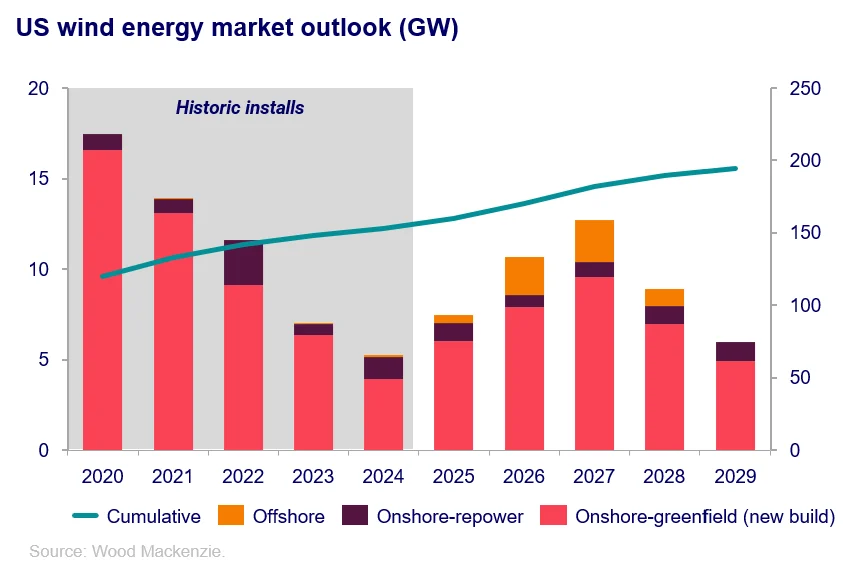
The United States wind energy sector is poised for a significant rebound in 2025, signaling a transition from a period of stagnation toward a more robust, long-term expansion. According to the latest U.S. Wind Energy Monitor report, jointly published by Wood Mackenzie and the American Clean Power Association (ACP), the nation is projected to add over 7 gigawatts (GW) of new wind capacity in 2025. This represents a substantial 36% increase over the previous year’s performance, underscoring a critical shift in the domestic energy landscape.
Despite this optimistic near-term outlook, the industry continues to navigate a complex web of regulatory uncertainty, supply chain constraints, and evolving power demands. While the total five-year outlook remains stable at 46 GW of new capacity through 2029, the internal dynamics of the market—characterized by shifting project timelines, rising capital expenditures (CAPEX), and a desperate race to meet surging demand from artificial intelligence and data centers—paint a picture of a sector in transition.
The Main Facts: A Path to 2029
The five-year trajectory for the U.S. wind market remains anchored by a firm commitment to build out 46 GW of capacity by 2029. However, the path to achieving these figures is uneven. While the 2025 growth is substantial, the industry is witnessing a "back-loaded" installation pattern. Project developers are increasingly pushing commissioning dates into 2026 and 2027, which are expected to yield 10.7 GW and 12.7 GW, respectively.
This delay is not necessarily indicative of failure, but rather a reflection of the intricate development pipelines and the reality of project-commissioning timelines. The market is currently experiencing a "catch-up" phase; for instance, while Q3 2025 installations missed expectations by 23%—coming in at only 932 MW—the sector is bracing for a massive final push, with 3.8 GW of capacity currently queued for Q4 2025. This single quarter alone represents more than half of the entire year’s projected additions.
Chronology of Development: From Short-Term Hurdles to Long-Term Gains
To understand the current state of the industry, one must look at the progression of projects through the development pipeline. The 2025–2027 window is considered "fully committed," with turbine orders already secured for the projects slated for completion in these years. More than 60% of the capacity planned for the next three years is either already commissioned or currently under active construction.
The chronology of this growth is bolstered by the rebounding appetite for turbine orders. After a period of cooling, new turbine order intake has climbed back to pre-OBBBA (One Big Beautiful Bill Act) levels. Q3 2025 saw 2 GW of firm commitments, marking a 79% increase quarter-over-quarter. This represents the largest intake in the region in the last nine months.
However, transparency remains an issue. Original Equipment Manufacturers (OEMs) are increasingly withholding granular project details, and a significant portion of "start-of-construction" activity is now taking place off-site through component manufacturing rather than traditional ground-breaking, making it difficult for analysts to gauge the true velocity of project delivery.
Supporting Data: The Geographic and Structural Shift
The expansion of wind energy is no longer confined to traditional wind-rich corridors. The geographic footprint of the industry is widening, as evidenced by Arkansas bringing its first utility-scale onshore wind project, Cordelio’s Crossover Wind, online.
Regional Leaders and Key Projects
The Western United States remains the engine of the current expansion. States such as Wyoming and New Mexico are projected to account for 34% of all wind activity between 2025 and 2027. Two landmark projects highlight this trend:
- SunZia (New Mexico): Pattern Energy’s 3.5-GW project stands as a cornerstone of the 2026 outlook, positioning the firm as the year’s top installer.
- Towner Energy Center (Colorado): Invenergy’s 998-MW project is currently the largest single development slated for 2027.
Repowering as a Growth Strategy
Beyond new builds, the "repowering" market is serving as a vital stabilizer for the industry. Wood Mackenzie projects that 18 major repowering projects will deliver 2.5 GW of capacity additions over the next three years. By replacing aging turbines with modern, high-efficiency technology at existing sites, developers are circumventing some of the permitting hurdles that plague new greenfield developments.
The Offshore Divergence
The offshore sector presents a starkly different narrative. While projects like Vineyard Wind have demonstrated operational success—connecting 15 turbines in Q3 and generating 200 GWh of power—the sector is suffering from a "diverging momentum." Harsh winter conditions are expected to slow Q4 2025 installations, pushing capacity into 2026. Looking further ahead, post-2027 offshore developments face significant risks. Constraints in the availability of specialized wind turbine installation vessels (WTIVs) are already triggering project delays and, in some cases, outright contract terminations.

Official Responses and Expert Analysis
The industry’s leadership is acutely aware of the paradox facing wind power today: unprecedented opportunity coupled with mounting cost pressures.
"The U.S. power market is facing mounting strain after a decade of flat demand, with utilities committing to 160 GW of large-load additions," said Leila Garcia da Fonseca, director of research at Wood Mackenzie. "This represents a significant opportunity for wind energy, which benefits from strengthened economic fundamentals and a compelling business case driven by its competitively low Levelized Cost of Energy (LCOE)."
However, Fonseca tempered this optimism with a warning regarding the current policy environment. "Turbine costs remain elevated due to tariffs, and mid-term wind growth will depend heavily on resolving permitting and policy uncertainty," she noted.
The Economic and Policy Implications
The primary engine driving demand for wind energy is the radical transformation of the U.S. power grid. After a decade of near-zero growth, power demand is expected to climb at an average rate of 3% through 2029. Data centers are the primary culprits, accounting for 59 GW of the projected 90 GW increase in peak demand. Wind energy, with its low LCOE, is naturally positioned to serve as the baseload provider for these energy-hungry facilities.
The Tariff Dilemma
Despite the surge in demand, economic headwinds persist. The report identifies tariff uncertainty as a primary threat to the industry’s long-term projections. While domestic manufacturing capacity for wind components is growing, it is often out of sync with permitted project volumes.
Wood Mackenzie predicts that U.S. onshore wind CAPEX will rise by 5% through 2029. This is largely due to tariff exposure on raw materials and essential subcomponents. Paradoxically, even as domestic manufacturing capacity potentially creates a surplus of equipment after 2028, the costs for developers are expected to rise rather than fall, as trade protections and regulatory hurdles inflate the bottom line.
Looking Toward 2029: The Permitting Cliff
A sobering observation in the report is the projected decline in activity toward the end of the decade. 2029 is currently showing signs of weakness, with a noticeable drop-off in activity following project cancellations and the designation of certain late-decade projects as "inactive." This is largely attributed to the "permitting trap"—the inability of developers to secure environmental and land-use approvals at the pace required to meet the demands of the power grid.
Conclusion: A Critical Crossroads
The U.S. wind industry is currently in a state of high-stakes transition. The sector has successfully pivoted to meet the demand surge triggered by the artificial intelligence boom and the massive expansion of the domestic data center footprint. With 7 GW of new capacity expected in 2025, the industry is demonstrating that it can scale when the economic fundamentals are aligned.
However, the path forward is fraught with systemic risks. The industry’s ability to sustain the growth momentum beyond 2027 will depend on three pillars:
- Regulatory Reform: Streamlining the permitting process to prevent the "late-decade" slump currently appearing in the projections.
- Supply Chain Stability: Resolving the tariff-driven cost inflation that is keeping CAPEX elevated even as manufacturing capacity expands.
- Offshore Infrastructure: Addressing the critical shortage of installation vessels that currently threatens to derail the long-term offshore wind pipeline.
For developers, utilities, and policymakers, the next 24 months will be decisive. The demand for clean, low-cost power has never been higher, but the ability to deliver that power remains tethered to the industry’s capacity to navigate a volatile economic and regulatory landscape. While the 2025–2027 pipeline offers a stable foundation, the industry must solve its structural challenges today to ensure that the promise of the energy transition does not stall on the horizon of 2029.